

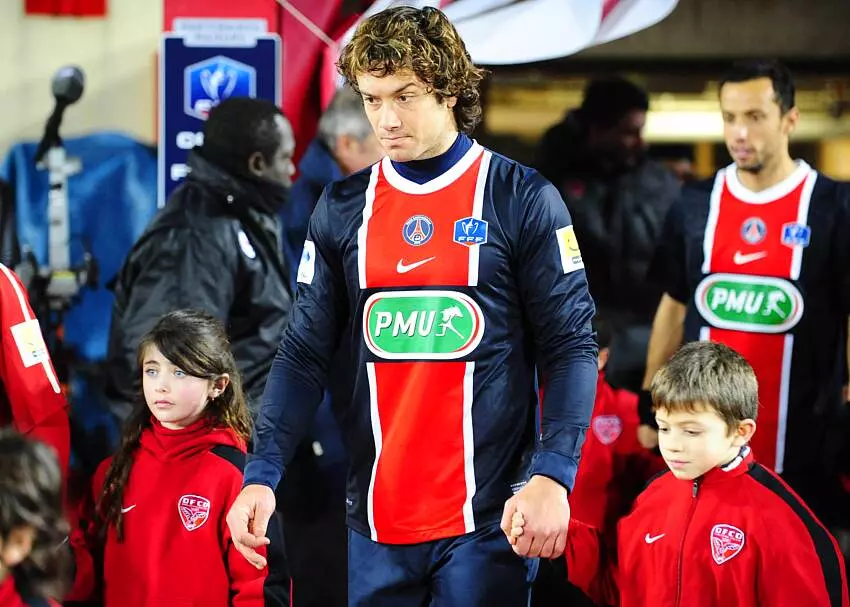
Former Paris Saint-Germain central defender Diego Lugano, 45, looks back on his arrival in Paris in 2011 in an interview with Flashscore. The Uruguayan recounts the early months of the QSI era—a time of immense ambition, still-rudimentary infrastructure, and his role as a bridge-builder within a dressing room undergoing a major transformation.
Lugano: “I still had the desire to make history”
In 2011, Valencia and Juventus were vying to sign you, but you ultimately chose PSG at the very beginning of the QSI era. What was the main motivation behind that choice?
“I’ve always believed that when you’re too comfortable somewhere, you need to make a change, take on a new challenge, and start from scratch. At São Paulo, I was an idol—I’d won everything—and yet, at the peak of my career, I decided to leave for Turkey. No one in Brazil understood it, but I wanted to start over.
In Turkey, with Fenerbahçe, I also became a key figure, and once again, I chose to leave at the best possible moment. The PSG project was just getting underway in 2011, and I was actually the first foreign player to arrive under the QSI and Leonardo regime. That’s what motivated me: the experience, starting from scratch, and taking on a new challenge. I was nearly 32, but I still had the desire to make history.”
Lugano’s stint at PSG would prove relatively short, but his arrival marked a unique period in the club’s recent history. In the summer of 2011, Paris was stepping up to a new level without having yet fully transformed its identity. Financial resources were already substantial, but the sporting project, the dressing room, and—above all—the club’s overall environment were still a work in progress. Lugano thus arrived at a PSG poised halfway between two eras, just before the spectacular acceleration of recruitment in subsequent transfer windows.
Lugano: “The club simply wasn’t ready”
You left a year and a half later. Do you have any regrets? What was the atmosphere like at the club at the start of this new era?
“It’s a long and eventful story. When I arrived, PSG was practically a neighborhood club. Its infrastructure and ambition were far below those of Fenerbahçe or São Paulo, even though the QSI project was massive. Leonardo brought me in to use my experience to manage the transition between the old Paris dressing room and the new ‘Galáctico’ squad that was arriving.
It was a rewarding but difficult experience because the club simply wasn’t ready. My first major clash with Leonardo was over the fact that PSG couldn’t have such basic, amateur-level dressing room and gym facilities if it wanted to attract top-tier players. There wasn’t even anyone to help a player find a house or a school for their children; I had to do everything myself.
When Maxwell, Lavezzi, and Thiago Silva arrived, it was the Uruguayan who showed them which schools or neighborhoods to choose. Aside from the huge salary, PSG didn’t offer the basic infrastructure a professional player needs. I have no regrets. If you ask the project leaders today, they still thank me for my leadership during that crucial transition.”
This part of the account really highlights how far PSG has come. Lugano describes a project where financial power had suddenly outpaced existing structures. QSI wanted to immediately attract players accustomed to the standards of major European clubs, while Paris still had to build the entire environment needed to accommodate them.
This contrast also helps explain why the early years weren’t just about stacking up new signings: the club had to simultaneously transform its squad, its methods, and its day-to-day operations. Lugano’s account thus offers an interesting snapshot of PSG in 2011. Before the stars, the trophies, and the relentless pursuit of the Champions League, there was this transitional period when ambitions had already shifted to a new scale, yet almost everything still remained to be built around them.


