

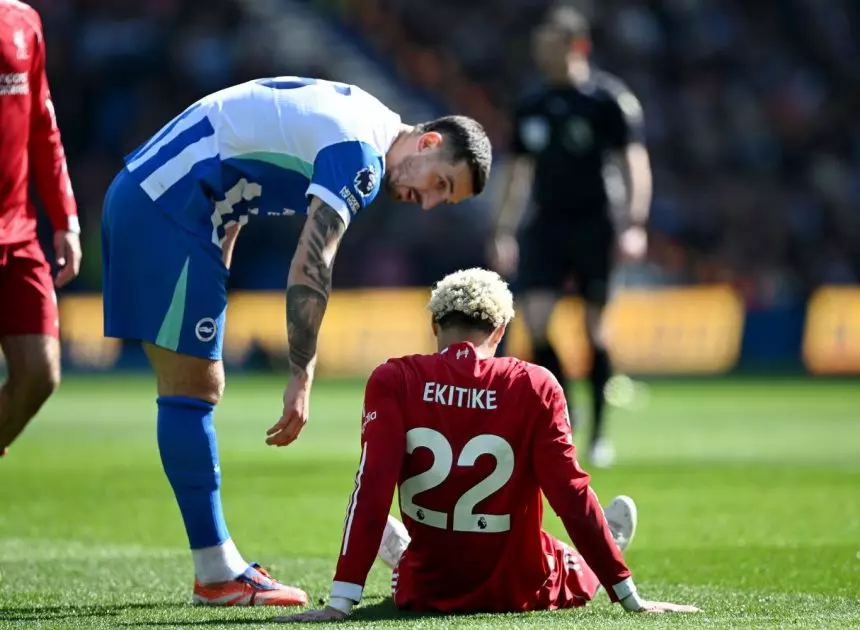
Liverpool’s 2-1 defeat at Brighton on March 21st was no mere blip. Ahead of their Champions League quarter-final against PSG, the English club displayed a team struggling in duels, less incisive in attack, and, above all, outpaced in the tempo of the match.
Starting composition (4-4-2 diamond):
Gakpo – Ekitike
Mac Allister
Wirtz – Szoboszlai
Gravenberch
Kerkez – Van Dijk – Konaté – Frimpong
Mamardashvili
Liverpool’s cause for concern
PSG’s upcoming opponent has fallen. On Brighton’s home turf, Liverpool were beaten 2-1 despite having equalized in the first half. Danny Welbeck opened the scoring with a header in the 14th minute, Milos Kerkez leveled around the half-hour mark after a mistake by Lewis Dunk, and then Welbeck scored the winning goal in the 56th minute. Crucially, Arne Slot himself acknowledged after the match that Brighton had been better in the second half and deserved their victory.
This defeat didn’t come out of nowhere. Liverpool remains fifth in the Premier League with 49 points after 31 matches, having just managed one point in their last three league games and suffered their tenth defeat of the season in the competition. At Brighton, the Reds were without Mohamed Salah and Alisson, while Hugo Ekitike was forced off early after a collision. This is no longer just an isolated slip-up; it’s a sign of a team losing stability whenever its cohesion is disrupted.
Challenges for PSG?
For PSG, this match leaves an interesting impression. Brighton didn’t simply beat Liverpool; they disrupted their game. The plan was clear: impose intensity, win the duels, stretch the defensive line, and make life uncomfortable for an opponent already hampered by absences and a packed schedule.
Slot emphasized his squad’s lack of freshness, the injuries, and the fact that Brighton had gradually gained the upper hand. The lesson for Paris is clear: when Liverpool can’t establish their own rhythm, they become much more vulnerable. This is an interpretation, not an absolute certainty, but a serious one.
Remember, the match is still a long way off.
However, it’s important not to prematurely declare Liverpool defeated. The quarter-final against PSG is scheduled for April 8th at the Parc des Princes, with the return leg on April 14th at Anfield, and the exact availability of some players who will be absent for the European clash remains to be determined. The key for PSG is therefore not to overestimate their abilities, but to recognize that Brighton has exposed some very real weaknesses: a team that can lose its focus, be overwhelmed by attacks from the opposition, and lack the necessary response when it doesn’t have all its key players available to control the game.
In short, this defeat on March 21st changes the landscape somewhat before PSG-Liverpool. It doesn’t eliminate the English threat, far from it, but it offers Paris a very concrete starting point for preparing for this quarter-final: increase the intensity, avoid any lulls, and force Liverpool to defend desperately rather than control the game. Brighton did this in a Premier League match. PSG now has a very serious area to work on for the Champions League.
5 Points to Work On
Impose the duel from the outset. Brighton struck early and immediately drew Liverpool into a physical and intense match; afterwards, the Reds chased their comfort zone more than they dictated the tempo. For PSG, this means an aggressive start to the match, with a high press and a fast pace, not a polite observation phase.
Attack the wings and crosses. Both of Welbeck’s goals came from plays where Brighton were able to create danger from the flanks and disrupt Liverpool’s penalty area. The lesson for Paris is clear: they must exploit the width of the pitch, then attack the final third with repeated runs.
They must prolong periods of pressure to wear Liverpool down. Slot acknowledged that Brighton took control as the match progressed and were the better side in the second half. The risk for Liverpool arises when the game drags on and they can no longer regain control. For PSG, this means not settling for a brief period of dominance: they must repeat these waves of pressure.
They must prepare two scenarios depending on absences. At Brighton, Liverpool played without Salah and Alisson, with Ekitike coming off very early, but the medical situation between now and April 8th could change. Paris must therefore prepare a plan against the best possible version of Liverpool, while also keeping adjustments in place should some absences be prolonged.
They must immediately punish any lapses in concentration. After the 2-1 scoreline, Slot felt that Brighton were closer to making it 3-1 than Liverpool were to making it 2-2. This is the most interesting signal for PSG: when Liverpool falters, they need to attack instead of managing the game. In the Champions League, these kinds of windows of opportunity are short-lived, but they can turn the tide of a two-legged tie.


