

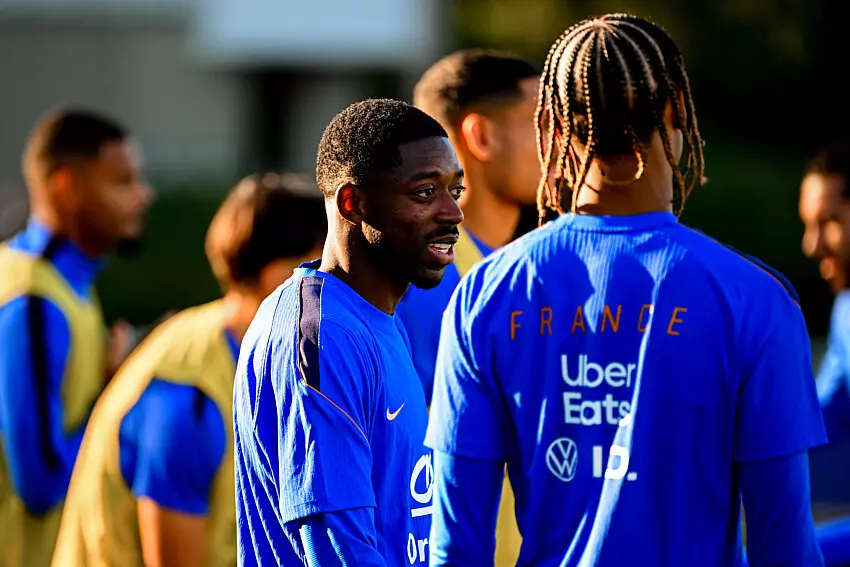
Zinédine Zidane makes no secret of his appreciation for attacking players developed by or associated with Paris Saint-Germain. In a press conference, the France manager highlighted 29-year-old PSG forward Ousmane Dembélé, while also mentioning 21-year-old Parisian attacker Désiré Doué.
Zidane: “An incredible work rate”
“For me, he’s already doing it. He’s the vice-captain. He embodies that role even when he isn’t wearing the armband. You can feel it. He’s a good guy, always there for the others. We need to make the most of his experience.
In Turkey, he played in the same position as he does at PSG. He does it very well. Tomorrow is another match; we’ll see how we approach it. But Ousmane brings a really interesting level of activity to the game. He puts in an incredible amount of energy. He can easily play 90 minutes.”
It is no longer just Ousmane Dembélé’s attacking talent that stands out. Zidane also emphasizes the player he has become over the years: a key figure, a leader on the pitch, and a player capable of contributing massively without the ball. This status directly reflects his evolution at PSG. Under Luis Enrique, Dembélé has gradually moved beyond the role of a flashy winger to become a much more complete forward—capable of playing centrally, initiating the press, and influencing the team dynamic far beyond just goals or assists.
Perhaps the most interesting aspect lies elsewhere: Zidane clearly isn’t trying to reinvent Dembélé for the national team. His deployment in a central role in Turkey mirrors the principles that helped the PSG player take his game to the next level. After years where clubs and national teams might assign vastly different roles to the same player, PSG has now become a reference point that the national team coach seems ready to lean on.
Zidane: “I love this type of player”
“They are young, highly dynamic, and incredibly interesting players. I love this type of player because the flanks are where you can really make a difference.”
Désiré Doué is a perfect fit for this kind of direct, penetrative play. The Parisian possesses the ability to receive the ball out wide without being confined to a traditional winger’s role—he can take on defenders, cut inside, combine with teammates, or beat his man. For a coach looking to create individual moments of magic in wide areas, his profile offers a wealth of possibilities.
Bradley Barcola may now belong to Liverpool, but his pairing with Doué in Zidane’s comments also highlights the attacking riches PSG possessed until recently. The two players have very different ways of taking on opponents: Barcola offers more power, speed, and verticality, while Doué brings more variety and an aptitude for playing inside. Clearly, this type of dynamic playmaker appeals greatly to the new national team coach.


