

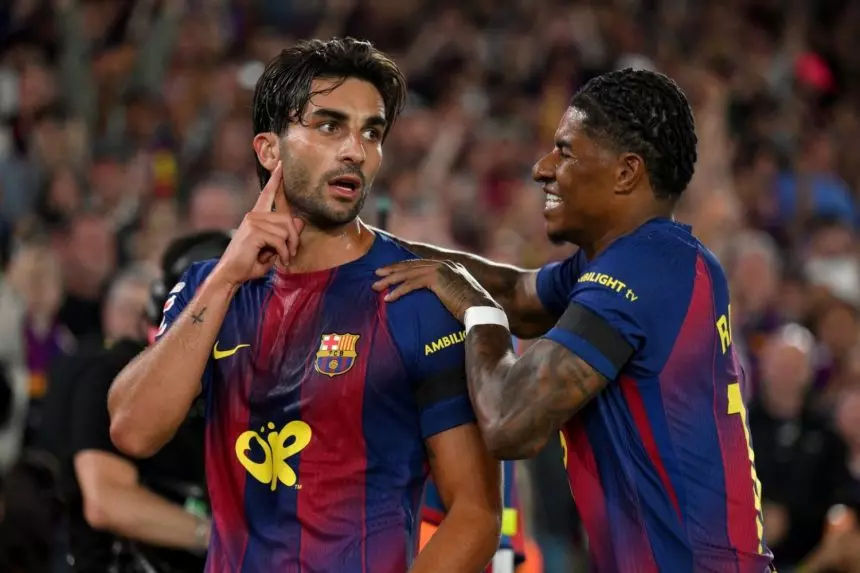
Paris Saint-Germain has explored the possibility of signing Ferran Torres to prepare for potential changes in their attacking lineup. According to several media outlets, the 26-year-old FC Barcelona forward has been sounded out and remains highly regarded by both Luis Enrique and the Parisian sporting management. While the option is on the table, no offers or advanced negotiations between the clubs have been reported at this stage.
The sporting rationale is clear. Luis Enrique knows Ferran Torres well, having managed him with the Spanish national team. The forward is also coming off a 21-goal season with Barcelona. However, signing him would only make sense if he were assigned the right role: that of a mobile, versatile forward, rather than a like-for-like replacement for Bradley Barcola.
A genuine option, but not a priority?
PSG is not yet negotiating a transfer for Ferran Torres. The Parisian club has inquired about his situation and is preparing various scenarios for the remainder of the transfer window. His contract with Barcelona runs until June 2027, which could open the door to discussions this summer if no extension talks begin.
According to L’Équipe, this line of thinking is linked to the uncertainty surrounding Bradley Barcola, who is being tracked by several major European clubs. However, the French international’s departure is not a done deal. Above all, Paris appears keen to avoid being caught off guard should a significant offer alter the makeup of its attack. Meanwhile, a different narrative is also circulating: Torres is reportedly being targeted primarily to cover for the potential departure of Gonçalo Ramos.
Ferran Torres is not the only option being considered, however. His name should be viewed as a credible option—one favored by the coach—rather than as a future signing already committed to Paris.
A key player for Luis Enrique’s Spain side
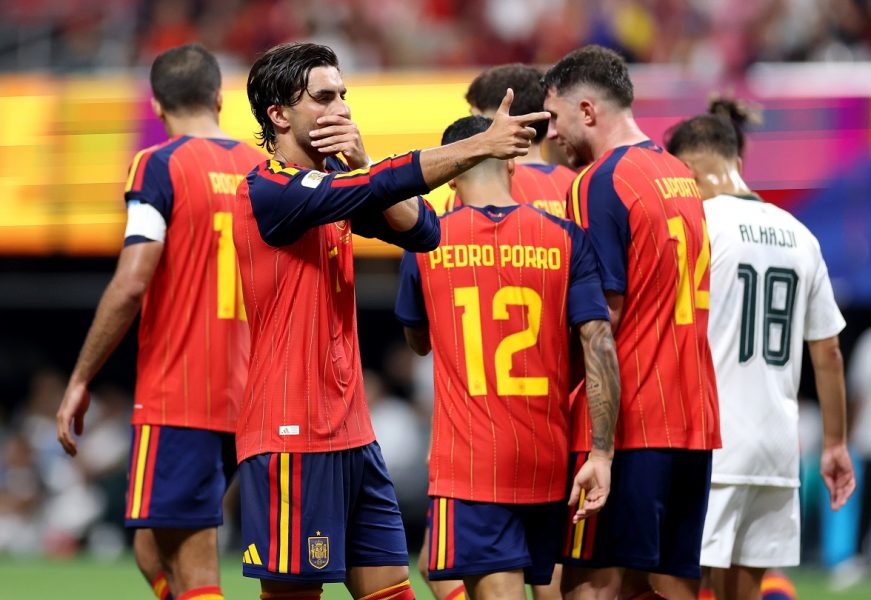
Luis Enrique’s interest is nothing new. Ferran Torres made his debut for Spain in September 2020 and quickly established himself as one of the head coach’s most frequently used forwards. Before the 2022 World Cup, FIFA even highlighted him as the top scorer of the Luis Enrique era with La Roja.
The manager deployed him both out wide and through the middle. Torres offered runs in behind, a presence in the penalty area, and the flexibility to alter attacking positions without needing a substitution.
This shared history reduces some of the tactical uncertainty. Luis Enrique knows how the player works, how he interprets instructions, and the positions he can fill. For his part, Ferran Torres understands the demands of a coach who requires his forwards to move, combine with teammates, and contribute to the collective effort.
The stats of a forward who has shifted to a more central role
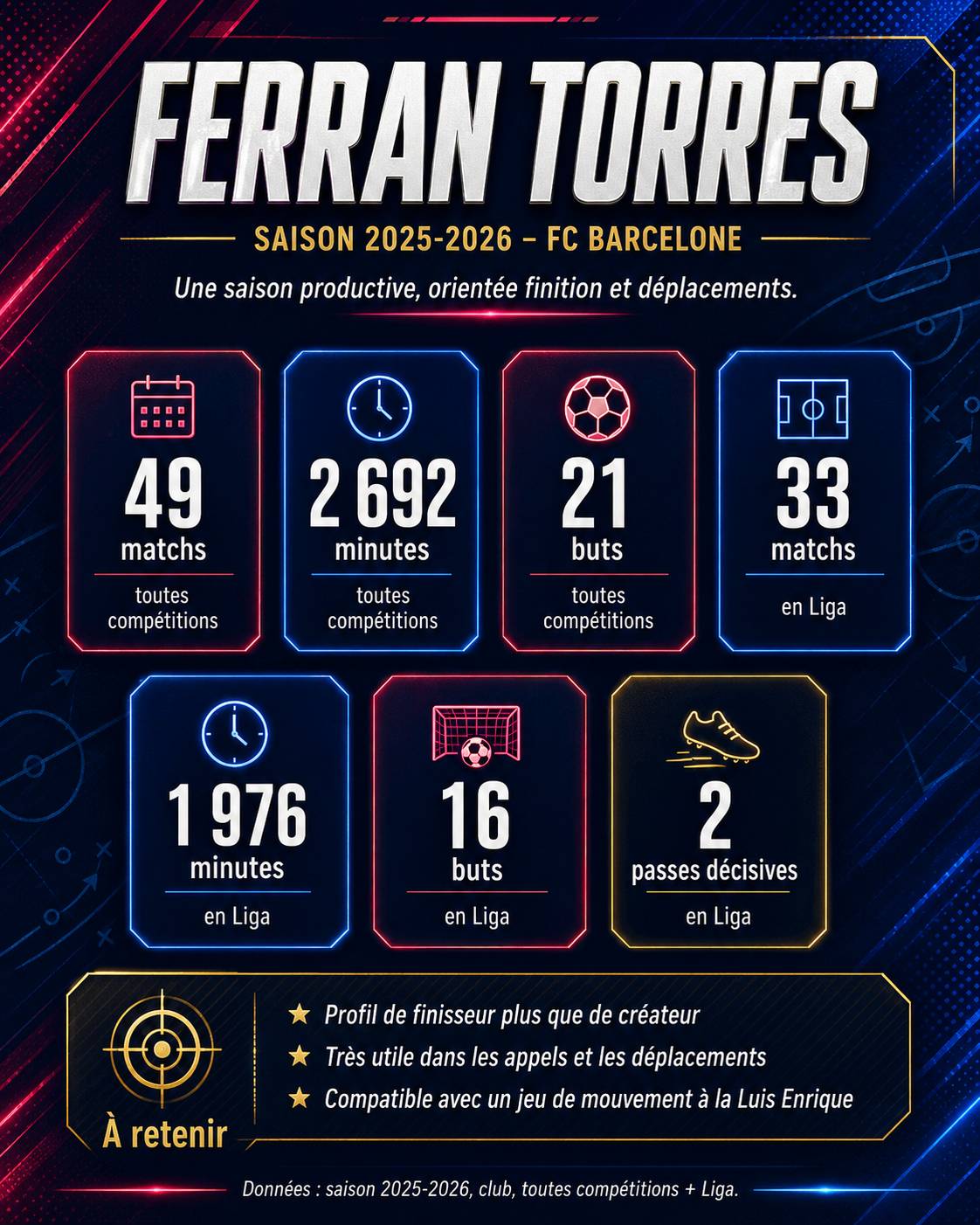
Ferran Torres played 49 official matches for FC Barcelona in the 2025–26 season, clocking up 2,692 minutes and scoring 21 goals. He averaged a goal every 128 minutes.
In La Liga, he recorded 16 goals and 2 assists across 33 appearances and 1,976 minutes. This output saw him share the Zarra Trophy—awarded to the league’s top Spanish scorer—with Lamine Yamal.
These figures reflect a season focused more on finishing than on playmaking. Torres scored far more goals than he provided assists; his primary value lies in his movement, his runs, and his ability to finish off moves created by his team.
A mobile centre-forward rather than a wide winger
FC Barcelona views Ferran Torres as a player capable of filling any attacking role. While he possesses this versatility, his recent development has seen him gravitate towards the centre-forward position.
Torres may start a match on the wing, but he frequently looks to move closer to goal. He attacks the spaces between defenders, joins the play inside the box, and capitalizes on his teammates’ movement to find space.
At Paris, he could play as a mobile number nine, swap positions with Ousmane Dembélé, or start out wide before cutting inside. He would not be signed to hug the touchline and constantly make runs down the flank.
What he could bring to PSG
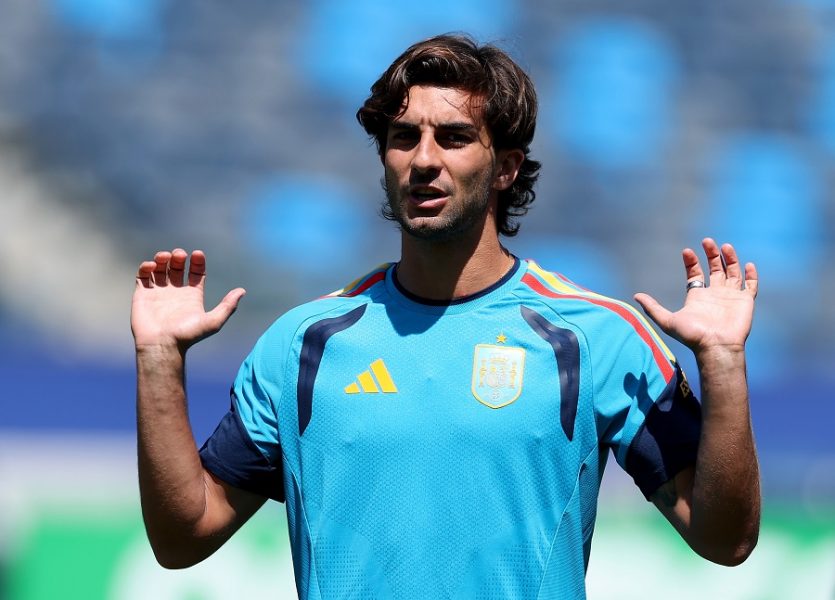
- Scoring without dominating possession
Ferran Torres doesn’t need to be the primary playmaker to pose a threat. His time at Barcelona demonstrates that he can score goals even with less playing time than a guaranteed starter.
This ability could prove valuable in a squad where Dembélé, Désiré Doué, Khvicha Kvaratskhelia, and PSG’s midfielders already play key roles in chance creation. Torres could focus on making runs and finishing.
- Movement suited to PSG’s passers
The Spaniard excels at attacking the space in behind and exploiting gaps created by his teammates’ movement. Vitinha, João Neves, and Doué could capitalize on his diagonal runs to play the ball forward more quickly.
His mobility would also allow Dembélé to drop deep or drift away from the center without leaving the penalty area completely unoccupied. Torres would provide a more consistent presence in the final third.
- Versatility that can be utilized immediately
Luis Enrique could deploy him centrally, on the left, or on the right, depending on absences and the specific opponent. This versatility would offer an additional option without requiring a complete tactical overhaul.
However, his pressing ability should not be viewed as a guaranteed asset. While Torres is familiar with Luis Enrique’s team principles, available data does not suggest he ranks among Europe’s elite forwards in this regard.
Limitations Paris must consider
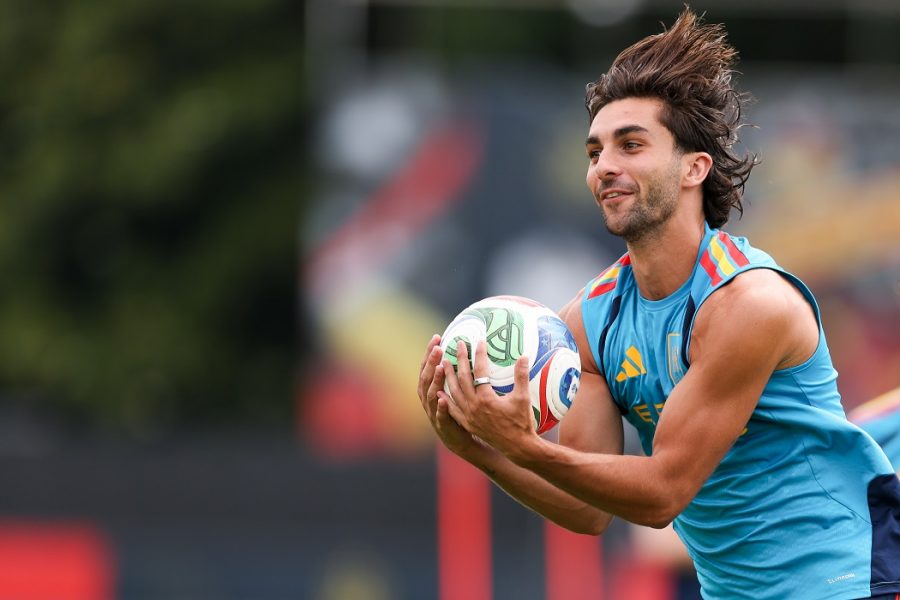
- He wouldn’t replace Barcola’s dynamic edge
Bradley Barcola brings pace with the ball, width, and the ability to take on defenders from the left flank. Ferran Torres tends to look for central areas and finishing opportunities.
If the Frenchman were to leave, Paris would gain a more central player but lose a true specialist in wing-based acceleration. Signing Torres would not necessarily compensate for all of Barcola’s qualities.
- Limited creative output
His two La Liga assists suggest his season was defined primarily by goal-scoring. While Torres can participate in combination play, he should not be viewed as a playmaker tasked with consistently delivering the final pass. Furthermore, he is not a prolific dribbler; his technique can sometimes appear casual or languid. This creates the impression of a player whose performance levels are not always consistent.
He relies on the team’s collective system to receive the ball in favorable positions. If Paris is primarily seeking an attacker capable of creating chances single-handedly against a low block, he is not the most obvious solution. He also displays occasional technical shortcomings.
- Not a classic target man
Ferran Torres is not a center-forward whose game revolves solely around playing with his back to goal, aerial duels, or holding up the ball under pressure. His value stems more from his mobility than from consistently dominating center-backs physically.
This distinction is not necessarily a flaw within Luis Enrique’s system. However, it would become a limitation if PSG were looking to sign a powerful target man to radically alter their attacking approach.
The transfer fee will shape the assessment
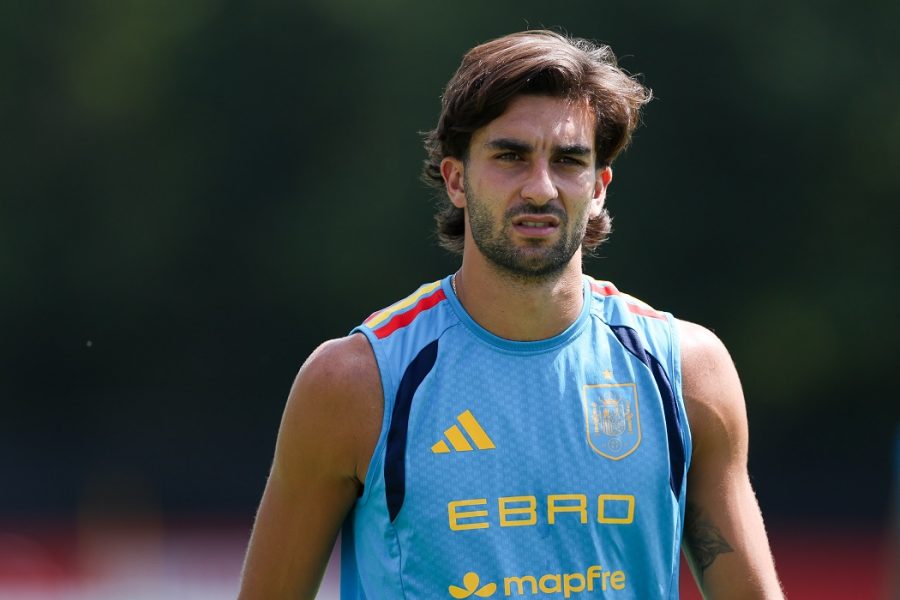
Ferran Torres’s contract runs until 2027, but his 21-goal season gives FC Barcelona strong leverage in any potential negotiations. No asking price from the Catalan club has yet been confirmed by a sufficiently reliable source.
Paris will therefore have to evaluate the move based on the role envisaged. A reasonable fee for a rotational forward capable of becoming a starter would make the deal logical. A massive investment for a player who does not address a priority need would be far more questionable.
At 26, Torres would be neither a young prospect to develop nor a superstar around whom to rebuild the entire attack. PSG would be acquiring an experienced player capable of making an immediate impact, though his potential for future appreciation in value would be lower than that of a younger talent.
Good target or bad target? It comes down to the role.
Ferran Torres would be a strong target if Luis Enrique is looking for a mobile forward—effective in the box, versatile enough to play multiple positions, and capable of quickly grasping his tactical principles. His season at Barcelona demonstrates that he can deliver goals without requiring the entire team’s play to revolve around him.
He would, however, be a poor choice if PSG viewed him as a direct replacement for Barcola, a dominant one-on-one winger, or a center-forward tasked with physically pinning back opposing defenses.
While the move makes genuine sporting sense, nothing is yet advanced enough to speak of a likely transfer. Paris has sounded out the player, and Luis Enrique rates him highly. Future developments will depend on changes to the Parisian attack, the price tag set by Barcelona, and—above all—the specific role PSG intends for him to play.


