
As the reigning two-time European champions, Paris Saint-Germain heads into the 2026/2027 season facing a challenge that is almost unprecedented: continuing to improve after having already won everything. Between the departure of Gonçalo Ramos, the anticipated arrival of Lucas Digne, various attacking targets, and the need to rebalance the squad’s internal competition, Paris must reinvent itself without disrupting its formidable winning machine.
After two triumphs, PSG is entering a new dimension.
- Winning again: a challenge that is more mental than tactical.
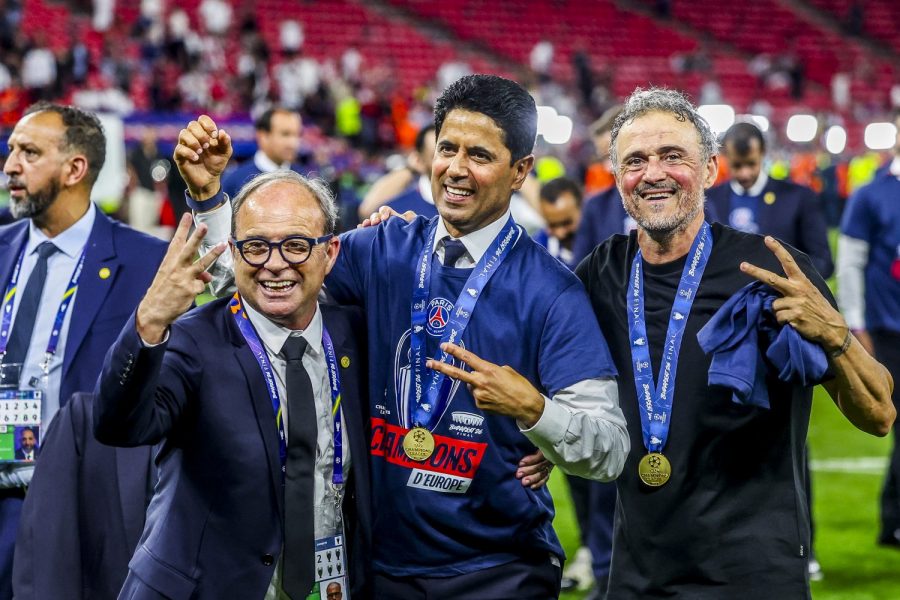
In the span of two years, PSG has stepped up to a new level. The first title—sealed with a 5–0 thrashing of Inter Milan in 2025—rewarded a team that had become unstoppable. The second, won on penalties against Arsenal in 2026, revealed something else: the ability to win without always dominating. After finishing eleventh in the league phase and scraping through a tough play-off against Monaco, Paris swept aside Chelsea and Liverpool before surviving a wild semi-final against Bayern.
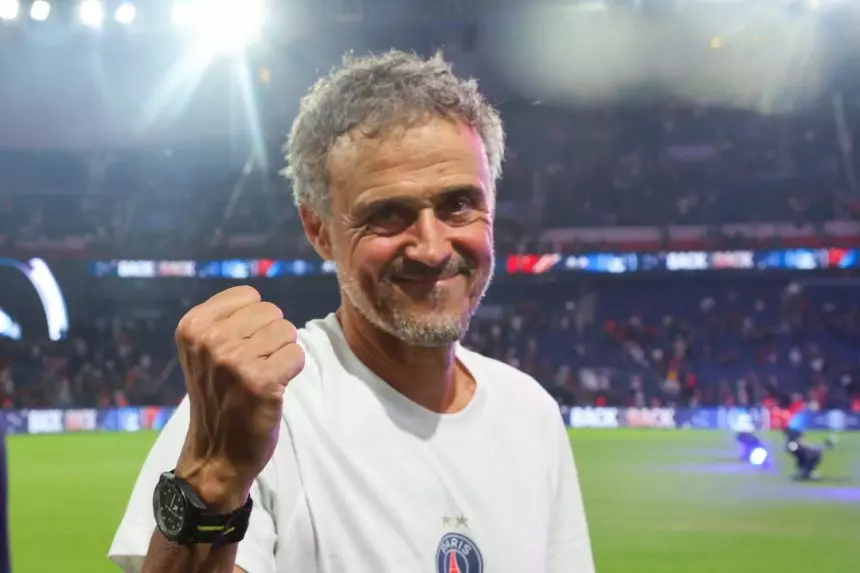
This distinction is crucial. Luis Enrique’s squad now knows how to impose its style of play, but also how to endure suffering, overcome doubt, and bounce back. To aim for a third consecutive title, they must not take this resilience for granted. Hunger, daily intensity, and an acceptance of internal competition will be the top priorities this summer.
Refreshing the squad without upsetting its balance.
- A precision transfer window, not a revolution.
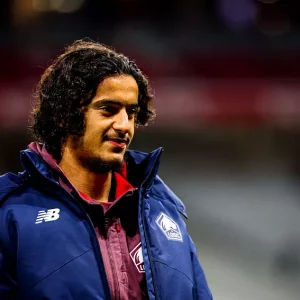
Gonçalo Ramos’s permanent move to AC Milan deprives PSG of its most natural center-forward. It also frees up a spot and the financial resources to reshape the attack. Maghnes Akliouche would bring creativity between the lines, excellent final-ball delivery, and real composure in tight spaces. Yan Diomandé would offer greater directness, pace, and the ability to unsettle defenses. These profiles address different needs and could even complement one another.
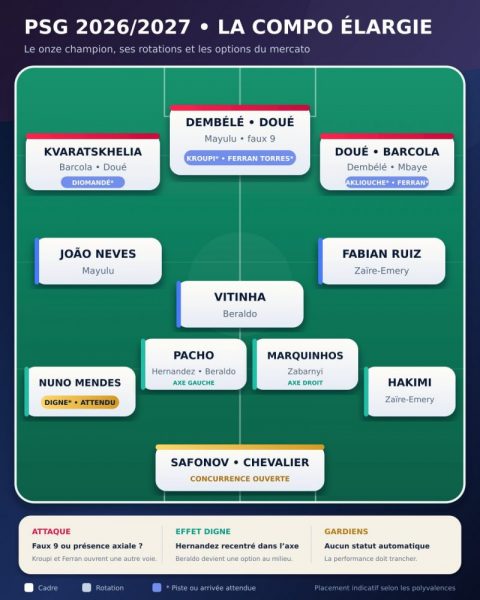
The temptation would be to simply stockpile talent. That would be a mistake. With Dembélé, Doué, Kvaratskhelia, Barcola, Mbaye, and Mayulu, Paris already possesses considerable attacking depth. Any new signing must offer a fresh tactical option, not merely add another name to the roster. Signing a center-forward is not strictly necessary if Luis Enrique wishes to maintain a fluid system, yet the squad still needs a solution capable of pinning back a low block and making an impact in the penalty area when the game stalls.
- Lucas Digne: a backup capable of filling multiple roles.
The anticipated arrival of Lucas Digne addresses a visible weakness from last season: the lack of a genuine alternative to Nuno Mendes. While the Portuguese full-back is peerless in his specific role, his absences forced Luis Enrique to shift players around, thereby weakening other areas of the team. Digne would not arrive to upend the existing hierarchy, but rather to maintain a high technical standard, contribute his experience, and facilitate more natural squad rotation.
His signing would trigger a domino effect. Lucas Hernandez could permanently shift to a central defensive role, while Lucas Beraldo could be deployed more regularly in midfield. Paris would thus strengthen three areas with a single signing—exactly the kind of smart move a championship-winning squad needs.
Essential competition across the board.
- Competition should keep key players on their toes, not displace them.
The numerous injuries of the 2025/26 season served as a reminder that an exceptional starting XI is not enough. Players like Hakimi, Nuno Mendes, Dembélé, Doué, and Kvaratskhelia cannot sustain peak intensity across every competition. Doubling up on positions is necessary, but requires players capable of stepping into the starting lineup without sparking a constant battle over status.
This applies to established stars as well. Marquinhos, Fabian Ruiz, and even the attacking trio must feel that performance dictates selection. After two title wins, the danger lies in confusing continuity with complacency. Luis Enrique must stick to his most fundamental principle: no one plays on reputation alone.
- Chevalier-Safonov: starting from scratch.
Lucas Chevalier was signed to become the new number one, but his first season in Paris was hampered by errors, injuries, and the rise of Matvey Safonov. The Russian gained ground, eventually shifting the pecking order. Relegating Chevalier to a mere number two role in July would be premature; handing him back the starting spot automatically would be equally hasty.
The healthiest approach is to open up genuine competition for the position. Chevalier still possesses the distribution skills and potential to establish himself within Luis Enrique’s project. Safonov, meanwhile, has earned more than just a stopgap role. The goalkeeper position should be determined by form, reliability, and influence on the team. Clear competition is preferable to a vague rotation system, especially when high-stakes knockout matches arrive.
Evolving the game to remain unpredictable.
- Regaining unpredictability when everyone is studying Paris.
After winning two titles, every opponent will approach matches against them like a final. Their build-up play, attacking rotations, Vitinha’s role, and the overlapping runs of the full-backs will all be dissected. Paris cannot simply rely on executing the same patterns even better.
Evolution can come from several directions: a back three during possession, Beraldo in midfield, Akliouche in a hybrid role, Doué playing more centrally, a winger capable of constantly attacking the space behind the defense, or an occasional aerial threat. The goal is not to change identity every week, but to offer various solutions while sticking to the same core principles.
- Physical management: a true priority for the season.
The schedule over the past two years has been grueling, and most international players are still coming off the back of a World Cup. Squad renewal, therefore, won’t come solely from the transfer market. Individualized rest, proactive rotation, and the integration of young players will need to be prioritized just as much as the big matches. Paris must be willing to sacrifice a little immediate quality at times to avoid losing their best players in the spring. Luis Enrique’s real challenge will be to keep everyone engaged without burning out his core group. Substitutes need to play before a crisis hits, not just when the treatment room is overflowing. It is through this management of the routine months that a third extraordinary European campaign can be built.
Evolving without forgetting what made Paris champions.
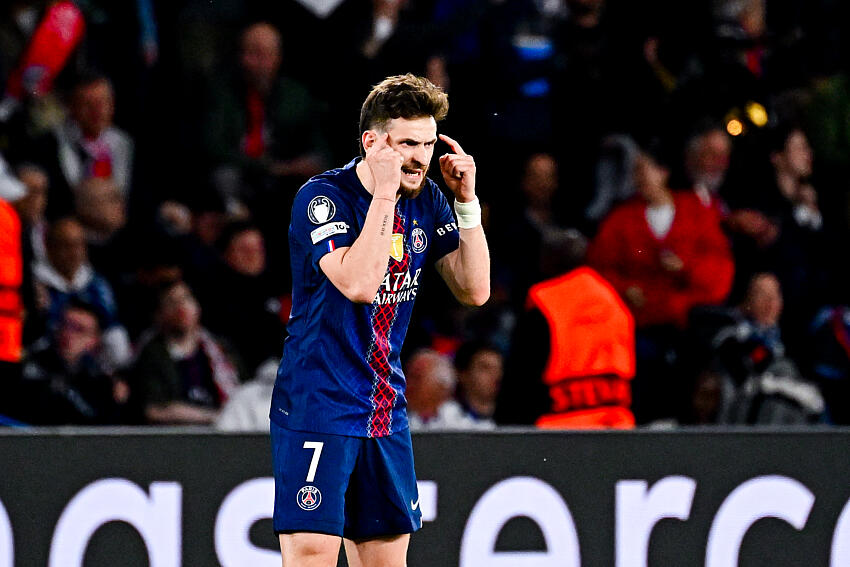
PSG does not need to completely reinvent itself. Its collective pressing, mobility, technical mastery, and lack of reliance on a single star remain its greatest strengths. Yet, European history shows just how much more a third consecutive title demands than merely a superior squad.
Paris will need to maintain its hunger, better manage playing time, resolve the competition for the goalkeeper spot, and recruit players capable of opening up new avenues. The best transfer window won’t necessarily be the most spectacular one; it will be the one that allows the European champions to remain true to themselves while—once again—becoming difficult to recognize.