
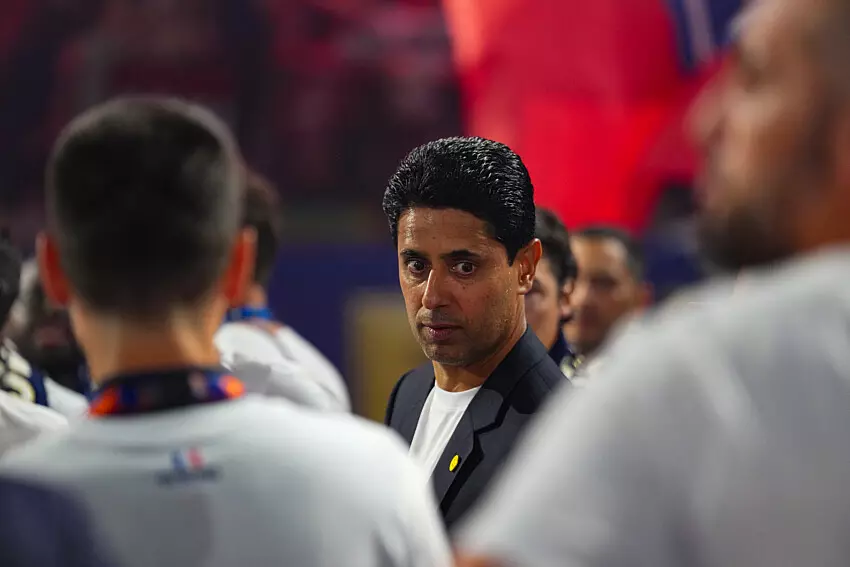
On June 29, a significant vote regarding French sport was initiated in the National Assembly. It concerns a bill—already passed by the Senate—aimed at reforming professional sports, particularly football. Among the key changes, Article 8 is expected to force Nasser Al-Khelaïfi to alter his current roles. He serves as president of both Paris Saint-Germain and beIN Media Group, while also holding a prominent position within the Professional Football League (LFP). This arrangement frequently raises questions about conflicts of interest—precisely the issue the legislative change seeks to address. The newspaper L’Équipe details the situation this Saturday.
“Nasser Al-Khelaïfi is the target”
Article 8 aims to curb the conflicts of interest often criticized in football, particularly during debates over future broadcasters and television rights.
Nasser Al-Khelaïfi is the specific target, as the Qatari executive heads both PSG and beIN Media Group, the parent company of the beIN Sports channels. He sits on the LFP’s Board of Directors (having also installed his general manager, Victoriano Melero, as head of the clubs’ union) and faces accusations of influencing decisions on a matter crucial to club revenues: beIN Sports France broadcasts Ligue 2 matches and held rights to one Ligue 1 match for the 2025–26 season.
“The PSG boss’s inner circle is skeptical”
As the law stands, Al-Khelaïfi would no longer be permitted to serve on French football’s governing bodies. Those close to the PSG boss view the provision with irony, pointing out that “NAK” is frequently asked for his opinion on these matters but recuses himself during actual votes.
Note, however, that the measure affecting Nasser Al-Khelaïfi has not yet been finalized. However, the law does indeed appear to target the practice of holding multiple roles—a common point of criticism in French football. It is frequently cited as a key factor behind the sport’s financial woes, even if that assessment isn’t necessarily justified, given the many other causes involved. Nevertheless, the situation invites skepticism and easy criticism, fueling significant tension. Avoiding such a scenario makes sense—especially considering that similar issues could arise with other executives.
The current president of PSG and beIN Media Group now faces several options. Fighting the law seems risky, while stepping down from his role at the Parisian club would come as a genuine surprise—and would likely be regrettable, given his significant standing in European football. Appointing a successor at beIN appears to be the most logical course of action.
We will have to wait and see exactly what measures are put in place; these are incredibly complex matters involving behind-the-scenes dynamics that remain beyond our view.