

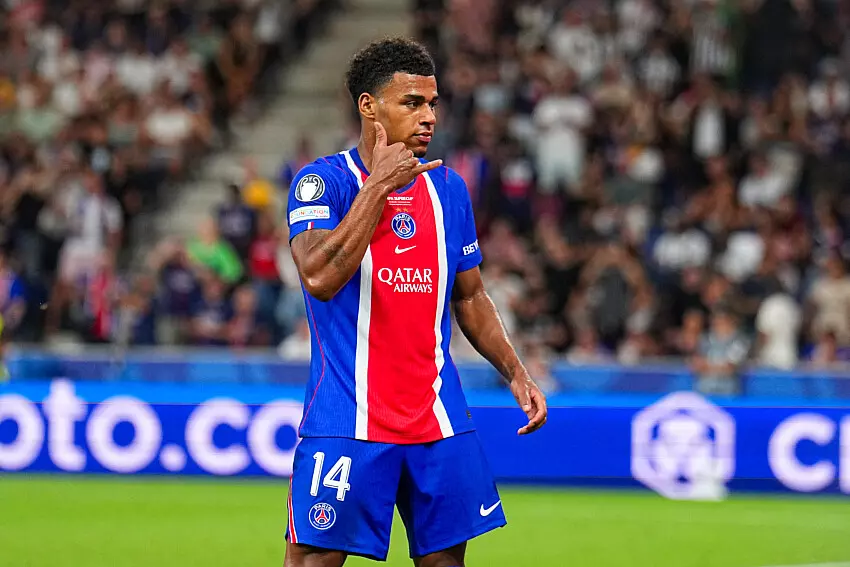
Désiré Doué (21) shone on Monday during the Belgium vs. France match (0–1)—so much so that Stéphane Jobard, a former assistant coach for the Red Devils, told Le Parisien he felt like he was watching “Michael Jordan.” That is fantastic. Less than two weeks ago, people were wondering if the Paris Saint-Germain player was losing his spot in the lineup. Modern football moves incredibly fast. Sometimes, far too fast.
A player, a quick label
Let’s be clear right away: Désiré Doué was excellent against Belgium. And Stéphane Jobard is perfectly entitled to be enthusiastic. That isn’t the issue. In fact, it’s rather refreshing to see a coach speak about a player with stars in his eyes rather than with a dozen Excel spreadsheets and a graph tracking high-intensity runs.
What is more amusing is the surrounding context. On September 17, Doué was coming off a brief spell where he had started two consecutive matches on the bench for PSG. Ferran Torres was scoring, the competition for places was intensifying, and the question arose almost naturally: was Doué slipping down the pecking order? A few days earlier, his absence from the 30-man Ballon d’Or shortlist had already caused surprise.
Yet, just as his situation was becoming a “talking point,” he remained the most-used Parisian forward since the start of the season. He had started PSG’s first five matches and was coming off a season that ended with a second consecutive Champions League title, having been one of the key figures in their first European triumph in 2025.
In other words, the patient was doing just fine. But since he had sat on the bench twice, we had already started looking for the waiting room.
Football has less and less tolerance for gray areas.
This is perhaps where the Doué case becomes interesting. Not to decry, yet again, the infamous “cult of the moment.” The issue is slightly different: we now want every single moment to define a player’s status. Ferran Torres scores? He moves ahead of Doué. Doué plays less? He has to win back his spot. Doué has a great game for Les Bleus? Suddenly, he’s a phenomenon again. And if, tomorrow, he has two mediocre matches, someone will likely ask if he has “a problem.”
Everything has to establish a hierarchy. Everything has to tell a story of rising or falling. It is becoming almost inconceivable that an excellent player might simply be a substitute because another excellent player is playing. Or that a 21-year-old might have an average month without it revealing something profound about his career trajectory.
The funny thing is that the current PSG squad makes that old way of looking at things even less relevant. Luis Enrique (56) has a squad teeming with attacking options, where the lineup depends on the opponent, player freshness, desired combinations, and the stage of the season. Competition there doesn’t necessarily look like a ladder—with a first, second, and third place, each expected to wait their turn in that order.
It looks more like a toolbox. Of course, that makes for a much less convenient subject for a forty-five-minute TV debate.
What if we just left Doué alone?
There is, of course, a valid counter-argument. The competition from Ferran Torres is real. Two matches on the bench are a fact, not a figment of the imagination, and Luis Enrique grants his players no special immunity. Doué will have to keep performing well to secure significant playing time in such a crowded position. It would be just as absurd to treat his match against Belgium as proof that any sporting questions were off-limits. Yet, analyzing the competition for places doesn’t require handing out labels—starter, substitute, has-been, or future leader—on a weekly basis.
That may well be one of the most interesting lessons from the PSG teams built in recent years: a great squad doesn’t need every player to have a role set in stone. It needs players capable of filling multiple roles—sometimes off the bench, sometimes for the full 90 minutes—without their value being called into question every time the team sheet comes out.
So let’s enjoy Désiré Doué. Let’s enjoy his dribbling, his talent, and even his bad games. At 21, he’ll have plenty of time to be a starter, a substitute, exceptional, frustrating, and probably a whole lot more.
As for Michael Jordan, though, perhaps we should wait a little longer. Even he needed a few seasons under his belt before anyone made ten-part documentaries about him.