

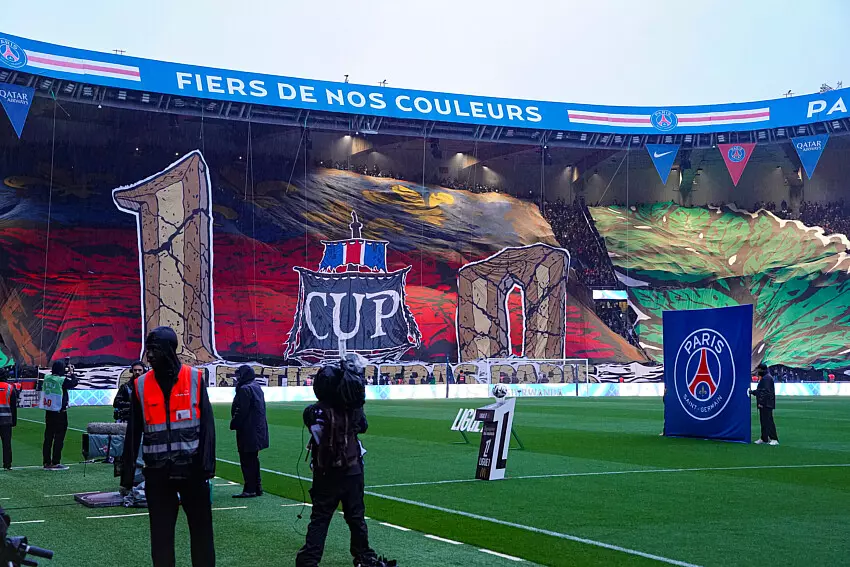
Paris Saint-Germain aims to own its stadium. Following the breakdown in relations during Anne Hidalgo’s tenure, the election of Emmanuel Grégoire as Mayor of Paris has reopened discussions regarding the sale of the Parc des Princes. However, Massy and Poissy remain under consideration as sites for a new arena. Balancing economic ambition, urban constraints, and loyalty to its history, Paris is preparing to make a decision that will shape the club for generations to come.
The Parc des Princes: a home where PSG does not own the walls.
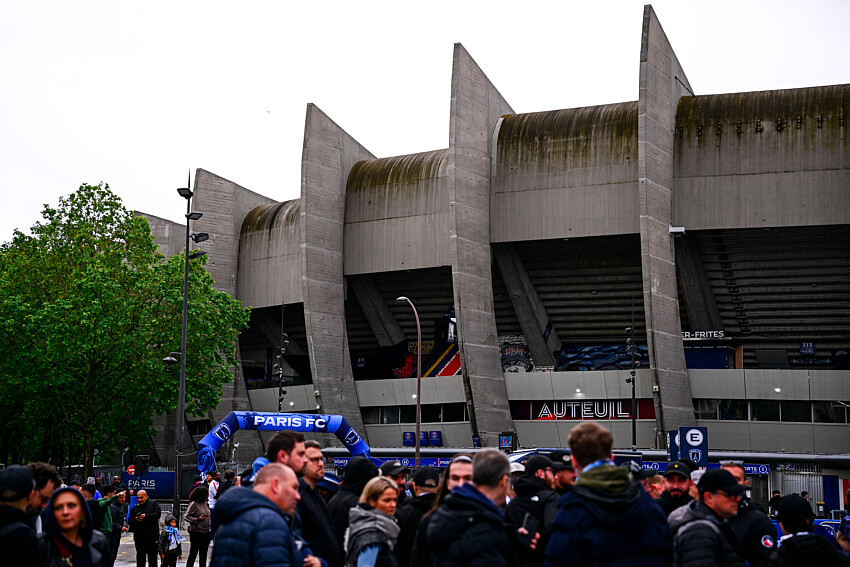
- A shared history since 1974.
The Parc des Princes is owned by the City of Paris. This legal detail might seem minor, given how inseparable the stadium and PSG appear to be; yet, it explains almost the entire current imbroglio.
Based at Porte de Saint-Cloud since 1974, the Parisian club is merely a tenant of its home ground. Its operating contract runs until 2044. While this guarantees many more seasons at the Parc, it does not grant the club the freedom an owner would have to radically transform the building.
PSG has already invested €75 million in renovations completed prior to Euro 2016. Seats were replaced, side pits were covered over, hospitality areas were expanded, and facilities were modernized. These works improved stadium operations without fundamentally altering its structure or capacity, which remains close to 48,000 seats.
“The Club invested €75 million to modernize the stadium.”
Source: Paris Saint-Germain, official presentation of the Parc des Princes.
This renovation demonstrated that the Parc could evolve without losing its character. It also highlighted the limitations of the current model. Investing in a leased facility was acceptable for interior modernization. However, for a transformation costing hundreds of millions of euros, ownership—or equivalent legal security—becomes a crucial factor that is difficult to bypass.
- Owning the stadium: an issue that goes beyond ticket sales.
When PSG states that it wants “its own stadium,” it is not merely asking for a few thousand extra seats; it wants to control a strategic asset.
Ownership would allow the club to decide on renovations and fund them, while also reaping the long-term benefits. A major modern stadium operates year-round, hosting hospitality services, dining, retail outlets, tours, a museum, seminars, concerts, and private events. Match-day revenue now represents only one part of the business model. In modern football, the stadium has become a tool for competitiveness. Real Madrid and FC Barcelona have undertaken massive transformations of the Santiago Bernabéu and Camp Nou. Bayern Munich, Arsenal, and Tottenham also boast larger facilities designed to generate significant revenue year-round.
The Parc thus places PSG in a paradoxical situation: the club belongs to the elite circle of European sporting and commercial powerhouses, yet its stadium is smaller than those of Marseille, Lyon, and Lille. The Paris City Council itself acknowledges that the current capacity no longer fully aligns with the club’s growth.
“The stadium must evolve to meet European standards and support the club’s development.”
Source: City of Paris, June 26, 2026.
The need for change is therefore recognized by both parties. The discussion now centers on how to address it.
Hidalgo and PSG: a rift that is as much political as it is economic.
- A disagreement over the sale and value of the stadium.
For several years, PSG’s management negotiated with City Hall to acquire the Parc des Princes. In November 2022, L’Équipe revealed a PSG offer of around €40 million. The City deemed it too low.
This figure became the focal point of the conflict. Opponents of the sale argued that letting go of a public facility in the 16th arrondissement at that price would have been a bad deal for Parisians. The club, meanwhile, based its reasoning on the substantial cost of future renovations and the numerous constraints associated with the building.
“PSG proposed around €40 million to acquire the Parc des Princes—an offer the municipality deemed insufficient.”
Source: L’Équipe, November 24, 2022.
This figure refers to a proposal reported in 2022; it should not be presented as a new offer made after the change of mayor in 2026.
The value of the Parc cannot be calculated like that of an ordinary real estate plot. Its location is prestigious, yet its use is restricted. A buyer could not simply replace the stadium with housing or offices; they would need to invest heavily to transform a complex structure while maintaining its function as a sports venue.
This did not automatically make PSG’s offer sufficient. However, the Parc holds value in terms of land, heritage, commerce, and symbolism—dimensions that do not necessarily point to the same price.
- When the doors were closed.
In January 2023, Anne Hidalgo publicly stated that the Parc des Princes was not for sale. The Paris Council confirmed this stance in February 2024.
PSG, having made its major investment contingent on acquiring the stadium, drew a firm conclusion from this.
“The Parc is over for us.” ”
Nasser Al-Khelaïfi, President of Paris Saint-Germain.
Source: Reuters, February 8, 2024.
This statement did not, of course, signal an immediate move. It marked the end of negotiations that had reached an impasse.
Anne Hidalgo’s position was defensible on the grounds of protecting public assets. PSG’s position was equally defensible based on economic logic. Their conflicting stances led to a deadlock: the City refused to sell, while the club refused to invest hundreds of millions of euros without owning the property.
The issue had by then shifted from technical matters to a political and media showdown. In this kind of match, the score often remains 0–0, yet everyone ends up wasting time.
Emmanuel Grégoire is reviving the matter, though the outcome remains uncertain.
- A decisive shift in approach.
Emmanuel Grégoire’s election as Mayor of Paris in 2026 fundamentally changed the landscape. The new mayor quickly re-established contact with Nasser Al-Khelaïfi and secured a mandate from the Paris City Council to reopen negotiations.
Unlike Anne Hidalgo, Emmanuel Grégoire no longer rules out a sale. He is also considering a long-term lease—specifically, a bail emphytéotique (a very long-term leasehold agreement)—capable of providing PSG with sufficient guarantees to justify investment.
“Paris wishes to explore all possible legal solutions with the club: a sale or a long-term lease.”
Source: City of Paris, June 26, 2026.
This shift is significant. However, it does not mean the Parc has been sold, nor even that there is a consensus on the principle of its transfer. Part of the municipal majority remains opposed to selling a public asset. Any final decision will have to be submitted to the Paris City Council.
The City is proposing several safeguards: maintaining a primarily sports-related use, protecting the site’s heritage, and having the relevant departments oversee the pricing. Revenue from a sale or a new lease would be allocated to grassroots sports, sports facilities, green spaces, and the redevelopment of the area.
- The project now extends beyond the confines of the stadium itself.
The new discussions are no longer limited to the Parc’s physical structure. The City wants to rethink the entire Porte de Saint-Cloud area, which is currently ill-suited to accommodating tens of thousands of people.
The district includes several facilities, notably the Jean-Bouin and Pierre-de-Coubertin stadiums. Consideration must also be given to Stade Français, Paris FC, local sports clubs, neighborhood activities, and relations with the neighboring municipality of Boulogne-Billancourt.
Expanding the Parc will therefore involve more than just adding a few rows of seats. It will require rethinking access, traffic flow, security, transport links, and likely the use of some adjacent land.
This urban dimension could slow the project down. It could also make it far more cohesive. A larger stadium without transforming its surroundings would merely shift the problem outside the stands.
Expanding the Parc: a feasible undertaking, yet formidably complex.
- A stadium integrated into its surroundings.
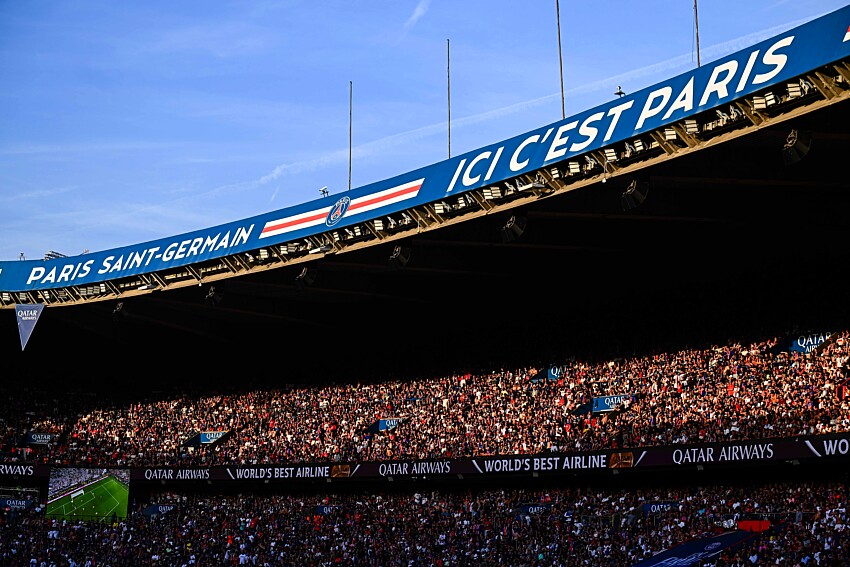
The current Parc, inaugurated in 1972, is an instantly recognizable architectural landmark. Its concrete ribs, ring-shaped roof, and stands positioned close to the pitch define its identity. The structure is also embedded in a highly constrained urban setting, with part of the building constructed over the ring road.
The stadium is surrounded by major roads, sports facilities, buildings, and the boundary with Boulogne-Billancourt. It lacks the extensive land reserves required for a conventional expansion.
Previous proposals primarily envisioned a Parc with a capacity approaching 60,000 seats. Since negotiations resumed, studies have focused on various scenarios ranging from 60,000 to 70,000 spectators. These remain feasibility studies rather than a finalized architectural project.
“Feasibility studies are now focusing on a capacity of between 60,000 and 70,000 spectators.”
Source: L’Équipe, June 25, 2026.
To achieve this capacity, various interventions could be considered: raising the roof, reconfiguring the stands, modifying access points, or utilizing adjacent land. Precise technical solutions have not yet been made public; it would therefore be premature to present any single option as a certainty.
- 70,000 seats—but at what cost?
Maximum capacity should not be the sole criterion. Expanding the Parc to 70,000 seats would not necessarily be a success if the result compromised the stadium’s character, made access difficult, or proved unreasonably expensive.
It will also be necessary to determine where PSG would play during the construction work. A phased renovation might allow some matches to be held at the Parc, though this would temporarily reduce capacity and extend the construction timeline. A complete closure would force the club to find an alternative venue. A stadium with a capacity of between 60,000 and 65,000 seats could offer an attractive balance: a significant increase in revenue and fan capacity, without turning a compact venue into an oversized structure. However, only a technical study will determine whether this balance is achievable.
Staying at the Parc only makes sense if the outcome truly aligns with PSG’s ambitions. Nostalgia does not fund construction work or resolve structural constraints.
Massy and Poissy: two alternatives that have become credible options.
- PSG is no longer just going through the motions of looking.
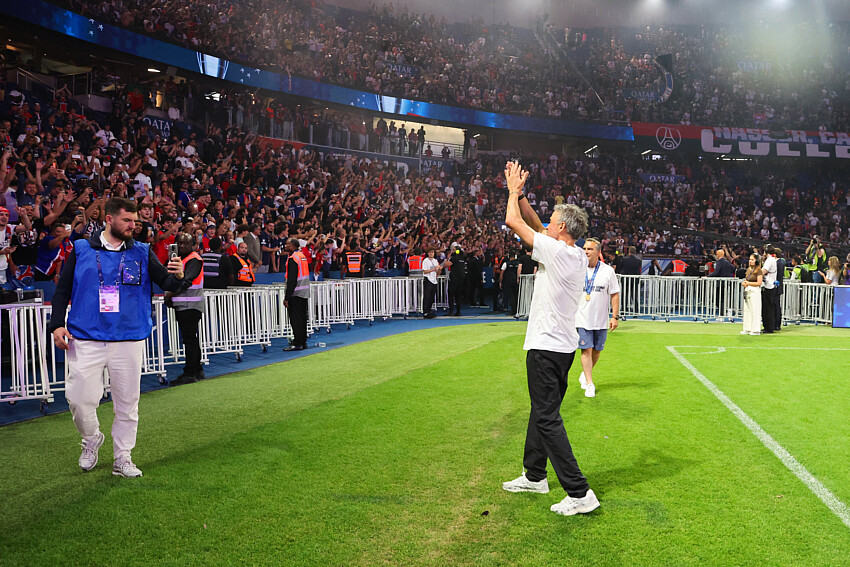
After reviewing various proposals within the Île-de-France region, PSG has shortlisted Massy and Poissy for further study.
Massy holds a significant advantage regarding transport. The town benefits from multimodal access and connections to Paris, the rest of the Île-de-France region, and the Saclay scientific and economic hub.
Poissy offers a different rationale. The site is located near the PSG Campus, which would allow the club to concentrate its main facilities within a single area.
Both sites are already developed land—an environmental criterion highlighted by PSG. The club maintains that neither site is currently favored and that feasibility studies are still required.
“At this stage, neither site is favored.”
Source: Paris Saint-Germain, June 13, 2025.
These potential sites naturally strengthen PSG’s negotiating position with the City of Paris. They provide a fallback option and prevent City Hall from taking the club’s continued presence at the Parc des Princes for granted. However, dismissing them merely as leverage would be unwise; technical and territorial studies are indeed being conducted for these scenarios.
- A new stadium with a capacity of 65,000 to 80,000?
Building elsewhere would allow PSG to start with a blank slate. The club could design a venue tailored to its sporting, commercial, and environmental needs without having to work around the existing structure of the Parc.
A large land area would allow for the integration of retail outlets, dining facilities, a museum, event spaces, parking, a public plaza, and hospitality areas. PSG could operate the entire complex year-round.
L’Équipe has mentioned a capacity of between 65,000 and 80,000 seats in the event of a move to the suburbs. Higher capacity figures have also been floated. However, these figures have not been officially confirmed by PSG and should not be presented as the finalized specifications for the future stadium.
“If the club moves to the suburbs, it could consider a capacity of between 65,000 and 80,000 seats.”
A scenario reported by the press but not officially confirmed by PSG.
Source: L’Équipe, March 25, 2026.
This solution would likely offer the greatest economic potential. It would also be a lengthy and costly process. It would require securing the land, obtaining permits, financing the project, adapting transport networks, and winning over local residents.
- Three options evaluated on a comparable basis.
The return of the Parc des Princes to the discussion has not led to the abandonment of the Massy and Poissy options. PSG has officially announced that all three possibilities will be studied using a comparable methodology.
“Each of the three scenarios will undergo a thorough and comparable evaluation.”
Source: Paris Saint-Germain, June 2, 2026.
The club aims to have sufficiently solid data by the autumn of 2026 to compare the feasibility and viability of each option. While this timeline does not guarantee an immediate final decision, it should enable PSG to move forward with selecting a site.
A larger stadium does not guarantee a stronger PSG.
- The race for capacity comes with its own pitfalls.
The notion that PSG automatically needs an 80,000-seat capacity is worth questioning.
The club can fill a massive venue for big European nights, matches against Marseille, or decisive games. The real issue lies with less prestigious fixtures played in winter or on weeknights. A stadium is not built solely for its ten most in-demand evenings.
An oversized venue can dilute the atmosphere and result in rows of empty seats. It can also push the club to prioritize premium services and casual fans over the core fanbase.
Increasing capacity should mean opening up more seats to young people, families, and supporters currently priced out or shut out by limited availability. Commercial ambition must go hand in hand with a commitment to the fan base. Otherwise, PSG might possess a magnificent economic engine, but many of the people who built its atmosphere will be watching it run from their sofas.
- The business model must not erase geography.
Massy and Poissy are very much part of the Île-de-France region. A PSG based in either of these towns would obviously remain Paris Saint-Germain.
But a move would carry symbolic weight. The slogan “Ici, c’est Paris” (This is Paris) draws some of its power from the fact that the club actually plays within Paris—even if the Parc is just meters away from Boulogne-Billancourt.
A new stadium could develop a strong identity over time. Many clubs have left their old grounds without losing their history. However, such a transition cannot simply be decreed in a marketing brochure; it is built through supporters, habits, and the passing of generations.
In that scenario, PSG would need to provide more than just a museum or a few red-and-blue seats. It would require replicating the close proximity of the stands, safeguarding a genuine offering for the general public, and ensuring a legacy that honors the history of the Parc.
Fans do not reject the future; they fear erasure.
- It is a legacy that cannot be captured on a balance sheet.
Le Parc may not be the most comfortable, functional, or profitable stadium, but it remains the place where PSG forged its story.
Generations of fans experienced the club’s first great European nights, the Canal+ era, periods of crisis, the return of the “popular” stands, the arrival of QSI, and the club’s greatest triumphs within its walls. Every stand holds memories that financial statements cannot measure.
This attachment should not be caricatured as a refusal to change. Fans fully understand PSG’s desire to accommodate more spectators and strengthen its financial position. What they ask, above all, is that this growth does not transform their club into a rootless brand.
- Sentiment cannot condemn Paris to stagnation.
Nor can history serve as an argument against any evolution. If studies show that Le Parc cannot be sufficiently expanded, that transforming it would be disproportionately expensive, or that doing so would destroy the very qualities that make it special, then staying would become a hollow gesture.
Preserving Le Parc is only worthwhile if PSG can still build its future there.
The Park as a reasonable priority, not an absolute obligation.
- A solution capable of reconciling identity and ambition.
The most balanced scenario would be an agreement allowing PSG to acquire the Parc—or secure a lease offering comparable guarantees—and then transform it into a stadium with a capacity of between 60,000 and 70,000 seats.
This solution would preserve the club’s Parisian roots, its history, and an atmosphere that is difficult to replicate. It would also offer increased capacity and new commercial spaces without turning economic development into a geographical rupture.
However, this scenario should only be favored if it rests on realistic terms. The price must protect the City’s interests without making the investment unviable. The architectural design must respect the Parc’s identity without being limited to a cosmetic renovation. Access and the surrounding areas must be upgraded. Finally, the club must secure sufficient legal control to commit the necessary funds.
- Avoid artificially pitting the past against the future.
If these conditions cannot be met, Massy and Poissy will become more than just backup plans. Building a new stadium could then prove to be the most rational decision for the coming decades—provided one does not confuse greatness with sheer gigantism.
The change of mayor has given the Parc des Princes a new chance to remain PSG’s home. It would be absurd not to explore this seriously. It would be equally dangerous to decide that the club must stay there before even knowing the cost of the operation, the realistically achievable capacity, and the nature of the transformations.
Ultimately, PSG need not choose between its history and its ambition. It must determine which project will allow it to grow without becoming a stranger to itself. Legally, a stadium belongs to a city or a club. A home, however, also belongs to those who bring it to life.


