

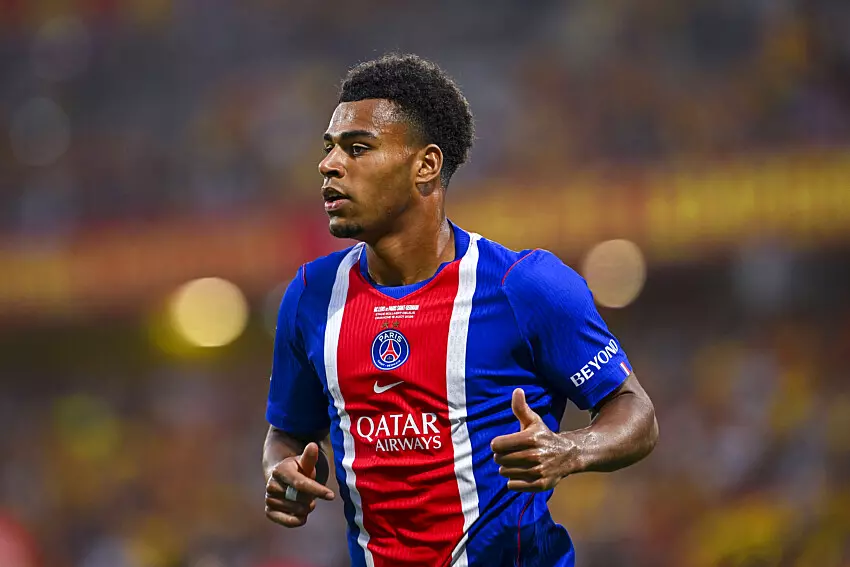
Désiré Doué, the 21-year-old Paris Saint-Germain forward, spoke to Téléfoot about his desire to improve his finishing. The Parisian number 14 embraces the risks inherent in his style of play while identifying a specific area for improvement: becoming more clinical and composed to better convert his chances.
Doué: “Sometimes, there can be some wastefulness”
“I’m a player who likes to pose a real threat, to create, to drive at the defense, and to take risks. Sometimes, there can be some wastefulness, but my goal is performance. When I can help the team—as I have in recent matches—I’m very happy.”
PSG needs players capable of unbalancing a defense, and that risk-taking inevitably comes at a cost. A failed attempt to drive past a defender doesn’t necessarily tell the same story as losing the ball while trying something unnecessarily complicated. The real work lies in decision-making: recognizing when to take on a defender, when to combine with teammates, and when to keep things simple. That is where boldness can become more effective.
Doué himself places the team’s needs at the heart of his mindset. This suggests his actions should be judged by what they contribute to the squad, with a focus on their appropriateness. A “zero-error” record looks appealing on paper. Yet on the pitch, a string of safe passes can leave the opposing defense completely untroubled. For Paris, the challenge is to maintain that ability to create danger while improving the quality of decision-making.
Doué: “I also need to work on my composure in front of goal”
“I want to score to help the team. I’ve already scored—in the Super Cup final (against Aston Villa)—but I know I need to do much more. I’m working on that, and I know that once it starts happening, the goals will keep coming.” Areas for improvement?
Efficiency. I manage to create great chances for myself. Now, I also need to work on my composure in front of goal—staying even calmer to finish the play, even if I only get one opportunity in a match. I work on this every day. I’m sure the goals will come and I’ll manage to score—both here for the French national team and at club level with Paris Saint-Germain.
His specific focus on that potential single chance is telling. It sets a concrete standard: the ability to be decisive without needing multiple attempts to find one’s range. For Doué, progress lies in mastering the final action after having created the opening. A play might require a burst of energy to reach the goal, followed by the composure to choose the right finish. That shift in tempo requires just as much work as the initial driving run.
His certainty that the goals will follow reflects confidence. It remains a conviction, however—one that must be validated by hard work on the pitch. The encouraging sign is his ability to pinpoint a specific weakness without making excuses. For PSG, progress will also be measured by the quality of his decision-making and his shooting: while a goal can unlock confidence, reliable finishing is built through consistency, not just a hoped-for breakthrough moment.


