
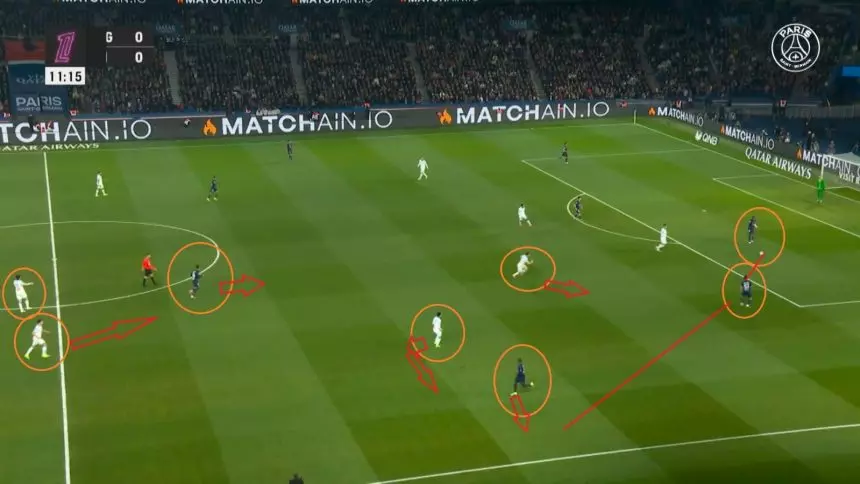
With the aim of providing our readers with richer content, we’ve launched a section analyzing key moments in a match, whether goals scored or conceded, skillful plays, missed opportunities, and more. The goal is to determine the degree of collective or individual success, or error, in each action. Here’s the latest installment. This particular piece focuses on the 5-0 victory against Olympique de Marseille this Sunday during Matchday 21 of the 2025-2026 Ligue 1 season. It’s the opening goal, which perfectly encapsulates the difference in the scoreline of this Classico.
The situation after regaining possession.
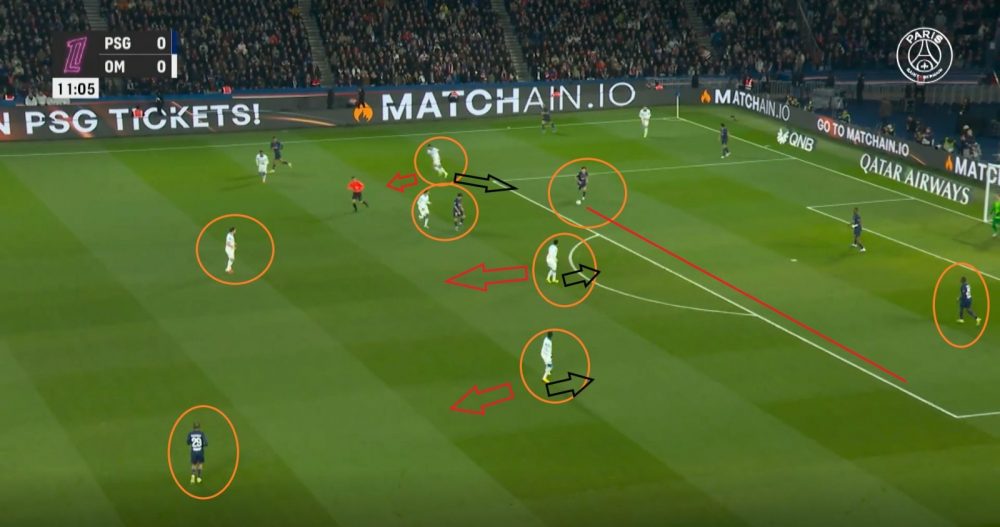
For the moment, there is no danger, and OM must primarily choose how to defend. This will be a problem throughout this play and the match. The Marseille players are pressing high, but their behavior isn’t consistent with a press. Except for the player marking Vitinha, they all drop back.
It was possible to “chase” João Neves to put him under pressure, disrupt passes to the left, and be ready to try and trap Paris. But OM opts for a “half-hearted” approach. They drop back a little, but, as we see later, without reforming into a solid block (although we can note that two Marseille players are marking each other in midfield with these movements). It’s more of a new pressing game that’s launched. Neves passes easily to the left, and a few passes follow without difficulty.
The situation when Pacho passes back to Neves.
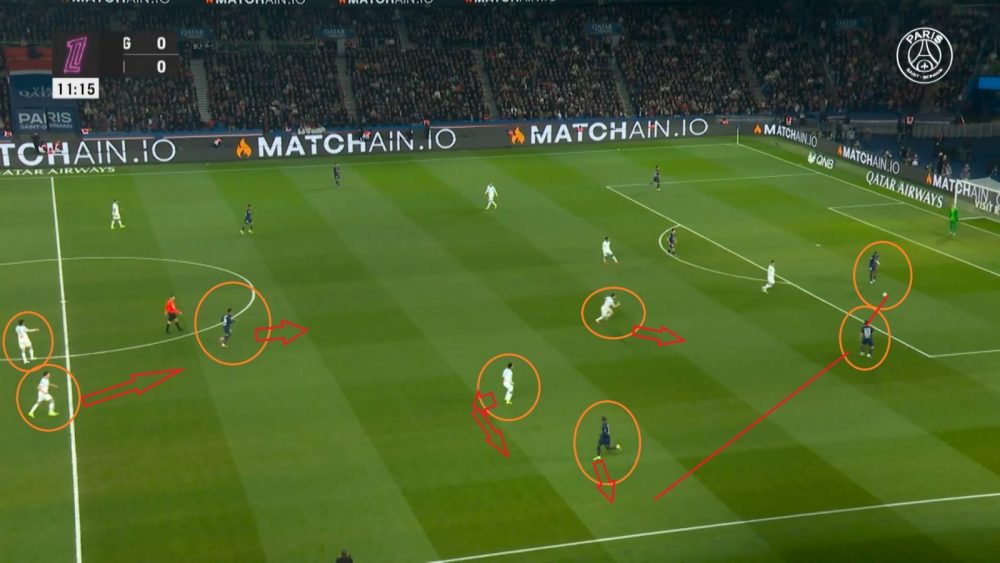
Legend: – Orange circle: the players being discussed – Everything in black: possible options – Everything in red: what happened after the image. Line = pass – Arrow = movement – White circle = ball
Marseille are still pressing high, but Willian Pacho has time to adjust his pass to Neves, who hasn’t been properly marked. It’s only now that the pressing run begins, far too late.
At the same time, Nuno Mendes moves to the left and pushes forward slightly, without being fully marked. His nearest opponent initially takes a few steps back, similar to the following situation.
We also see a new problem posed by PSG, a classic one in coach Luis Enrique’s fluid team: Désiré Doué, the right winger, cuts inside to add another option. Marseille is a bit lost; we can see Leonardo Balerdi wondering who should cover him. Benjamin Pavard, also a center-back, volunteers. A bit late.
The situation when Nuno Mendes passes to Barcola.
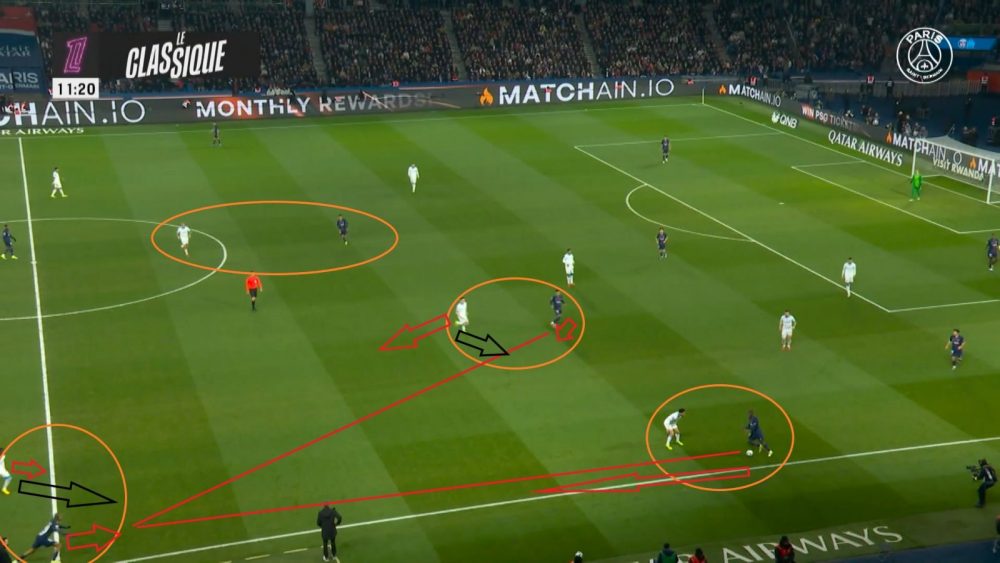
Nuno Mendes was able to control the ball, look around, analyze the situation, and still has room to act since the Marseille player stopped. Perhaps out of fear of being dribbled past, but this still raises the issue of letting the full-back choose his pass. While Timothy Weah, possibly also out of caution to avoid being caught out of position, allows Barcola to drop deep and only fully engages in defending once the pass has been made.
In midfield, even though it wasn’t shown, the pass to Doué was feasible since Pavard was far from marking him. And at the moment of the pass to Barcola, again most likely out of caution (we grant him that he is a central defender who defends in the opposition’s half close to his attackers), he drops back. But he could have marked Doué, even coming over there and thus contributing to the pressing. This freedom given to the Parisian allows Barcola to play a one-touch pass to Doué, who controls it without too much pressure.
The situation when Doué plays Nuno Mendes through.
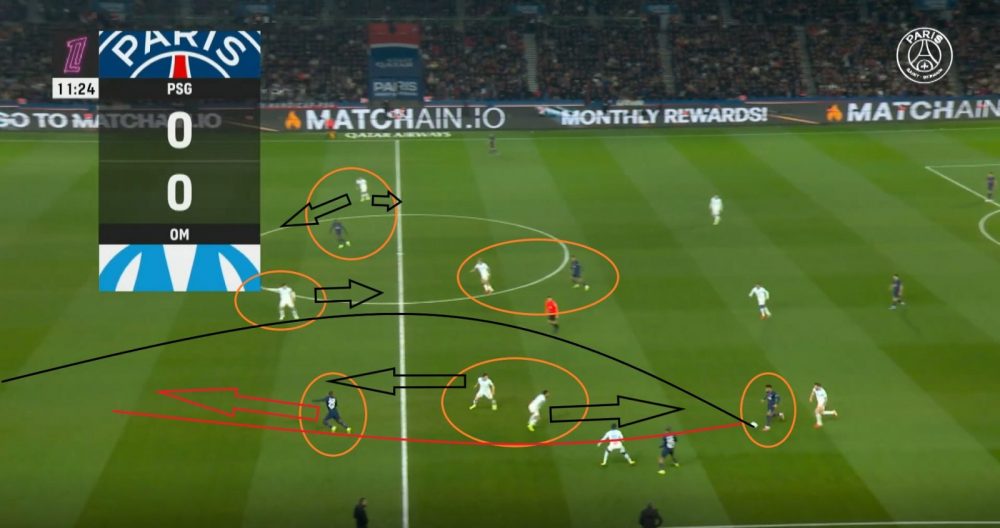
There’s a lot of information on the image, which is a shame. But it’s good because there were plenty of things that could have been done differently, even though PSG played the situation well. We can highlight the quality of Doué’s outside-of-the-foot pass. It’s perfectly weighted and easy for Mendes to play. It was possible to play it in the air, but it’s more complicated for the receiver.
But OM could also make the pass more difficult. We see two players between Doué and Nuno Mendes, but neither is really defending. They would either have to drop back completely or put Doué under maximum pressure. It’s unthinkable to give him so much space, especially against such players. Pavard, for example, shouldn’t stop. Especially since Medina moved into midfield to defend against Mayulu. For a coherent press, the Marseille player facing Doué would need to mark him much more closely.
The last line of defense, consisting of only two players, could also already be sprinting towards their own goal, given how clear the situation seems. It’s also possible to try and play the offside trap, considering the difficulty in marking Nuno Mendes and Dembélé. But this in-between approach is fatal.
This observation perfectly sums up the entire play: Marseille are almost always caught between intense pressing and a deeper defensive block, except that neither is fully committed. PSG deserves credit for their movement and technical quality, but OM have simplified things. This is evident in the other goals, with individual errors or this lack of cohesion.