

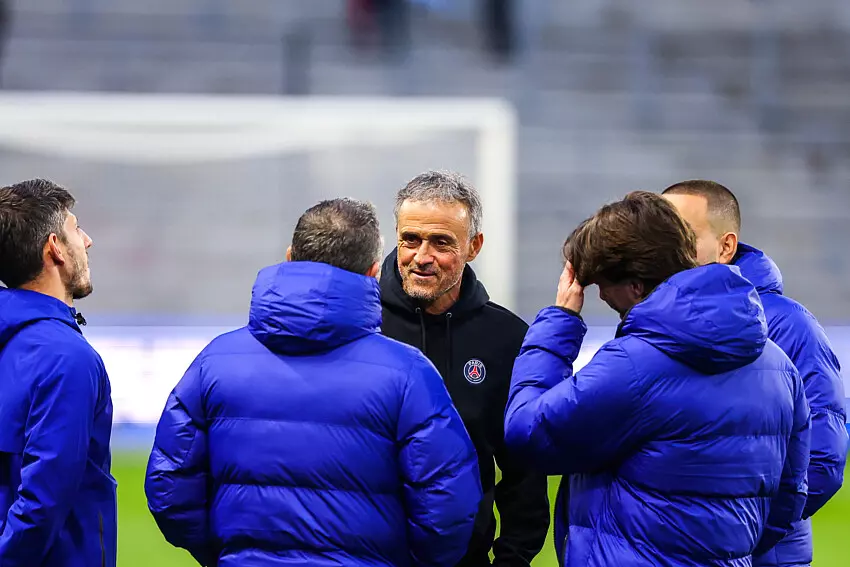
On Saturday, during the 10th matchday of the 2026-2027 Ligue 1 season, Paris Saint-Germain (1st) will face Troyes (16th) at the Parc des Princes (kick-off at 9:05 PM, CET). On the eve of this encounter, Paris coach Luis Enrique answered several questions during a press conference.
Luis Enrique: “This is the most difficult match of the week.”
Do matches against teams like Le Havre or Troyes provide as much information about your squad as games against the likes of City or Barcelona?
As I’ve said many times, many different matches provide a great deal of information. This is a league match, and it’s very important. We need to show that we are ready. Troyes may be struggling, but it won’t be easy. People might think otherwise, but the reality is the opposite—this is the most difficult match of the week. We need to demonstrate that we are a cohesive team and that we need these 3 points. It’s a good test for us.
Pressing is your trademark; which coach—or perhaps which team—inspired you?
No specific team. I draw inspiration from my own players and from what we aim to achieve. As a coach, you convey your ideas, and then it’s up to the players to interpret them. We can work on certain aspects, but there are many moments where the players must make decisions for themselves—and that is something I really value. I want to share my ideas and the necessary approach; I am driven by what I expect from my players.
Luis Enrique: “We need to put that behind us and focus on the challenges posed by Troyes.”
How did you debrief the match with your players? Were there any negatives? The most important thing is the result. And regardless of the result, there are always things to improve. The gap we saw today is not the true one; sometimes there are matches that defy explanation. The actual gap is smaller. Football is unpredictable. It’s great to win a match like this, but one must realize that it’s an exceptional case. We need to put it behind us and focus on the issues that arose against Troyes.
Luis Enrique: “That is not the true gap.”
What does the 1–9 result between Lens and Como say about the gap in the league?
You’re mistaken; that doesn’t represent the gap. Lens is a very good team. I enjoyed watching Como play—they are a wonderful, fantastic side. But that scoreline isn’t a reflection of the actual gap. Como performed exceptionally well, while Lens struggled. That doesn’t make them a bad team. This is competition; results happen. Sometimes things like that occur—much like the match between PSG and Villarreal. It’s not the true gap.
Do you need to rein in your players when they receive praise or hear comments from opponents? How do you keep them grounded?
It’s simple—at PSG, there are generally two scenarios: either things are “catastrophic”—which we’ve experienced—or opponents are afraid of us. That’s just the noise; you have to live with it. We stay focused; we carried out our training session just as usual. We know there will be high expectations against Troyes—people expect us to score—but that’s not how it works. We have to focus on the things that actually matter for the match.
Luis Enrique: “He is an incredible midfielder—one of the best in the world.”
In today’s football, is a player like Ruiz too often overlooked?
That’s normal. But it’s clear that to play the way we do, you need players capable of linking up with their teammates. That’s exactly what Fabián does. He is always compensating for the movement of other players; sometimes, he even tells his teammates where to play the ball.
He is an incredible midfielder—one of the best in the world. The number of trophies he has won is remarkable. We’re very happy; when we first arrived, the atmosphere surrounding him was different, but he has changed that. We are very pleased to have a player like him.
You often talk about balancing the good times and the bad. How do you go about that?
It’s simple. If you’re still thinking about the Villarreal match and let that become a distraction tomorrow, things will get difficult. There’s always a lot of outside noise, but our players are very mature. I appreciate the fact that they always maintain the same mentality. We might play well, or perhaps not as well, but the mindset remains constant. With every challenge, we demonstrate our level. That’s why we’re still in a position to achieve things—we stay focused on what matters: the present.
Luis Enrique: “It would be the first time we’ve won every match between two international breaks.”
What has changed since the last international break?
It’s the same PSG. Every season has its ups and downs. We want to showcase the level of our players—as we always do—by using squad rotation and providing opportunities. We are in a very strong position across all competitions, which serves as a great motivation. If we win tomorrow, it will mark the first time we’ve won every single match between two international breaks. That’s a real motivator.
Is your team ahead of schedule?
I’ve never planned things out in terms of winning exactly 8, 9, or 10 matches. You have to adapt to each game and each opponent. You never know how many injuries you might face. We try to stay focused on the present—on the match at hand. It makes the journey much more enjoyable.
Luis Enrique: “We always want to improve the weaker foot.”
How important is it to have a left-footed player as a left-sided central defender? What makes left-footed players so special?
I’m not sure! (smiles). Take Rafael Nadal—he’s left-handed, but he’s also capable with his right. He chose to use his left hand, which makes him harder to counter. In football, people are also less accustomed to dealing with shots from left-footed players. It’s simply easier to play on the left side if you’re left-footed. That said, I’ve fielded pairings with two right-footers in central defense, and others with two left-footers.
Ideally, you want a mix, as it makes passing easier. But it’s not a deal-breaker. We always strive to improve the weaker foot—even at the highest level. It’s something that should be developed in young players, yet you still see top-tier professionals who haven’t fully mastered their weaker foot.
Luis Enrique: “The primary criterion is the person.”
Is it important to show respect for the opponent by continuing to play hard until the very end?
Absolutely. The best way to show respect for an opponent is to play at your maximum—especially when you’re already leading 3–0 or 4–0. That’s the time to keep playing. Respect doesn’t mean lowering your intensity. It’s like the All Blacks in rugby—a concept I admired back when I was a young coach. That’s the mentality I want to see in my team: maintaining the same level of play. If we are the superior side, that is how we should play.
As a player, you were known for your grinta (fighting spirit), self-sacrifice, and total commitment. Is that what you try to instill in your team today?
I’ve never looked for players who are just like I was. I look for players whose specific qualities fit our needs—players willing to improve in areas that might otherwise be overlooked. By doing that, you can discover a different kind of player. It’s all about the little things. The primary criterion is the person—and that includes their environment, like their family. Once you have the technical and physical foundation, you can start building something unique.
Luis Enrique: “That is the key for me.”
Previous coaches struggled to move past a reliance on a single star player; how did you manage to break away from that?
Through rotation and the decisions I’ve made—decisions for which I’ve been criticized, even though no one really understood the reasoning behind them. Players need to understand what is required to wear the PSG jersey. You have to fight for the team.
My wife once asked me why the team always played the same way, regardless of which players were on the pitch. That’s when I realized we were on the right track. For me, that is the key.


