

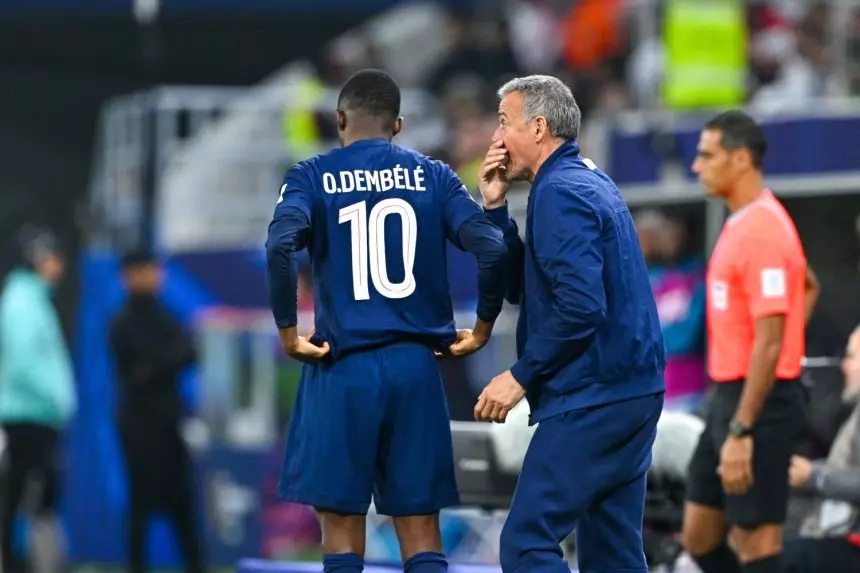
Hristo Stoichkov, the 1994 Ballon d’Or winner, praised the transformation of Ousmane Dembélé, the 29-year-old Paris Saint-Germain striker, in an interview with L’Équipe. The former FC Barcelona player sees Luis Enrique’s influence as one of the major keys to the French international’s new level of performance.
“This is the real Dembélé”
“Today, Dembélé is at the very top. But why? Because Luis Enrique is the coach. There was no one better to motivate him. How many coaches has he had before, and how did it go? At Barcelona (2017-2023), his behavior was a disaster. Today, he’s not the same. He runs, he presses, he distributes the ball, he scores, he plays for the team. This is the real Dembélé.” “
Hristo Stoichkov’s comments are interesting because they don’t reduce Dembélé to just a good season. Above all, they reveal a shift in his status. Long judged on his inconsistency, his relationship with professionalism, and his injuries, the former Barcelona player is now described in terms of his collective contribution.
This shift is crucial. Dembélé is no longer just the player capable of the impossible, but also the one who presses, repeats efforts, is willing to play for others, and brings coherence to Paris Saint-Germain’s attacking project. This is precisely where Luis Enrique appears as a catalyst.
The Spanish coach hasn’t simply repositioned Dembélé in a more favorable environment. He has given him a clear role, a responsibility, and a constant demand for excellence. In this PSG, talent alone isn’t enough. He must serve the team. And it’s perhaps this constraint that has liberated the player.
The comparison with Barcelona is harsh, but it also sheds light on Stoichkov’s analysis.” In Paris, Dembélé no longer seems to be a victim of his image. He has turned it around. What was once perceived as inconsistency has now become a form of controlled unpredictability, integrated into a much more structured team.
“Dembélé will naturally be a strong contender.”
“The Champions League is important, but beyond that, there’s also the World Cup. Messi plays, Cristiano Ronaldo plays, Lamine Yamal plays… But if PSG wins the Champions League again, Dembélé will naturally be a strong contender.”
The debate surrounding the Ballon d’Or then takes on a new dimension. Stoichkov isn’t just talking about a spectacular player, but about a player who has become central to a team that still aims for the European summit. It’s often this combination that weighs heavily in this type of award: individual performance, yes, but above all, his impact on a memorable season.
For Dembélé, the Champions League obviously remains the main draw. If Paris Saint-Germain confirms its status at the highest level, his case will become difficult to ignore. Not because he ticks all the usual media boxes, but because he embodies a rare transformation: that of a long-debated talent who has become a collective benchmark.
The mention of Messi, Cristiano Ronaldo, or Lamine Yamal also serves as a reminder that competition never disappears in a World Cup year. But Stoichkov includes Dembélé in this conversation without exaggerating. That in itself is a significant sign. Not long ago, the idea would have seemed almost provocative. Today, it becomes defensible.
A rehabilitation that speaks volumes about PSG
This issue goes beyond the Dembélé case. It also says something about Luis Enrique’s Paris Saint-Germain. The club is no longer simply looking to amass strong individual talents. It is trying to transform them into players compatible with a shared playing style, discipline, and high standards.
In this context, Dembélé’s progress has symbolic significance. It lends credence to Luis Enrique’s management, but also to the collective shift undertaken by Paris. If the Ballon d’Or truly enters the debate, it won’t be solely due to goals or assists. It will be because Dembélé will have become one of the most credible faces of this new Parisian identity.


