

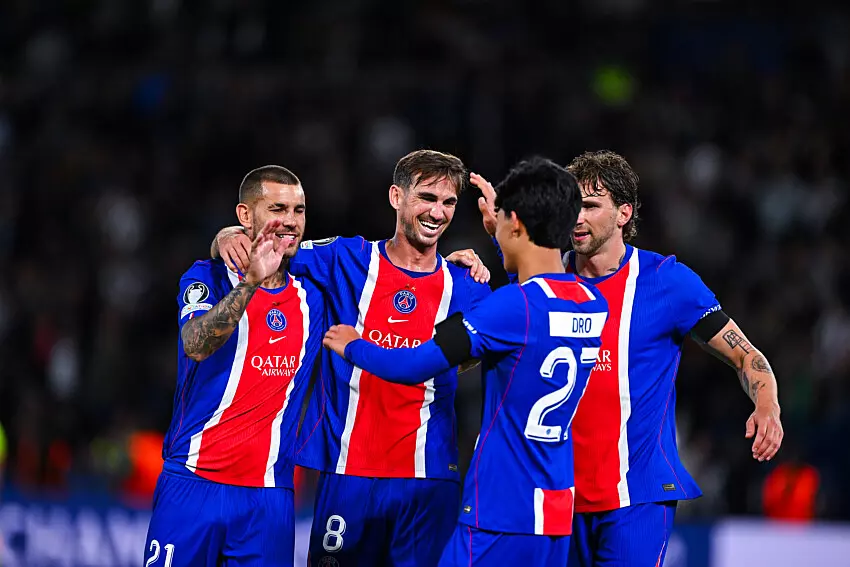
Fabián Ruiz, the 30-year-old Paris Saint-Germain and Spain midfielder, spoke to Radioestadio Noche while with the Roja squad for the current international break. He discussed the World Cup, his career path, life at PSG, and the 2026 Ballon d’Or.
Ruiz: “I’d rather it come from the people than from me.”
Do you already have space in the cupboard for the World Cup replica?
Yes, we have to make room for it; you know, I think it’s really important. And I’m really happy to be back together after that World Cup—very happy we were able to do it. It must have been like reuniting after a summer camp—a very intense relationship, 50 days. Of course, we came back as champions, all of Spain is talking about us, and then suddenly, we’re back together. Yes, we missed each other. Actually, after spending so many days together—and it’s already been two months since the final—we were really looking forward to meeting up again and reliving those moments. I think it’s wonderful, and we’re eager to play.
Someone said to me, “You need to campaign for Fabián.” And I replied, “Well, I’ll hand the microphone over to him.”
Right, let’s let the people do it. I’d rather it come from the people than from me.
Ruiz: “Because, in the end, everyone knows it.”
The Mbappé-style campaign; it’s like a video message straight to the camera: “Hi, I’m Fabián Ruiz, I’ve won everything, I’m a starter [laughs], I play all the time, and I’ll see you in Paris!”
Well, I don’t think that needs saying, does it? Because, in the end, everyone knows it. And then there are the titles I won last season… Obviously, I’m the player with the most trophies, but hey, I’ll leave the campaigning to others. We all like being recognized, don’t we? For the work we do—it’s a nice feeling, isn’t it? I hope that one day, I’ll be able to lift an individual trophy myself.
Ruiz: “I owe everything to my mother for all the effort and sacrifices she made.”
What remains of that boy from Los Palacios who arrived at Betis?
Well, the truth is, I’m happy. And as I’ve always said, I never imagined I’d achieve so much doing what I loved most: playing football. That boy was just playing for fun. Ultimately, I owe everything to my mother for the effort and sacrifices she made back then, without knowing what the future held for me. That’s what I always say, isn’t it?
I’m happy and proud to have achieved so much, but above all, I value the affection people show me and the fact that I can be an example to them. For the kids who see me on TV and for everyone I can pass values on to—that’s what matters most to me. The truth is, as you say, you never imagine becoming one of the best players in the world; yet, I’ve been in the top 30 for two consecutive years, and I hope to climb a little higher this year.
Ruiz: “I was surprised myself.”
Was the €30 million move to Napoli a major milestone?
I was surprised myself. That they paid so much back then for such a young player—and Ancelotti, right? He turned out to be an incredible coach, and it was amazing that he put his trust in me. For me, at that moment, it was something very special. And then, I think it was in January that I extended my contract with Betis.
My release clause was €15 million, and we agreed on €30 million—as if to say, or at least I was saying: “OK, don’t panic, no one’s leaving, no one’s arriving, I’m staying at Betis for life, right?” And five months later, Ancelotti arrived, and I was really happy that a coach like Carlo believed in me at such a young age. My career took off—Napoli, then Paris Saint-Germain, the national team call-up, the trophies, the glory.
Ruiz: “You have to protect yourself, isolate yourself a bit.”
And at what point do you lose touch with reality? I mean, at what point do you lose sight of what matters—the context, the kid who used to go to training, the one his mother would wake up for practice? Do you ever lose that?
Of course, no one should be harassing you, but hey, photos are important. “Hey, Fabián, this…” One way or another, you have to protect yourself, isolate yourself a bit. In the end, the upbringing I received—especially from my mother and family from a very young age—that’s what stays with me, isn’t it? The values they passed on to me. I think that’s what matters most to me. As I always say, before being a player, I’m a person. Ultimately, I view this as a job like any other. It’s just that our work gets more recognition. But I’m happy when people stop us because… well, for me, it’s truly incredible. And the affection they show us—that’s what counts, isn’t it?
Ruiz: “So that, in the future, Fabián is remembered for who he was.”
The example we set—on and off the pitch—so that children… well, want to be like us. For me, that’s the greatest triumph a player can experience, and it’s what I always strive for: self-improvement. I’m always trying to get better, to be a better person—and a better player too, because it is my job, after all—but above all, a better person, so that in the future, Fabián is remembered for who he was.
Ruiz: “I think that made things easier for me.”
Was the arrival of Luis Enrique at PSG—the coach who hadn’t picked you for the World Cup—a cause for concern?
Look, everyone kept saying that, right? When the manager arrived, people said that since he hadn’t taken me to the World Cup, I wouldn’t play. Well, I always replied that they were looking at it the wrong way, whereas I saw it positively. He was a Spanish manager who knew what he liked and already knew me well, and I think that made it easier for me to get off to a good start.
During his time there—and I think I actually mentioned this in a press conference—obviously, the decisions coaches have to make are very tough when you have so many good players but can only pick 25 or 26, meaning you have to leave some out. It’s hard; naturally, you might second-guess yourself later, but at the time, I think he made the right call. And for him, it’s just a story from the past now. Now I tell him: “Look, I played in a World Cup and I won it!” [laughs]
You’re Fabián the Invincible! I read once in Paris that you never lose with the national team.
I’ve played 50 games—well, let’s not speak too loudly about it [laughs], and here’s to many more! And I hope you get to play plenty more matches, too; that would be great for everyone.
Ruiz: “We’re very happy.”
What’s life like in Paris?
It’s good, really; we’re very happy. Yes. Does your mother come and go? My mother, yes. When she comes—whenever she can, and we let her come—she’s absolutely delighted to be in Paris. She has free time now, so we see her every other day. She’s here with us and she’s happy.
We can enjoy the city, go see the Eiffel Tower, go out for dinner. Yes, it’s true—Paris is nothing like Naples. In Naples, I couldn’t go out, whereas here, it’s the exact opposite, isn’t it? We have more freedom to walk around the streets, a bit more privacy, and I really appreciate being able to go for walks with my family when they come to visit.


