

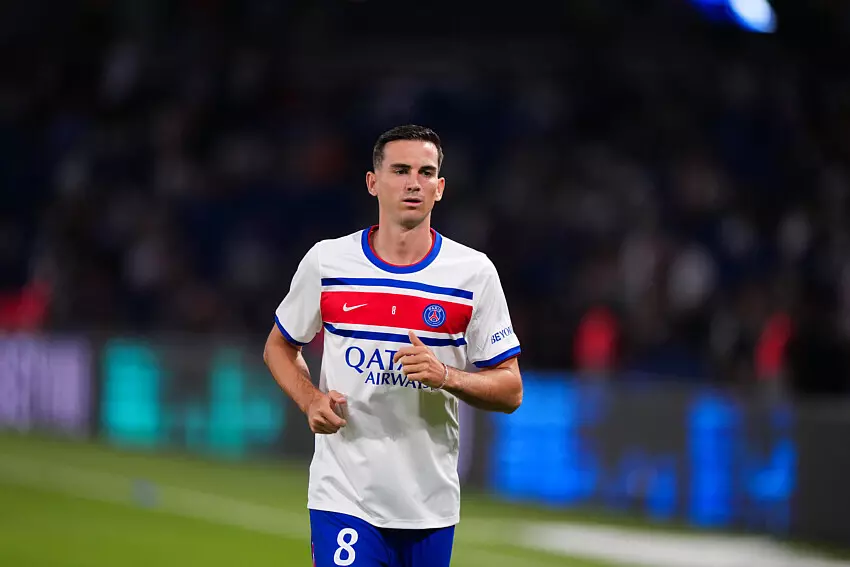
Fabian Ruiz, the 30-year-old Paris Saint-Germain midfielder, spoke at length with the Spanish media outlet AS. It was an opportunity to discuss his future goals, the 2026 Ballon d’Or, expectations, forward Ousmane Dembélé (29), coach Luis Enrique, and his own personality.
Ruiz: “From what I’ve achieved, from feeling important at PSG and with the national team.”
What is left for Fabián to win?
Last year—well, last season—I couldn’t ask for more, could I? In terms of team achievements, I couldn’t ask for more; I’ve won everything. They’ve been incredibly good years, especially the recent ones. At the club level, we managed to win the Champions League—two in a row—which is the best thing a club can win. And I’ve also been lucky enough to win the Euros and the World Cup back-to-back. In terms of team honors, that’s the pinnacle.
And on an individual level, there’s something shining on the horizon: the Ballon d’Or. Everyone has their arguments, and you certainly have yours, don’t you? Enough to realistically think about it.
Well, why not? The truth is, in terms of team success, I’m the player who has won the most titles. I think it’s been seven in recent years. I’m very happy with this season and what I’ve achieved—feeling like a key player for PSG and the national team. That’s important for any player, and especially for me. The truth is, the Ballon d’Or is a beautiful award—something every player wants to win. I’m happy to be talked about and recognized for the work I’ve done. So, I’ll try to finish as high as possible—and why not dream about winning it?
Ruiz: “It’s nice to be recognized.”
“Fabián, Ballon d’Or”—that has a nice ring to it, doesn’t it?
(Smiles) Honestly, whenever people say that, it always puts a smile on my face.
It certainly did just now. (Smiles again) Yes, yes—obviously, I’m not going to lie to you: all players like having their work recognized, just like in other professions. If you do your job well and people on the outside acknowledge that you’re doing a good job—that you’ve had a good season—it’s nice to be recognized.
Ruiz: “We win matches by scoring goals, certainly, but it is the result of teamwork.”
The Ballon d’Or has always been a trophy that favors attacking players, but do you think that perception shifted a bit with Rodri? Do you think the scope has broadened somewhat?
Everyone knows it’s natural for forwards to post better stats than midfielders, defenders, or goalkeepers. It’s harder for a defender to match a forward’s numbers, but I think in recent years, other positions have been given a lot more value and importance—which I believe is crucial. A team is made up of the eleven players on the pitch plus the bench, and I think a defender or goalkeeper is just as important as a forward. We’ve seen players like Modrić and Rodri win it recently. That’s important for the football world and, above all, for young players—so they look at positions other than just the goal-scoring ones, though those are important too. Matches are won by scoring goals, but it’s a collective effort by the whole group.
Ruiz: “Winning once is great, but doing it again is a whole different ball game.”
And you have a bit of a lucky charm going for you.
(Smiles) Sometimes I don’t want to say it out loud so I don’t break the streak, but yes—50 games with the national team without a loss… Let’s hope the run continues for a long time yet. It would be good for me, but above all, for the national team.
Success goes hand in hand with high standards, doesn’t it? And that brings even greater demands.
Yes, the coach has already told us that no one remembers the past anymore; it goes down in history and it’s wonderful, but now we have to focus on the present. The hardest thing in football is winning again. Winning once is great, but doing it a second time is the real challenge. That’s the standard we have to set for ourselves now: wanting to do it again, continuing to win. It’s very difficult, but this team has the tools to pull it off, and we’re incredibly eager to go after this title, which we also value highly. Hopefully, we’ll make it to the Final Four.
Ruiz: “I don’t see them as rivals, but as teammates who also deserve to be here.”
One more question about the Ballon d’Or: who do you see as your main rivals?
Well, there are many players who have had a tremendous season. The 30 nominees are there for a reason, and there are some very good players who have performed well. But if it goes to someone from my own dressing room—someone I play alongside—then all the better. I don’t view them as rivals, but rather as teammates who also deserve to be there and deserve the chance to win it.
Did Dembélé talk to you about it last year?
Yes, actually. (Smiles) Ousmane is a very warm and affectionate person, and he always says that collective effort leads to individual awards—that he couldn’t have achieved it without the team’s help. He often thanked us for helping him improve. The coach (Luis Enrique) helped him a lot, too. He deserved it.
Ruiz: “We have a great atmosphere in the dressing room, and we’re always laughing.”
And now that you’re back from the break, has there been much teasing involving Vitinha, Neves, or even Ousmane? After all, you won the World Cup, but you were the one who knocked them out.
Yes (half-smile), we have a great dressing room and we’re always joking around. When we got back, well, there was the usual banter about us knocking them out, leaving them on the sidelines… because right after the match wasn’t the right moment. But they sent congratulatory messages; they’re happy for me, happy that I won it. And once we were back in the dressing room, a few jokes were made.
I’d like to ask about the coaches who have made an impact on you in recent years. Let’s start with Luis Enrique. Is there anything he asked of you that helped you take that next step, or does it stem more from your own footballing maturity?
I think the two go hand in hand. We already knew each other from our time with the national team, so I more or less knew what he asked for and what he liked. But he pushed me defensively—to be a bit more aggressive, to realize I had the ability to defend and win back more balls. Between that improvement and the foundation I already had, we really hit the ground running. And everyone knows what a great coach he is, and how approachable he is with us. For us players, that’s very important.
Ruiz: “I have the recognition of those who matter to me.”
There was a comment made by the other Luis—De la Fuente—in 2024, before the Euros: “If his name wasn’t Fabián, he’d get more recognition.” Does Fabián get the recognition he deserves now?
(Nods) I’ve always said I’m happy with the affection I see from the fans. I don’t dwell on what people might say; I focus on the warmth I get from them. I have the recognition that matters to me—from the people close to me: my coaches, my teammates… That’s what’s most important to me, since they’re the ones I’m with day in and day out. I can’t control what people think, but being recognized for your work is always nice.
Ruiz: “It’s a bit difficult, but you get used to it. Maturity plays a part.”
I heard a few days ago that you were socializing with a group of Spaniards in Paris and that, at first, you were a bit hesitant about them knowing you were the PSG player. Has that barrier—the idea that it’s no big deal if you’re Fabián, the footballer—been broken down now?
Yes, it’s true that when I join a group of people who don’t know me, I always try to avoid being recognized—to fly under the radar, basically. I’ve always been a somewhat shy person; I don’t necessarily want people to know what I do for a living because of the implications that come with it. My family and I have always been that way—especially my wife and sister, who are young; when they go out, they try not to mention that they’re related to me, just so people don’t look at them differently. It’s something we have to treat as normal. It takes a bit of effort, but we’re handling it better and better. That comes with maturity.
Ruiz: “We are people, long before we are players. For me, that is the most important thing.”
That same Fabián carries over onto the pitch; I’m someone who doesn’t cause trouble or get into messes while playing…
Yes, I think that, ultimately, who I am doesn’t change—whether on or off the pitch. I try to demonstrate the values my family instilled in me, both on and off the field. We serve as examples for many people—for the children who watch us every day. In the end, I believe the kids take what we do on the pitch and carry it into their own lives. I try to set the best example I can. I try to help others, whether they’re opponents or teammates; after all, we are human beings first and players second. To me, that’s what matters most.
Ruiz: “It’s incredible, I never could have imagined it…”
Do you ever stop to think about the Fabián who was just a kid, going to the training complex with his mother and falling asleep in the car outside? After achieving everything you have, do you have moments where you look back? Where you think about what you’d say to that child?
Wow, that’s a good question. (Pauses) To be honest, sometimes I don’t really think about it. I don’t always fully take in everything I’ve managed to achieve—after so much sacrifice and effort, especially since I was little. (Visibly moved) But I think about it not for my own sake, but for my mother’s. She was the one who made the sacrifices; she put in so much effort just so a little kid could do what he loved—playing football—without worrying about the future or where I might end up. All my mother wanted was to see me happy, to see me play without the pressure of becoming a professional. And well, looking back now and seeing everything I’ve achieved and won… It’s incredible; I never could have imagined it…
And now you make her happy.
Yes, she’s the happiest of all. I always say that without her effort and sacrifice, none of this would have been possible; I’ll always be grateful to her. She’s the one who sacrificed more than I did. I was just playing football, while she was the one putting in all that hard work. Everything I have and everything I’ve won, I owe to her.


