

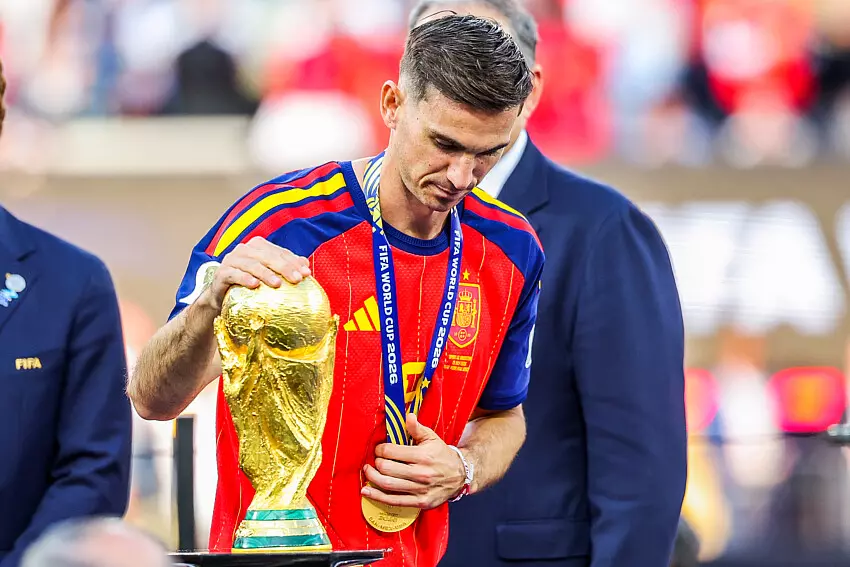
Fabian Ruiz (30) isn’t campaigning for anything; regarding the Ballon d’Or, he prefers to “leave that to others,” as he explained to Onda Cero this week. Yet, the Paris Saint-Germain midfielder has been named among the 30 nominees following two consecutive Champions League campaigns and a World Cup. Perhaps he embodies a broader issue: our football culture loves stars but is far less adept at telling the stories of the players who make those stars shine.
Football loves moments that fit into a highlight reel.
- Recognized, but rarely the focal point.
Fabian Ruiz isn’t really underrated anymore. It would actually be a bit of a stretch to keep describing him that way. He is a starter for PSG and Spain, a world champion, a two-time European champion with Paris, and a Ballon d’Or nominee. There are certainly more obscure players out there. The issue lies elsewhere: Fabian is recognized, yes, but he rarely takes center stage in the conversation. You often have to start by listing his achievements just to convince people he belongs there.
- The spectacular moment almost always wins out.
That may be because modern football loves things that are easily packaged. A goal? Perfect. A dribble? Even better. A burst of speed, a Cruyff turn, or a strike from 25 meters out? That’s the kind of material that fuels social media, TV shows, and debates for days. But a movement that opens up space, a pass that sets up the next play, a press that forces the opponent to play the ball into a bad area, or the player who balances the entire team while others take risks—that’s a harder sell. Try making an eight-minute TikTok montage about defensive cover; you’ll likely lose a few followers along the way.
And that is precisely what makes Fabian so interesting. Luis Enrique (56) notably pushed him to become more aggressive defensively, as the player himself recounted to AS. The Fabián we see now is no longer just the elegant, tall left-footer who arrived from Napoli. He runs, closes down opponents, wins back possession, surges forward, offers an outlet, and—above all—accepts that not every touch of the ball needs to be a highlight-reel moment. It might seem almost mundane. It isn’t.
Even PSG itself isn’t immune to the game.
- When it comes to choosing who gets top billing.
The funny thing is, PSG obviously knows what it has. Without Fabian, its midfield wouldn’t have the same balance. His coaches know it, and so do his teammates. Yet, when kicking off the mini-media campaign for the Ballon d’Or, the club initially chose to back three candidates before refocusing its messaging on Ousmane Dembélé (29) and Khvicha Kvaratskhelia (25).
It’s understandable. An individual campaign relies on image, simple narratives, and players who can instantly embody a season. Dembélé and Kvaratskhelia attack, dribble, score, and naturally produce those memorable moments that stick in the mind. If the goal is to win over voters, splitting the vote probably isn’t the smartest strategy.
- The irony is certainly striking, though.
Even the club that knows Fabian Ruiz’s importance better than anyone else ultimately bows to the conventions of the football narrative. When it’s time to put someone on the poster, you start with the players who get the crowd on its feet. There’s nothing scandalous about that. But it’s hard to find a better illustration of the problem: between the player who makes a team better and the one who produces the weekend’s highlight-reel moment, we know full well which one will win the battle for attention.
Being essential isn’t always enough to be central.
Fortunately, Fabian is no longer invisible.
We must also acknowledge that things are changing. Fabian himself feels he receives the recognition that matters most to him—that of his coaches and teammates. And his inclusion among the Ballon d’Or nominees clearly shows he is no longer invisible. The triumphs of Luka Modric and Rodri have also served as reminders that an individual trophy isn’t strictly reserved for the player who finishes with 47 goals and a signature celebration.
Yet, he has to win almost everything just to get noticed.
A strange impression remains: for a player like Fabian to truly enter these conversations, he almost needs to amass a track record that would be considered obscene for others. Two consecutive Champions League titles, a European Championship, a World Cup, a pivotal role in two of the best teams of the moment… and yet, his candidacy still feels like the one slipped in at the end of a debate with a casual, “Oh, right—he’s worth mentioning, too.”
Fabian Ruiz doesn’t need a manufactured injustice to make him interesting. His story speaks to something deeper. In a team sport increasingly obsessed with individual trajectories, we still focus more on the player who finishes the move than on the one who makes it possible. The paradox is almost perfect: Fabian spends his time making others’ football more beautiful, and that is precisely what makes him a harder sell. Perhaps it isn’t him we need to learn to watch differently; perhaps it is the game itself that sometimes requires a different perspective.


