

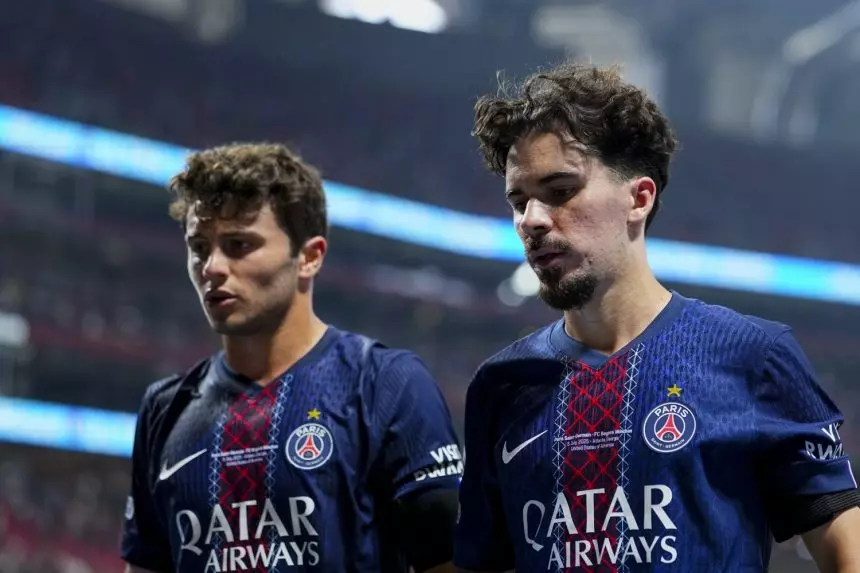
At Paris Saint-Germain, Vitinha and João Neves seem made to play together. Yet, with the Portuguese national team, Jorge Jesus has treated them almost as competing options. As L’Équipe points out this Monday, one started against Wales, while the other started in Norway. This difference in approach perhaps speaks volumes—and very flatteringly—about the work Luis Enrique has done.
In Paris, the puzzle has no fixed pieces
- Two players who seem naturally complementary
After seeing them together so often, one might almost believe Vitinha (26) and João Neves (22) came in the same box. The former organizes, directs play, and sets the tempo. The latter runs everywhere, presses, attacks open spaces, and brings an energy that sometimes makes it seem as though he can be in two places at once. Handy.
At PSG, their partnership now seems so obvious that we hardly even question whether it works. Instead, the focus is on how opponents might manage to disrupt it. Yet, the start of Jorge Jesus’s (72) tenure with Portugal serves as a reminder of a simple fact: this complementarity is not a given in every context.
Against Wales, Vitinha started, while João Neves only came on in the final seconds. Three days later in Norway, the roles were reversed: Neves started, and Vitinha replaced him in the 55th minute. Two matches, two choices, and—crucially—not a single start together.
- Vitinha the “number 6” is already a different player.
The most interesting part lies in the explanation. Jorge Jesus simply does not view Vitinha the same way Luis Enrique (56) does. The Portuguese manager believes his midfielder possesses too much dynamism to be anchored in the defensive role he regularly plays for Paris. In his system, he prefers to field a more positionally disciplined player behind him and give Vitinha the freedom to operate further up the pitch.
And this is where the topic becomes far more interesting than a debate over whether Jorge Jesus or Luis Enrique has figured out the “instruction manual.” There is likely more than one right way.
Luis Enrique isn’t just looking for good players.
- Above all, he seeks to make them compatible.
PSG functions precisely because positions there don’t quite capture what the players actually do. Vitinha can start in front of the defense without spending the whole night camped between the center-backs. João Neves can line up as a box-to-box midfielder and suddenly appear in the penalty area seconds later. Positions serve as a starting point, rarely as a cage.
This is perhaps one of Luis Enrique’s greatest achievements since his arrival: he didn’t settle for simply identifying each player’s qualities. He orchestrated the movements of some to allow others to express theirs.
Put another way, Vitinha and João Neves might not be naturally complementary in every system. They became so within PSG’s setup.
That distinction is important. It also explains why certain partnerships at PSG now seem so natural. When everything works, we tend to forget the mechanisms that make it all work in the first place. That is something of a problem for good teams: by making things look simple, they create the impression that it was simple all along.
- For that matter, Jorge Jesus is hardly a heretic.
It would be unfair, then, to paint Jorge Jesus as a coach who decided—on a strange whim—to split up two players who have won the European club title twice. A national team trains less frequently and possesses a different squad, a different balance, and a different project. The Portuguese manager wants a clearly defined holding midfielder. From that starting point, it makes sense for Vitinha and João Neves to find themselves competing for other roles.
And this apparent contradiction ultimately makes the case even more interesting. Because if two players can seem almost inseparable at PSG yet far less so for the national team, the credit doesn’t belong solely to their individual talent.
It also speaks volumes about the current PSG side: Luis Enrique hasn’t simply assembled a group of very good footballers. He has built a framework in which their qualities stop getting in each other’s way and start feeding off one another. Vitinha and João Neves are excellent individually. At Paris, they sometimes give the impression of having been designed to play together. The Portuguese national team serves as a reminder that this might not have been written on the box.


