

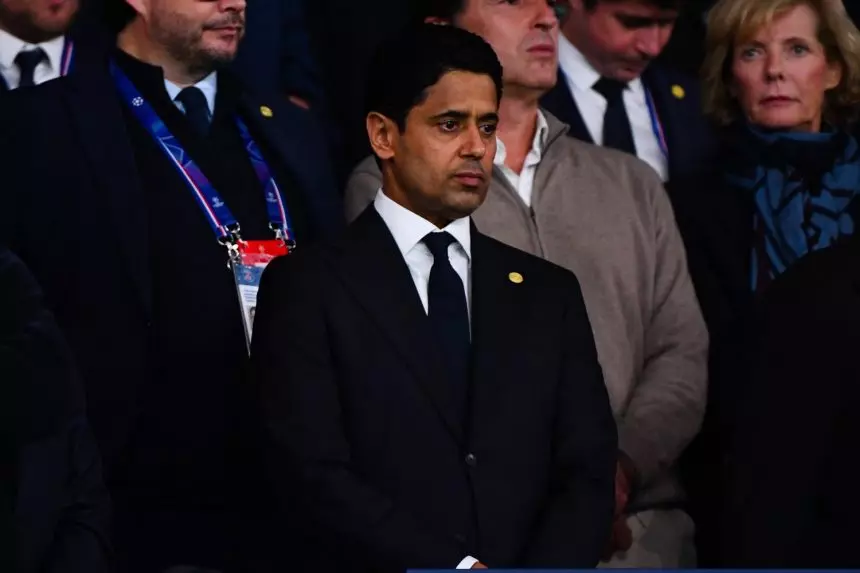
Nasser Al-Khelaïfi, president of Paris Saint-Germain, was questioned by judicial authorities on September 17 as part of an investigation into digital harassment campaigns linked to the club. According to Le Parisien, the executive—who was questioned under the status of an “assisted witness”—denied any involvement in these operations. Nevertheless, several elements continue to raise questions for the magistrates.
Al-Khelaïfi denies knowledge of a “digital army”
On September 17, accompanied by his lawyer, Renaud Semerdjian, Al-Khelaïfi was questioned by judges Vincent Lemonier and Serge Tournaire under the intermediate legal status of an “assisted witness.” During the hearing—the details of which have been reviewed—the Qatari executive disclaimed any responsibility for the execution of these digital raids.
“I was not aware of this agency before this case was opened. (…) I am opposed to this type of contract with external agencies,” Al-Khelaïfi stated to the judges, asserting that he had no role in the contracting process.
At the heart of the case is a contract signed in September 2018 between PSG and the agency Digital Big Brother (DBB), overseen by Jean-Martial Ribes, the club’s then-director of communications. Ribes was placed under formal investigation in December 2023, notably for online moral harassment.
Nasser Al-Khelaïfi’s defense hinges on a distinction: he claims he tasked his staff with defending the club’s interests through legal means, without being aware of the specific methods employed. The magistrates are now seeking to test this position against communications from that period.
In June 2018, for instance, Jean-Martial Ribes mentioned to the president the creation of a “shadow army on the Internet.” At the time, Al-Khelaïfi reproached him for planning certain actions without informing him. The judges view this as a factor that might call into question the extent of his knowledge regarding this strategy. The executive, however, maintains that he was completely unaware of these operations.
Two harassment campaigns at the heart of the investigation
The judicial inquiry has identified two primary victims of this harassment strategy. The first is the former editorial director of L’Équipe, Jérôme Cazadieu.
“We don’t stoop to such things,” he asserts, when asked whether he had approved this digital offensive. “Frankly, if I had been informed of this, the people involved would have been fired. It’s petty, vulgar—you don’t go after individuals like that; they have families and children.”
The first case concerns Jérôme Cazadieu, who was targeted following an investigation published by L’Équipe in October 2018 regarding a potential match-fixing incident between PSG and Belgrade. Communications between Jean-Martial Ribes and a consultant for the agency reveal an intent to ridicule the journalist. The campaign reportedly had serious consequences for his personal life.
The second case involves Nelson Douard, a Rennes supporter who was slapped by Neymar following the 2019 Coupe de France final. Personal information about him was obtained through Malik Nait-Liman—a former police officer recruited by PSG—and subsequently disseminated via the “Paname Squad” Twitter account, which was used for these operations.
In both instances, Al-Khelaïfi maintains that he was not informed of these practices. He condemns personal attacks and advocates for responding to criticism directed at the club exclusively through legal channels.
However, the issue extends beyond the question of his personal responsibility alone. The investigation also scrutinizes the methods employed by individuals working for or with PSG. There is a fundamental distinction between the legitimate defense of an institution and the alleged orchestration of campaigns against specific individuals. This distinction is also critical for the club’s image, regardless of the legal outcome of the case.
The recruitment of Malik Nait-Liman reveals another contradiction
During his hearing on April 1, Jean-Claude Blanc, the club’s former general manager, explained that he had been opposed to the hiring—having received several negative reports—but ultimately went ahead with it “at the president’s request.”
“I told Jean-Claude: don’t hire him,” counters Nasser Al-Khelaïfi, who claims he actually deferred to the arguments raised by his general manager. “I didn’t know he had been hired,” NAK asserts. “I don’t get involved in staff recruitment. I have thousands of other things to do.”
This discrepancy marks another significant point from the hearing. Jean-Claude Blanc and Nasser Al-Khelaïfi offer two conflicting accounts regarding the recruitment of Malik Nait-Liman, which took place in August 2018. The former general manager maintains that he acted at the president’s request, while the latter insists he had expressed his opposition.
While this disagreement makes it impossible to determine who is telling the truth, it does raise questions about the internal workings of PSG at the time—specifically regarding the division of responsibilities for certain sensitive decisions.
Finally, it is worth noting the precise legal status of the PSG president. Questioned as an “assisted witness” (témoin assisté), Nasser Al-Khelaïfi was not placed under formal investigation (mis en examen) following the hearing. His lawyer, Renaud Semerdjian, emphasizes that no charges were brought against him and affirms that he continues to cooperate with the judicial authorities.
At this stage, the questions posed by the magistrates do not constitute proof of his liability. They do, however, indicate that the investigation is still seeking to establish who was aware of these practices, who authorized them, and how far up the chain of command within the club this information reached.


