

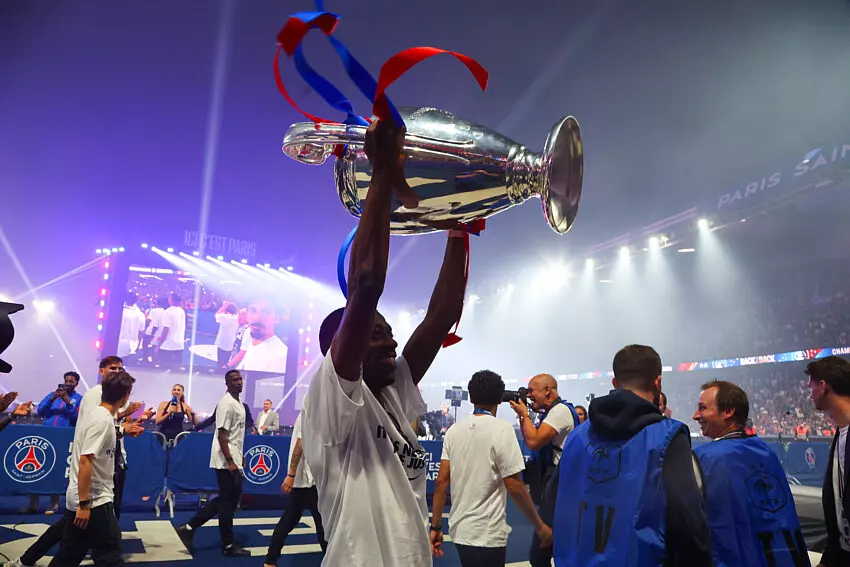
On September 17, 1986, Paris Saint-Germain played the first European Cup match in its history against Vitkovice. Forty years later, as L’Équipe points out, the contrast is almost absurd: the club that was then discovering Europe’s premier competition is now the reigning two-time European champion. Paris has moved up to a different level. And, clearly, so have we.
A different Europe, a different PSG
For starters, the format alone speaks volumes about the era. In 1986–87, the European Cup featured 31 teams and didn’t exactly go in for administrative suspense. Paris faced Vitkovice in a two-legged tie—and that was it. After a 2–2 draw at the Parc des Princes followed by a 1–0 defeat in Czechoslovakia, the curtain fell. Thanks, goodbye, and maybe see you next year.
Forty years later, you almost need an Excel spreadsheet to follow the Champions League. 36 clubs, eight different opponents, four home games, four away games, an overall league table, teams qualifying directly, others heading to the play-offs… Where the old European Cup had the brutal simplicity of the axe, the new competition fully embraces its convoluted, labyrinthine nature. You might prefer one or the other, but the contrast is quite striking.
And amidst all this, PSG has followed the same trajectory: it has changed scale.
When the exception becomes the norm
Ultimately, the craziest thing isn’t even how much Paris has grown. It’s the speed at which we’ve gotten used to it.
Luis Enrique’s PSG (he is 56) didn’t just win the Champions League. They won it for the first time in 2025, then retained the title in May 2026 against Arsenal, winning the final on penalties after a 1–1 draw. In the modern era of the competition, only Real Madrid had previously managed to successfully defend their crown. Normally, an achievement like that should be enough to keep you on cloud nine for a few years. But that’s not the case. Football doesn’t work that way—and Paris even less so. Very quickly, the next question arises: what now? A third title? A dynasty? Another semi-final? Another final? Every major success immediately raises the bar a little higher.
And let’s be clear: that isn’t entirely absurd. A growing club inevitably changes its standards. No one is going to ask the PSG of 2026 to approach a European Round of 16 tie as if they were discovering the continent for the first time. Their resources, squad, track record, and ambitions are in a completely different league now. The Paris of today must be judged by today’s standards.
Yet, there is something quite fascinating about this ability to turn the extraordinary into the new baseline. Yesterday, winning the Champions League was the ultimate dream. Today, winning it twice in a row might almost become the starting point for the next debate.
High standards don’t preclude remembering the past
This isn’t about trotting out the old “just be happy with what you’ve got” line. That would be too easy—and, frankly, a bit tiresome. History should never be used to stifle criticism. You can acknowledge where PSG came from without expecting everyone to smile blissfully after every poor performance.
But the date of September 17th serves a purpose: it restores some perspective in a landscape where the present often dominates everything. In forty years, Paris has gone from a first-round exit in the European Cup to winning back-to-back Champions League titles. In the meantime, the competition has changed, the club has changed, and our expectations have kept pace at breakneck speed.
Perhaps even a little too fast at times. Because in the rush to chase what comes next, we almost forget to look at what has just happened. That is the true vertigo of this anniversary. It is not merely a matter of measuring the distance between Vítkovice and today. It is seeing how what was once unthinkable has become the bare minimum acceptable standard. Paris no longer needs to win to surprise us; it must now win to avoid disappointing us.


