

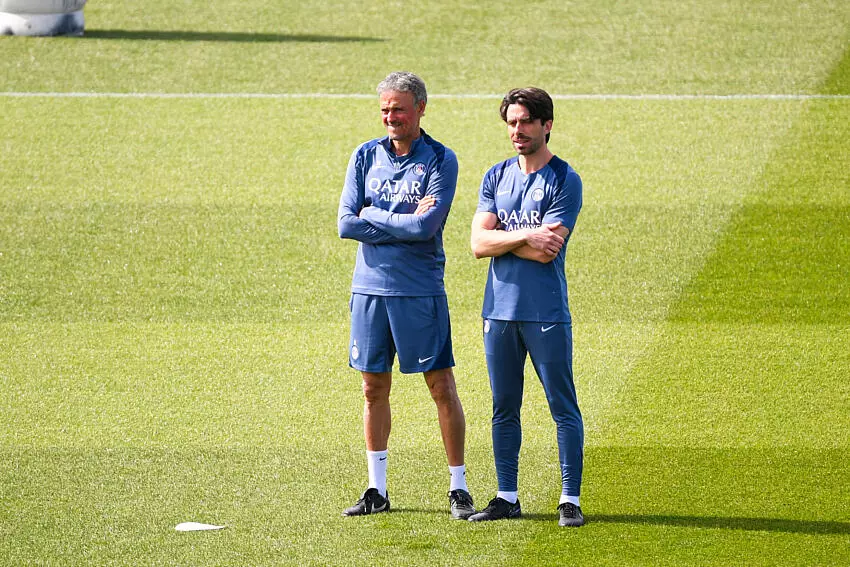
After their victory over Olympique de Marseille (2-1), Paris won’t play again until October 10 against Le Mans. On paper, this looks like a chance to finally get some work done. The catch, however, is that 19 Paris players have joined their national teams. Consequently, this long break looks less like a period of intensive team building and more like a nearly empty training complex.
The timing of this paradox is unfortunate. Since the start of the season, PSG has alternated between highly convincing spells and periods of play that lacked fluidity. They crushed Bratislava but lost to Monaco; they scraped a win at Brest and then secured a valuable victory in Marseille, yet without consistently recapturing the poise and spontaneity we have come to expect from them.
There is no cause for alarm in September, but there are certainly issues to address. New signings still need to settle in, certain player partnerships need to become more natural, and the team has yet to regain its full consistency.
Three weeks without a match, but not three weeks of training
One might look at the twenty-day gap between the Marseille game and the home match against Le Mans and think that Luis Enrique (56) has exactly what he needs: time. Finally.
Except that this time is largely illusory. Nineteen members of the professional squad have been called up for this international break. Some will travel across multiple countries, play back-to-back matches, and only return to Paris days before play resumes. Under these conditions, it is hard to imagine Luis Enrique gathering his starting eleven around a tactics board for two weeks to calmly iron out the team’s shortcomings.
This is, in fact, one of the paradoxes facing the current PSG side: the stronger the squad becomes, the more indispensable its players become to their national teams—and the harder it becomes to find those long training stretches needed to help the team progress as a collective unit. The Campus can be used for individual work, player rehabilitation, integrating a few squad members, or drilling down into specific principles with the remaining players. However, you cannot truly fine-tune attacking patterns or collective pressing when three-quarters of the players responsible for executing them are hundreds or thousands of kilometers away.
It is not an excuse; it is a fact of life.
It would obviously be too easy to use this as a preemptive excuse. PSG is not the only major European club that sends a large portion of its squad off to international duty. It is also up to Luis Enrique and his staff to plan for these periods. Moreover, a significant part of the team has been working together long enough not to have to relearn everything come September. Yet, acknowledging this does not mean we should pretend the context doesn’t exist.
We often hear that teams should “take advantage of the break to work.” It is a convenient phrase. In reality, for a club like Paris, an international break has become almost the opposite: a period without PSG matches during which a large part of the PSG squad is nonetheless playing elsewhere.
And the schedule ahead won’t offer much more breathing room. Le Mans is up next on October 10, followed by Manchester City four days later, Strasbourg on the 17th, and FC Barcelona on the 20th. That is four matches in eleven days. By the time everyone returns, the window for experimentation will already have closed.
This certainly doesn’t preclude us from evaluating PSG’s performance or expecting more from certain players. But we must also accept a reality that is less dramatic than debating the quality of this or that player: modern football leaves top teams with less and less time to improve on the training pitch. For PSG, this break offers plenty of days on the calendar, but far fewer on the field. And that is precisely where the problem lies.


