

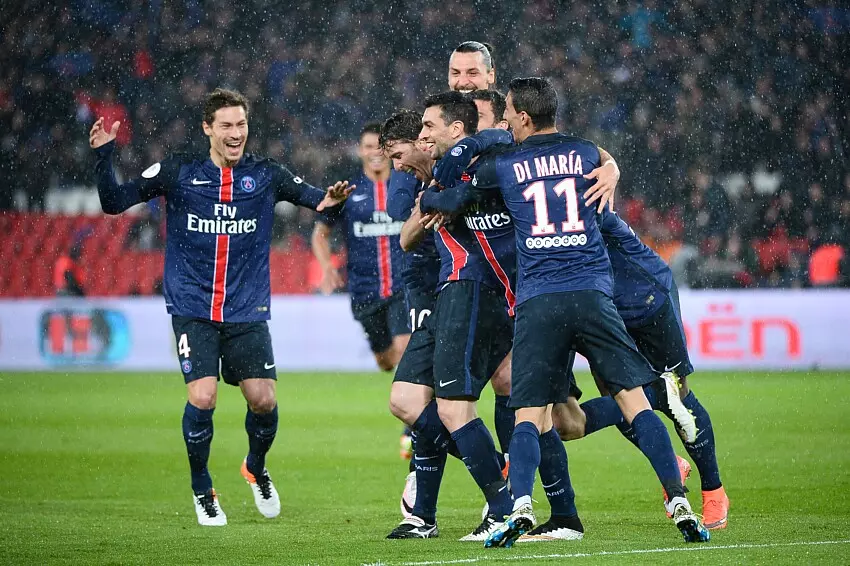
Javier Pastore, the 37-year-old former Paris Saint-Germain attacking midfielder who has since retired, looked back on his time in Paris in an interview with Flashscore. The Argentine recalls a dressing room filled with stars, but above all, an ambition that was palpable from the very early days of the project—a journey whose full extent he appreciates today.
Pastore: “They all left their mark on the club’s history”
“I had the privilege of playing alongside extraordinary talents. Zlatan Ibrahimovic’s arrival was crucial for us younger players. He brought a fighting spirit, intense professionalism, and high standards that helped us improve. Then came Lavezzi, Cavani, Di Maria, Thiago Silva, Neymar, Beckham, Mbappé… You learn from each of them, and they all left their mark on the club’s history.”
Pastore’s recollections go beyond a mere parade of big names; his account also chronicles the gradual building of an elite-level culture. Ibrahimovic, in particular, stands out as one of the players who helped shift the dressing room’s standards at a time when Paris was still striving to establish itself as a lasting European powerhouse.
Generations followed one another, bringing a wide range of profiles and personalities. Pastore, for his part, had the unique experience of spanning several of those eras.
Pastore: “The club has grown exponentially”
“Right from the start, you could see the ambition and the project that the management, the president, and the Qatari group wanted to build.” When they signed me—and subsequently attracted world-class players like Thiago Silva, Zlatan Ibrahimovic, Ezequiel Lavezzi, and all those who followed—they were building a new Paris Saint-Germain with the goal of reaching the level it occupies today.
I’m not just talking about the pitch, but also the infrastructure, the training center, and the stadium. The club has grown exponentially over the last 15 years. Today, it competes at the very pinnacle of European and global football, alongside the biggest clubs.
Pastore: “It is the result of years of building.”
Did you think the club was capable of reaching such heights in the Champions League back when you played there?
Yes, absolutely. The scale of the project presented to us from day one, in 2011, aimed for exactly that: building a world-class training center, renovating the stadium, and recruiting players capable of winning the Champions League. Every year, the right foundations were being laid to compete in semi-finals and finals.
In my time, we always fell short in the quarter-finals. Sometimes we lacked that little bit of luck, key players were missing for decisive matches, or we simply ran into a better opponent on the night. In recent years, PSG has delivered incredible performances in the Champions League, showing great tactical discipline and immense solidity in both attack and defense. It is the result of years of building to achieve the elite status the club enjoys today.
Looking back, Pastore places the project’s early years within a much broader context. While high-profile signings were the most visible aspect of the transformation at the time, the ambition went far beyond merely assembling the squad. Fifteen years later, the Argentine’s perspective highlights the sheer scale of the transformation PSG has undergone. He recounts this evolution—inevitably with a touch of nostalgia—recalling that when he first arrived, much of what Paris represents today had yet to be built.
Some view that initial phase as a mistake, though the assessment offered here seems more balanced. Admittedly, the management could have handled certain aspects better; that is simply part of the learning curve when pursuing such an ambitious transformation. Yet, targeting star players proved beneficial for PSG, enabling the club to step up in terms of quality, standards, and global image. It was precisely that groundwork—including regular Champions League appearances—that paved the way for the successes of recent years. Nor should we forget that Paris came close to deep European runs much earlier on, or that recent victories could easily have swung the other way due to the finest of margins.


