

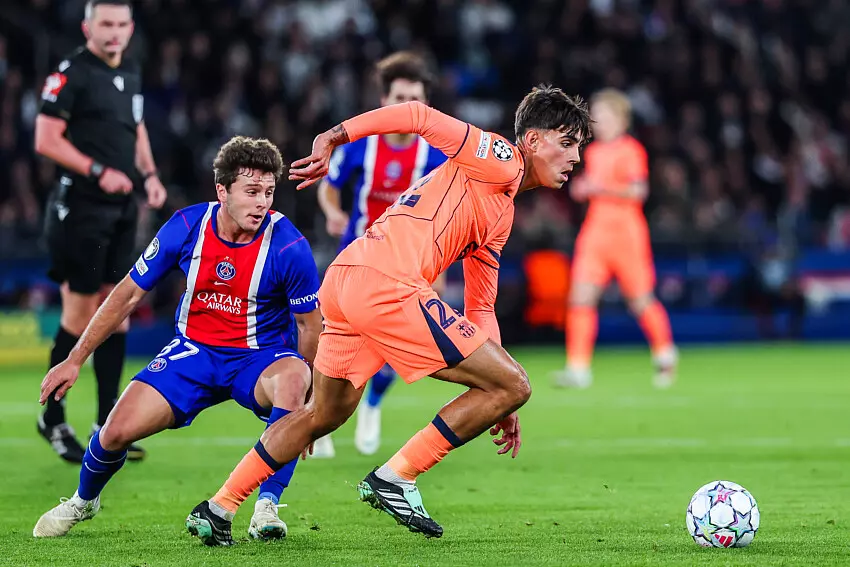
Marc Bernal, a 19-year-old midfielder for FC Barcelona, refuses to rank Paris Saint-Germain above Barça. Speaking to COPE—in comments reported by Le Parisien—he downplayed the significance of the match between PSG and Barça (which ended 4–2), played on October 20 at the Parc des Princes during the third round of the Champions League league phase.
Bernal: “Is PSG better than us? In my opinion, no.”
“We lost, but one match doesn’t determine who is better.” “Is PSG better than us? In my opinion, no. If we were playing PSG at home, do you think they’d beat us?” “For me, it’s Barça… If we don’t have confidence [in ourselves], what are we supposed to do?” “Honestly, if we’re in good form, play our own game, and don’t have any injuries, we can beat them.”
Bernal is right about one thing: a single encounter is not enough to establish a definitive hierarchy. And no one expects a Barça player to prepare for a rematch by admitting defeat in advance. But between believing in one’s own chances and dismissing any superiority on the part of the opponent, there is still room to acknowledge what actually took place. Evidently, that is a difficult balance to strike.
His reasoning essentially relies on a very convenient scenario: a different stadium, a full-strength squad, and a perfectly executed game plan. Under those ideal conditions, Barcelona could indeed beat Paris. Perhaps. But that merely demonstrates a possibility, not inherent superiority.
As for PSG, they won the match that actually took place. While Bernal is defending his team’s confidence, his refusal to concede even the slightest advantage to the Parisians also suggests a defeat that is still hard to swallow. After all, conceding four goals might warrant something more than just a change of scenery.
Bernal: “I like watching the big matches.”
“In La Liga, I follow four or five teams: Betis, Atlético de Madrid, Real Madrid—sometimes Athletic Bilbao and Real Sociedad.” “I also watch some Premier League teams. I like watching the big matches.”
When asked which teams he watches besides Barça, Bernal did not mention Paris. There is no need to turn his television-viewing habits into a diplomatic incident; this omission implies no particular underlying intent. More telling is his earlier reasoning, in which the Parisian victory ultimately carries less weight than the certainties held by Barcelona.
As for PSG, there is no reason to take issue—neither with their absence from his evening viewing schedule, nor with the lack of an acknowledgment of their superiority. In their most recent encounter, the Parisians already secured the only answer that truly matters: the one delivered on the pitch.


