

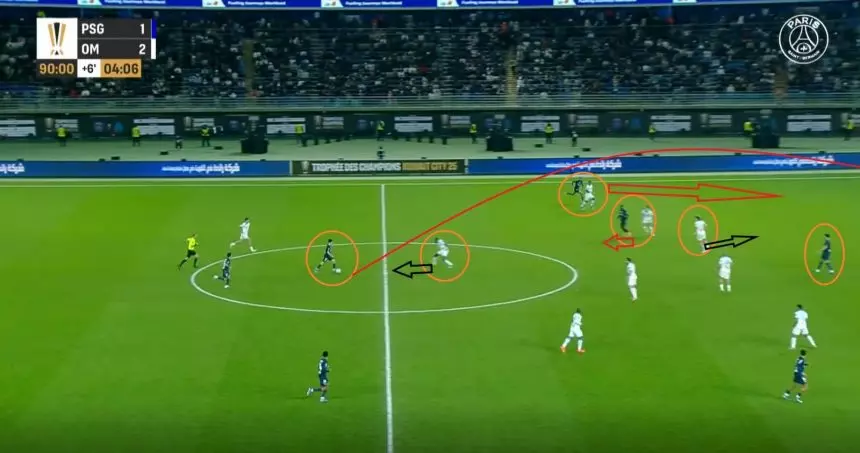
With the aim of providing our readers with richer content, we decided to launch a section analyzing key moments in a match, whether goals scored or conceded, skillful moves, missed opportunities, and more. The goal is to determine the degree of collective or individual success, or error, in each action. Here is the latest installment. This particular sequence is from the penalty shootout victory (2-2, then 4-1 on penalties) against Olympique de Marseille during the 2025 Trophée des Champions. It focuses on Gonçalo Ramos’ equalizing goal, a combination of factors.
The situation when Kondogbia passes the ball to Aubameyang.
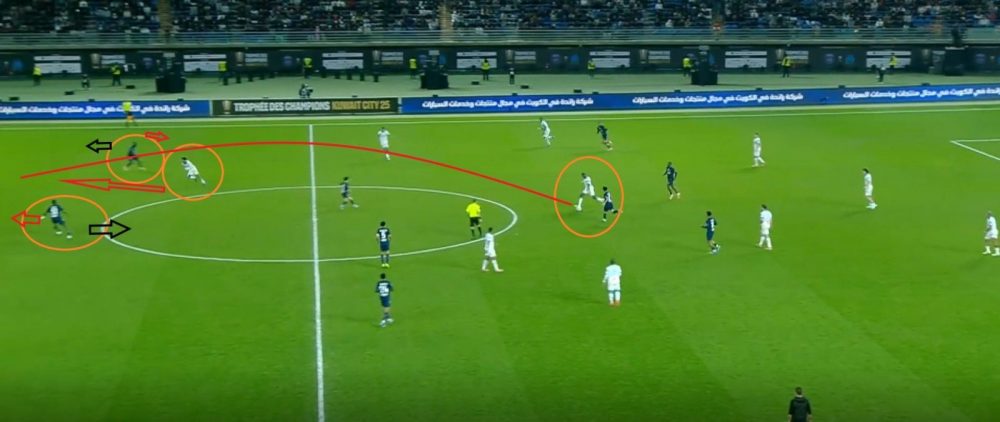
At this point, OM has possession just after winning the ball back, and Geoffrey Kondogbia plays a beautiful through ball to Pierre-Emerick Aubameyang. This was achieved by taking advantage of disorganization in the Parisian defense, which wasn’t illogical at that point in the match.
Nuno Mendes moved forward to play the offside trap, even though he could have also tracked Aubameyang. Willian Pacho chose the latter option, even though he could have tried the offside trap (although he seemed a bit far off, partly because he had already decided to cover the run). Both options were viable, but the defenders needed to agree.
The situation when Aubameyang chose to dribble.
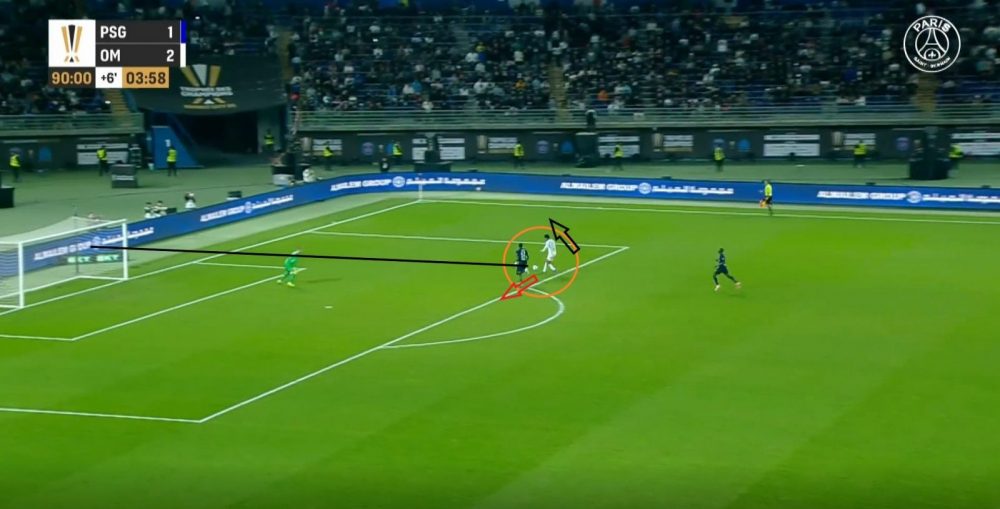
OM and Aubameyang were able to capitalize on the misunderstanding. The striker had the ball in the Parisian penalty area. He could have opted for a cautious approach and moved towards the corner flag to waste time. There was almost no one there (a Marseille player was coming up behind him), so it was conceivable that this situation would persist for a while.
But we can understand the desire to seal the victory; the choice is never simple (it’s always easier to analyze things calmly and away from the ball). In this case, Aubameyang already seemed to be in a good shooting position. He had the edge over Pacho, and a goal was possible.
Except that he chose to dribble, possibly for an easier shot. It’s understandable, but also risky. Because losing the ball while dribbling can lead to a quicker counter-attack. Pacho wasn’t fooled by the feint (it must be said that he defended exceptionally well, as the tackle could have been tempting) and managed to pass to Nuno Mendes, who quickly played it to Vitinha.
Given PSG’s quality, it was probably wiser to play for a 1-2 lead and then bide their time.
The situation when Vitinha passed to Barcola.
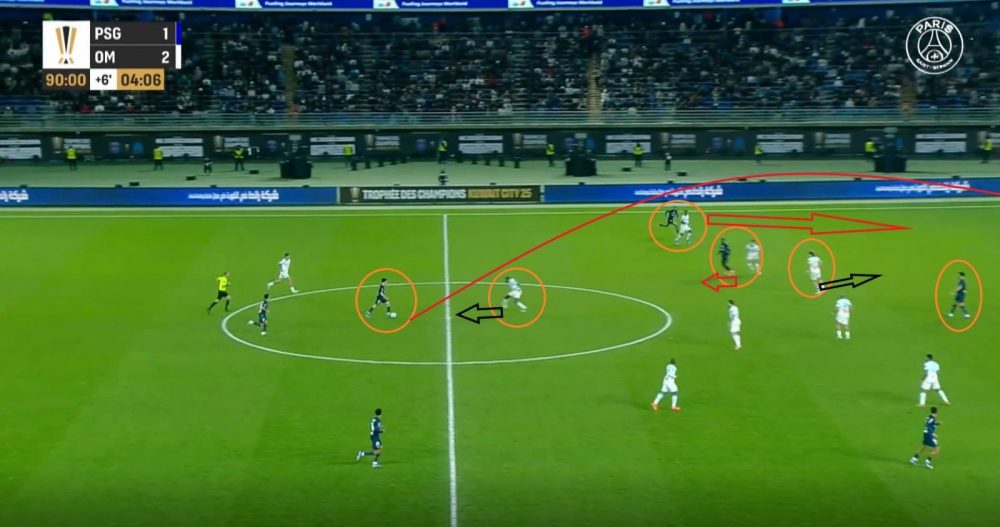
But it would be unfair to put all the blame on Aubameyang. PSG were very strong afterwards, even though the defense could have done better. Vitinha had too much time in midfield against a very high defensive line. They either needed to really close him down—Kondogbia (and the team) can come out earlier and doesn’t need to stop so far back—or they needed to sit deep.
As it happened, the PSG midfielder had all the time in the world to gather information and adjust his pass (with pinpoint accuracy) to Bradley Barcola, whose speed is no secret. Meanwhile, the nearest center-back was drawn away by Ousmane Dembélé, which created even more space. And in the center (Leonardo Balerdi, we think) seemed focused on what was ahead, rather than anticipating the ball for Barcola. There was no offside trap or cover. A major foul at this level.
Meanwhile, Gonçalo Ramos is playing the striker’s game. He’s clearly offside, but it’s a (common) tactic used to gain an advantage once his teammate receives the ball and puts it back onside.
The situation as Barcola prepares to head the ball towards Ramos.
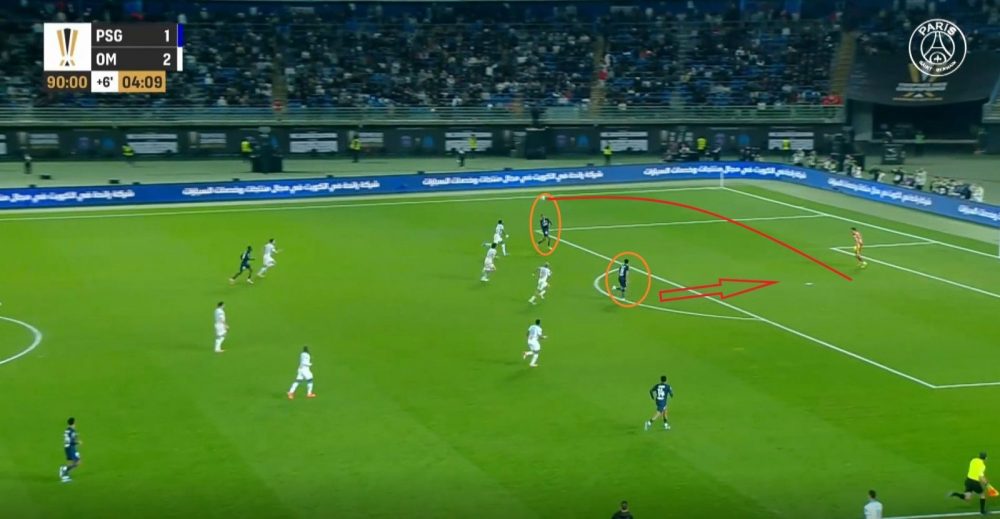
The Marseille defense is caught out of position, Ramos is back in play, and the challenge is to find a way to get the ball to him. The quality of Barcola’s header is noteworthy, as it’s far from obvious on such a pass.
However, goalkeeper Geronimo Rulli could also be more proactive. He’s in a terrible position, with a significant advantage for the attackers. It’s difficult to be perfect. However, he drops back, which is often disastrous in this position. This is especially true because there’s a lack of support afterward (to make a run to intercept Ramos, for example). Here, we also see that the pass ultimately arrives not far from where Rulli was positioned. He could have been more aggressive and intercepted.
Especially since Barcola is positioned quite clearly for this header. And if he chooses to control the ball, it seems preferable to be able to react quickly to him, or he could more calmly adjust his pass. It’s never easy when the attack has such a lead, but it’s always good to do something to shift the balance of power.
In any case, we arrive at a memorable goal where some things seemed simple and almost “normal.” Yet, as is often the case, there’s an accumulation of choices and actions that turn everything around. Finally, we can highlight PSG’s quality: scoring a goal without the ball touching the ground in the opponent’s half is rare.
To watch the replay:


