

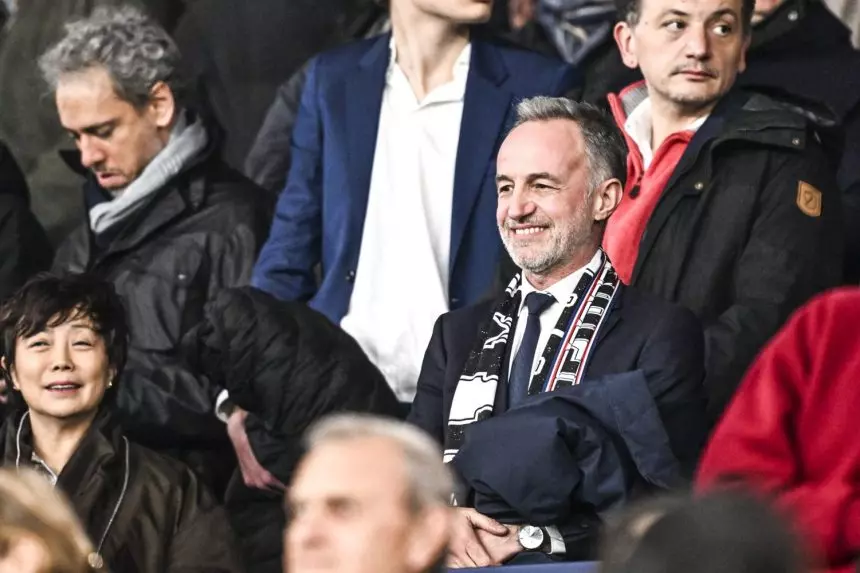
Emmanuel Grégoire, 48, the mayor of Paris, once again addressed the future of the Parc des Princes and Paris Saint-Germain on the 100% PSG le Mag podcast. Faced with figures circulating about a possible sale, the elected official primarily sought to regain control of a debate that has become highly politicized.
Grégoire: “Letting Paris Saint-Germain leave the Parc des Princes would be a political mistake.”
“Letting Paris Saint-Germain leave the Parc des Princes would be a political, sporting, and historical mistake. The negotiation of the sale price is very strictly regulated; I don’t get involved much in that matter. Because French law is very precise. When it comes to public property, the valuation of that property is complex, but it is carried out jointly with a supervisory body called the Domaines, which reports to the Ministry of the Economy and Finance.” It is responsible for verifying that when the State sells an asset or when a local authority sells an asset, it sells it at a fair price.
Grégoire: “The only question, of course, is whether PSG agrees to match the asking price.”
He will not “reveal [his] working hypotheses on the sale price, since it is confidential and part of the tactical and strategic negotiation process. There are plenty of intelligent people who will be looking into this and who will help us find the fair value. The only question, of course, is whether PSG agrees to match what the relevant authorities consider the correct value for the Parc des Princes, and it’s an asset that is difficult to assess because it depends on many criteria.”
Grégoire: “I regret it when figures are thrown around like that.”
The figures announced (300/200 million euros) “are fanciful.” I regret it when figures are thrown around like that, because there are many factors that aren’t taken into account, such as the scope, the duration, the constraints, etc. There’s no formal evaluation by the relevant departments. I think it’s just hearsay, which has no value whatsoever.
In any case, the documents in question haven’t been provided to me; I requested them urgently after hearing these figures. There has never been a formal written offer mentioning these amounts. As usual in these sensitive discussions, they must remain strictly confidential so that we can move forward calmly. We’re not going to broadcast this to the world on the internet.
Behind the opening remarks, Emmanuel Grégoire is proceeding with almost surgical precision. The Mayor of Paris asserts that PSG’s departure would be a major mistake, while also reminding everyone that the sale of public property cannot be settled with spectacular declarations or figures thrown around in the media. His statement thus resembles both an olive branch and an exercise in political control.
He wants to demonstrate his commitment to keeping the club at the Parc des Princes, but refuses to publicly disclose the sensitive parameters of the negotiation. This is the crux of the ambiguity surrounding the issue: Grégoire speaks of a historical stake, criticizes the figures as fanciful, but maintains a very controlled communication strategy. In short, the door is open, but no one has yet truly grasped the concept.
This balancing act primarily illustrates the complexity of the situation. For Paris Saint-Germain, the Parc des Princes is a symbol, but also a lever for development. For the city council, it represents public property, a political choice, and a risk to its image. It goes without saying that this doublespeak is not an accident: it is part of the strategy.