

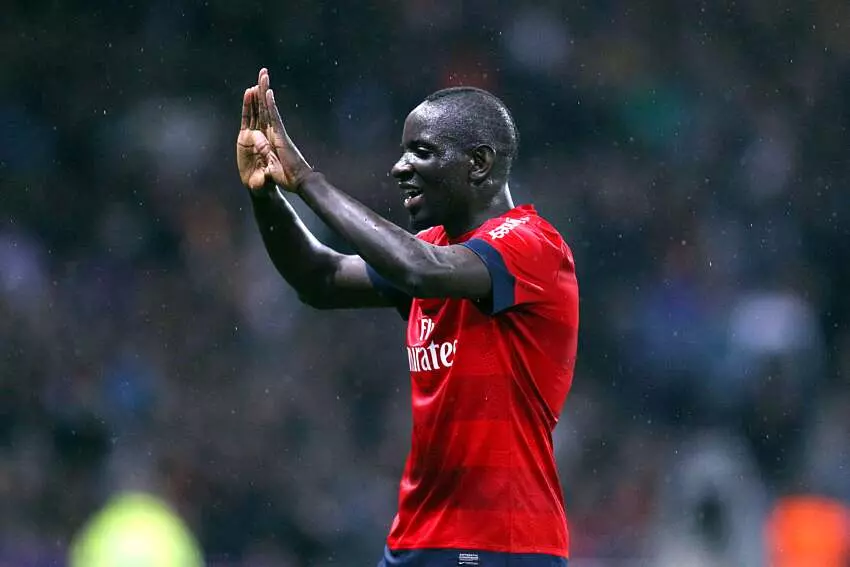
Interviewed by PSG’s official website, Mamadou Sakho, former Paris Saint-Germain defender, offered a powerful perspective on the club’s evolution ahead of the Champions League final against Arsenal. The former PSG youth player emphasized the club’s development, the impact of Luis Enrique, and the mental strength of a squad that will nevertheless have to avoid the trap set by the Gunners.
Sakho: “A club grows great with time”
“For me, a club grows great with time. I think Paris Saint-Germain has built itself up. We had to go through tough, very tough, trials, but that’s part of building a history that becomes increasingly solid. Today is the culmination!
We managed to lift the Champions League trophy and bring it back to the Eiffel Tower. There’s nothing to regret. Everything that has happened to Paris Saint-Germain had to happen so that we can savor these moments even more and hope to secure a second victory.” At the start of the season, nobody imagined we’d be able to reach the final again… and we did it! I hope we can bring it back to Paris once more.”
In Mamadou Sakho’s words, there’s undoubtedly an element of affection for his boyhood club. But there’s also a fairly accurate understanding of what PSG has gone through to reach this level. Paris didn’t become a European powerhouse simply by amassing talent. The club also grew through disappointments, criticism, painful eliminations, and seasons where the gap between ambition and reality was sometimes brutal.
It’s this journey that gives even more weight to this new final. Under Luis Enrique, Paris Saint-Germain seems to have found a stronger sense of cohesion: a collective vision, a clear framework, and a team capable of suffering together. Before Arsenal, this is an immense strength, provided they don’t assume history is already written.
Sakho: “Nothing Happens by Chance”
“For me, it’s not an achievement because nothing happens by chance. It’s simply that Luis Enrique has this determination, and so do the players. The coach has a very clear message, and the players manage to absorb it and translate it onto the pitch. We see a young team, having fun together on the field, putting in a tremendous amount of effort, all together.
We often talk about results, but we also have to see the way they do it. It’s not just about putting on their boots and going onto the pitch. These guys give their all in every match, they go after the results. They have a mental strength that is simply exceptional.”
This passage perfectly sums up the Parisian transformation. Sakho isn’t just talking about a talented PSG, but about a group that understands what its coach asks of them and is willing to make the necessary effort to implement it. This is where Luis Enrique has profoundly changed the face of the team. Paris attacks, presses, runs, defends, and persists with an intensity that no longer relies solely on the inspiration of a few individuals.
This collective strength will be essential against Arsenal, a team capable of closing down spaces, slowing the tempo, and pushing its opponent to the brink of frustration. The danger for PSG is therefore clear: to remain true to its principles without succumbing to impatience. A final doesn’t just reward the best team on paper, but the one that maintains its composure and focus the longest.
Sakho: “Paris always manages to tip the scales in its favor”
“The Champions League semi-final against Bayern Munich sums it all up. That attacking flair, that defensive solidity, against a very strong team… That sums up the Paris Saint-Germain of today. Paris always manages to tip the scales in its favor, and for good reason.”
The reference to Bayern Munich is not insignificant. For Sakho, this two-legged tie revealed the full spectrum of the current PSG: a team capable of playing with flair in attack, but also of holding firm in tougher moments. This is perhaps the major difference with some past PSG teams.
Paris no longer wins only when everything is going smoothly. It also knows how to resist, absorb pressure, bounce back, and turn a match around with its intensity. Against Arsenal, this maturity will be essential. The Gunners won’t come to simply enjoy the Parisian title, but to disrupt this momentum and impose their own scenario. PSG has the weapons, the momentum, and the confidence. But he will have to approach this final as a conquest, not as a confirmation of what has already been achieved.
Underlying this, Mamadou Sakho reminds us of a simple truth: this Paris Saint-Germain is strong because it has been built over time, through hard work and genuine commitment to Luis Enrique’s project. Now, the challenge is to transform this strength into control. Against Arsenal, the trap will not only be tactical; it will also be mental.


