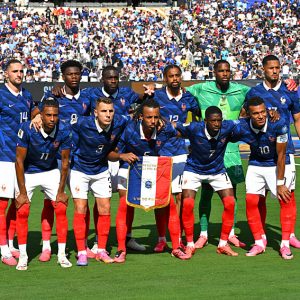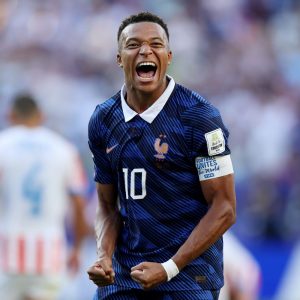

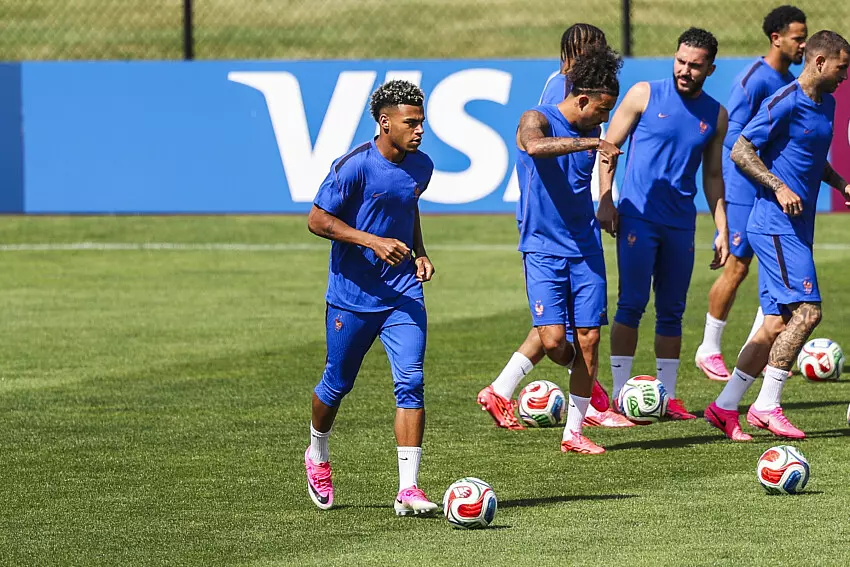
Speaking at a press conference with the French national team, Désiré Doué discussed the competition for attacking spots, as well as teammates Warren Zaïre-Emery and Bradley Barcola, amidst the World Cup campaign. Quoted by RMC Sport, the Paris Saint-Germain player emphasized, above all, the collective mindset of Les Bleus.
Doué: “It pushes us all to raise our game”
On the competition in attack
“It pushes us all to raise our game. Defensively, we are very strong. We have excellent midfielders and the best forwards in the world. The coach has built a squad of 26 players where everyone has a role to play. I stay ready, and whenever I get the chance, I give 100%.”
In the context of the French national team, this statement aligns perfectly with the demands of a major tournament. Doué does not speak of competition as a burden, but rather as an environment that drives everyone to stay prepared. It is the mindset of a player who quickly grasps the rules of an international squad: status matters, but the ability to step up at the right moment matters even more.
Doué: “Warren is an exceptional player”
On Zaïre-Emery
“Warren is an exceptional player with a champion’s mentality. He demonstrates that every day. He always brings the same energy and drive.”
Doué chooses to praise Warren Zaïre-Emery, and this is significant. In the national team—where spots are scarce and the spotlight is intense—such comments reinforce the image of a united squad. There is no visible jealousy, no snide remarks, and no manufactured rivalries. Just a player highlighting a teammate and reminding us that the team’s dynamic relies on this collective maturity.
Doué: “I’m enjoying this first World Cup”
On his World Cup experience
“I’m enjoying this first World Cup. All the players feel nothing but happiness. It’s a magnificent tournament to play in. When I smile during the anthem, it’s because I’m happy to be here.” »
On Barcola
« We have a lot of qualities. Our profiles are different. I’m capable of playing in several positions, whereas Bradley is more of a winger. He’s fast with and without the ball. I’m more comfortable in tight spaces. »
The comments on Barcola are interesting because Doué carefully avoids the trap of a direct comparison. He speaks of different profiles—and thus of complementarity. That is invaluable in a World Cup: depending on how a match unfolds, a coach might need speed, direct running, inside play, or the ability to combine in tight spaces. Doué isn’t making demands; he’s making himself available. It’s a polished, intelligent, and frankly reassuring approach.