

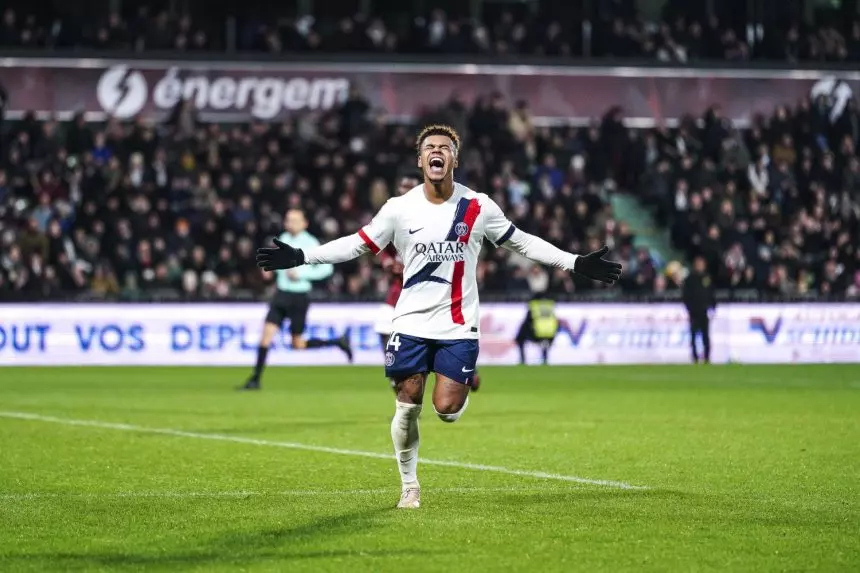
At PSG, a dip in form doesn’t trigger an analysis; it triggers a trial. Désiré Doué, on February 5, 2026, was returning from a 2025 season marred by two injuries. Logically, he was looking to reclaim his place as a key player… and he was forcing it: too many dribbles, less fluid combinations, rushed decisions. The media were unforgiving, some fans quickly changed their tune, and he went from “key player” to “bench” as easily as changing the channel.
Except that it didn’t help anyone. The path was simple: fitness ➡ confidence ➡ expression. If Paris wanted to rediscover the brilliant Doué of last season, the quickest way wasn’t to burn him out. It was to guide him, support him, and stop digging himself into a hole.
Remember what we’ve seen: that player already exists.
Doué isn’t a highlight reel fantasy. He has already delivered at the highest level, even scoring last season in the match that carries the weight of the game: the Champions League final. This reminder isn’t a shield against criticism, it’s a compass: we’re talking about a player capable of major performances, not a player yet to be invented.
And that’s precisely why the current reaction is strange: at the slightest flaw, we don’t correct it, we devalue it. We don’t say “he’s going through a phase,” we say “he’s losing his status.” As if status were a mood.
Two injuries at the end of 2025: the context that changes the interpretation.
We can discuss his level, but not while ignoring the chronology. At the end of 2025, Doué suffered two muscle injuries that disrupted his momentum: calf then hamstring. It doesn’t “explain everything,” but it already explains the essentials: a disjointed return, a rhythm to rebuild, and automatic reflexes to re-establish.
And a comeback, especially after two injuries, is rarely spectacular at first. It’s not a direct return. It’s a restart: footwork, timing, explosiveness, confidence in his body. At PSG, this work is done under harsh glare, and that amplifies everything: the slightest imprecision becomes a symbol.
The Doué trying too hard: a logical symptom, not a verdict.
We see it: Doué is trying to become indispensable again, but he sometimes acts as if he wants to “make up for” what he missed. This creates the perfect recipe for a difficult return: too many dribbles, botched combinations, “too easy” moves that create tension, quick decisions, fewer goals, fewer passes.
It’s not a moral failing. It’s a misalignment. And that’s where we find an echo of his beginnings: before reaching a new level, he had to learn to choose. To create opportunities when necessary, to simplify when necessary. He has the talent. Getting back to his best is often the art of becoming simple again… at the right time.
The evidence without the inventory: yes, the atmosphere surrounding him is already tense.
No need to turn this editorial into a match report. But let’s be honest: some recent performances have fueled the criticism, and the complaints keep coming back: “he’s stubborn,” “he’s fading,” “he’s annoying,” “he misses too many chances.” Which would be almost commonplace… if the conclusion weren’t always so extreme.
Because the problem isn’t saying he’s underperforming. The problem is making it a definitive truth, as if returning from injury should produce a “final” version as early as the second week.
Ruthless media, fickle fans: the recipe for extreme judgment.
The media forgives nothing because the verdict makes more noise than nuance. The sentence is shared more easily than an intelligent paragraph on rhythm and choices. And the fans, for their part, live by emotion: when something shines, they praise it; When things go wrong, we condemn. PSG makes everything more intense, and therefore everything more unfair, if we don’t apply a minimum of method.
The result: we mistake a state for an identity. We judge a phase as if it reveals the player’s “truth.”
Yes to the bench, but as a tool, not a scepter.
Yes, Doué can go to the bench. And it’s not a tragedy. The bench can be a smart management tool: minutes, increased workload, mental rest, healthy competition. The bench is a tool.
What ruins everything is the “punitive” bench, the one demanded to humiliate, to “send a message,” to erase a player’s status. That’s no longer managing a player: it’s pushing him to justify himself. And a player who justifies himself on the pitch pushes him even harder.
The Zaïre-Emery mirror: the example that should calm everyone down.
Zaïre-Emery paid a heavy price for his poor performances last year: benching, demotion, talk of “regression,” and even a stint with the U21s, which fueled easy criticism. Then reality set in: renewed confidence, continuity, and a return to his indispensable status, with top-level performances.
The lesson is simple: being tough doesn’t always “build character.” Sometimes it breaks. And at PSG, when you break a player mentally, you waste time… exactly the opposite of what you claim to want.
Conclusion
Doué needs to “make history” over time, yes. But that history won’t be built in a weekly court of law. The fast track is the mature path: context, high standards, patience. First, physical conditioning. Then confidence. And when these two levels are solid, the third will follow: expression. The one we’ve already seen, and that we’ll see again sooner if we stop digging under its feet.


