

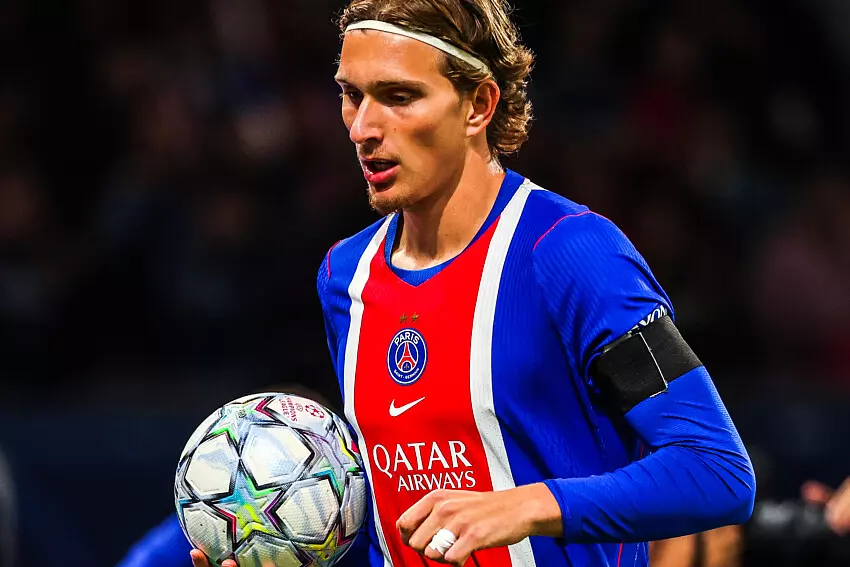
The serious injury to Khvicha Kvaratskhelia (25)—who suffered a torn anterior cruciate ligament in his right knee during the match against Barcelona (4-2)—has reshuffled the offensive options for Paris Saint-Germain. Mika Godts (21), signed this summer, is one of the potential solutions. Having shown some hesitation thus far, the Belgian now has a major opportunity to add a new dimension to his time in Paris.
Godts must now show more
His initial appearances have not exactly dispelled the questions surrounding him. More dynamism, personality, and influence on matches are expected. It is not unfair to point this out: Godts has joined a club with high standards, and his performances are open to scrutiny. However, it would be premature to turn this mixed start into a definitive judgment on his ability. Having arrived this summer from Ajax, the Belgian is still getting to know his teammates, adapting to a new league, and adjusting to a highly demanding team system. This explains some of his struggles—though it certainly doesn’t excuse every lost ball.
Nevertheless, Kvaratskhelia’s long-term absence changes the landscape. New opportunities are emerging, responsibilities will need to be redistributed, and Godts’ profile makes him well-suited to step up. It is now up to him to prove that he can offer more than just the occasional rotation role. PSG cannot simply hand him a spot in the starting lineup just because a rival has been sidelined—starting positions aren’t something you get by prescription. But this new situation could allow him to build some consistency, find himself in more scoring positions, and develop better chemistry with his teammates. For a player still in the process of adapting, that is significant.
Taking on responsibility without trying to do it all at once
The trap would be trying to replace everything Kvaratskhelia brings to the table in a single night. Godts must first make his own play useful: taking on opponents when a duel can be won, combining with teammates who are better positioned, making runs after laying off the ball, and contributing to the team’s defensive efforts. A convincing performance begins there—well before any goal or spectacular piece of skill. To earn trust, you must also make others want to look for you. Individual talent takes on a whole new dimension when it becomes a genuine solution for the team.
Doué’s journey didn’t begin in Munich
The career path of Désiré Doué (21) serves as a reminder that we should keep a bit of perspective. Before his brace in the Champions League final against Inter Milan, his first few months in Paris were far more understated. His maiden goal for PSG didn’t come until December 2024, in Salzburg—a match in which he also provided an assist. The player who would go on to impress all of Europe initially had to search for his place in the side. His eventual success does not erase that earlier period; rather, it highlights exactly why that phase was a necessary part of his development.
Of course, Godts is not Doué, and their trajectories are not interchangeable. One positive precedent is no guarantee of future success. It would be quite absurd to defend the Belgian today only to demand a brace in a final from him tomorrow. The comparison simply serves to illustrate a more reasonable point: while the opening weeks may reveal certain difficulties, they are far less reliable for defining a player’s ultimate limits. Godts needs to improve—it just remains to be seen how far that improvement can go.
Luis Enrique can help the player grow
Under Luis Enrique (56), there is a credible framework for this progression. The case of Doué demonstrates that an attacker can learn to better harness his strengths within this team. For Godts, the challenge goes beyond merely securing more playing time; it is about learning how to make better use of those minutes. This means choosing the right moments to accelerate, understanding the movement of those around him, and becoming more precise—all without losing the boldness that prompted the club to sign him in the first place. The coach’s role is to make these qualities more effective, without turning the player into someone who feels the need to ask for permission before attempting a dribble.
Back in late September, Godts mentioned that his teammates were helping him adapt and that he felt his own level rising through his interactions with them. Now, that conviction needs to translate into something more tangible during competitive matches. The situation will demand responses—a process that inevitably entails mistakes and adjustments. Confidence can give him the courage to take risks, while high standards should guide him toward better decision-making and success.
PSG has lost a key player, and the resulting void will need to be filled by the collective. As for Godts, he has a more significant role to stake a claim to. It is entirely fair to ask him to demonstrate why Paris brought him in; it is far less reasonable to expect him to already be the player he might one day become. This is his moment—it is up to him to start making the most of it.


