

With the aim of providing our readers with richer content, we’ve launched a section analyzing key moments in a match, whether goals scored or conceded, skillful plays, near misses, and more. The goal is to determine the degree of collective or individual success, or error, in each action. Here’s the latest installment. This particular sequence is from the 2-1 victory against Strasbourg at the Stade de la Meinau this Sunday during Matchday 20 of the 2025-2026 Ligue 1 season. It focuses on the goal conceded, which originates with the opposing goalkeeper, and the subsequent rapid sequence of events (15 seconds).
The situation where Penders places the ball on the ground to make a pass.
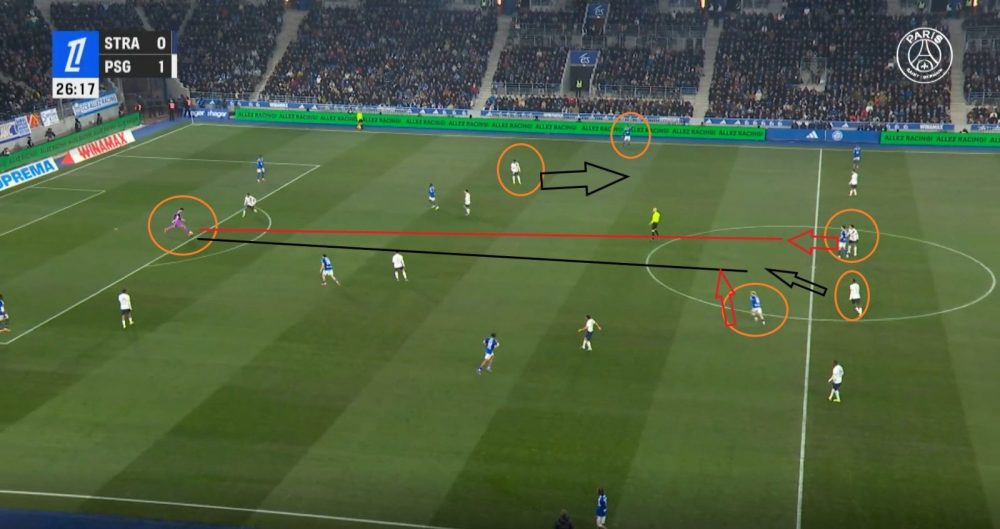
For the moment, PSG isn’t in any particular danger. The ball is in the opposing penalty area, at the goalkeeper’s feet. But the Parisians’ very high press implies risks. Here, everyone’s positioning means there’s a possible pass directly to the striker, Joaquin Panichelli, in the middle. It’s also risky, because losing possession would quickly become very dangerous. Except that Marquinhos is outpaced by his opponent’s speed and power.
Enciso could also have been played in; he even seems like a more logical option, since he’s already moving. Willian Pacho hesitates to follow him, even though he’s been primarily marking Panichelli throughout this match. Finally, the Strasbourg attacking midfielder can be played in by Panichelli, with time to transition the play to the left.
Down the flank, Strasbourg has an numerical advantage because Ibrahim Mbaye takes too long to track back. His initial positioning is understandable; it puts pressure on the defense and makes a long ball difficult (though not impossible). But once the pass cuts through the midfield, he should have reacted more quickly. He does get back, though, because he makes the effort, but Strasbourg has managed to advance thanks to a series of small errors by PSG.
The situation when Enciso cuts back towards the center.
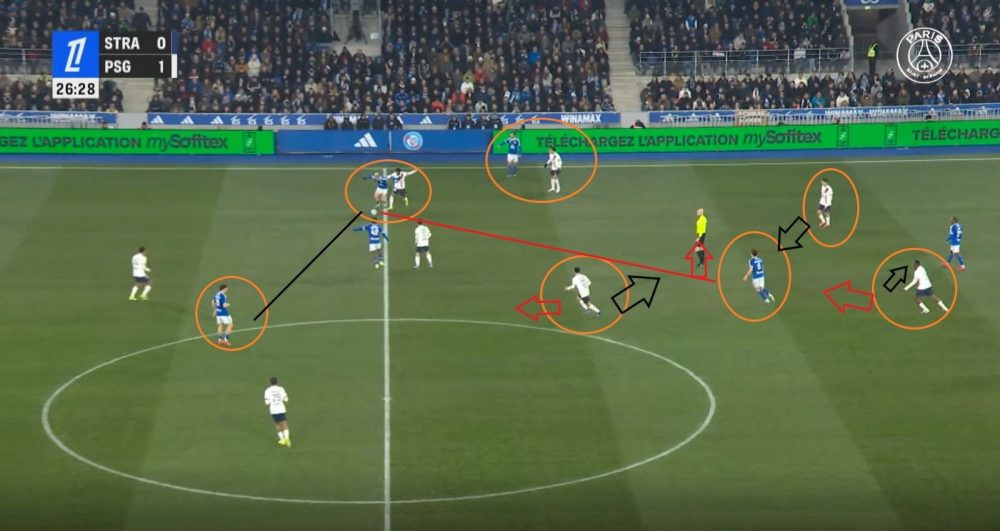
Mbaye eventually came back and dueled with Enciso, but couldn’t get the ball. We note that Marquinhos, in keeping with PSG’s philosophy, followed the ball to apply pressure and found himself in a right-back position, seemingly without much danger. Enciso was in the duel and could have opted for a simple pass back, possibly through the middle. This is what Warren Zaïre-Emery was trying to anticipate.
Except that it might have been a bit too much. Senny Mayulu was there to disrupt the play, thus leaving space for Panichelli, who was then played in by Enciso. It was a risky move that didn’t pay off. But it’s worth noting that Achraf Hakimi could also have been more involved here. He gives way to Marquinhos on the right, without quite filling in centrally. Perhaps still thinking about the Africa Cup of Nations, he seems disconnected from a situation that is, in fact, right in his area. Pacho tries to come out, but he’s late, when he should have been marking a danger in the center.
The situation when Panichelli turns to face the play.
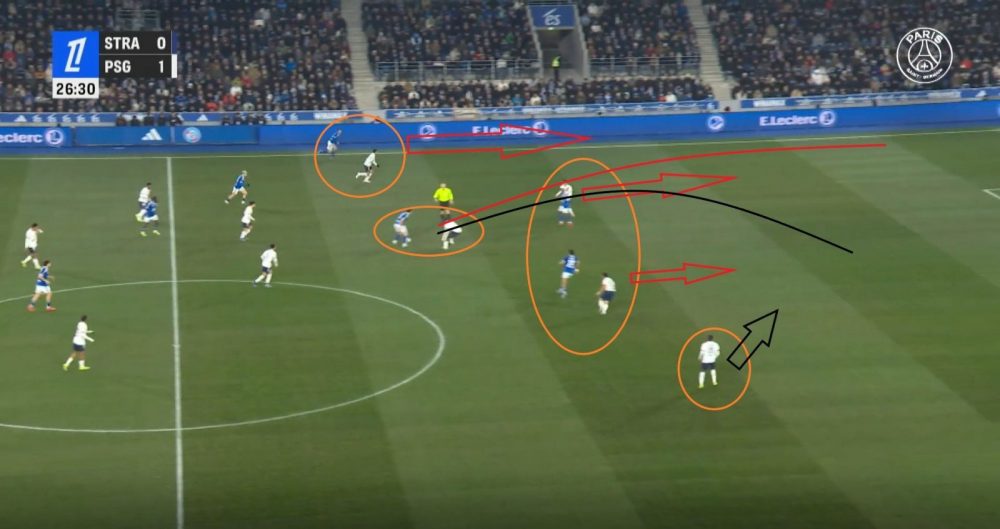
Panichelli is ahead, Pacho is hindering him but not enough to prevent the player from receiving information and making the pass. On the wing, Marquinhos is outpaced. Hakimi tried to get back into the game, but he hasn’t fully recovered his legs and is too late. It’s worth noting that he doesn’t seem quite ready to intervene here either.
Nuno Mendes is also possibly a bit too far out, while the entire central defense has pushed forward. João Neves finds himself alone in the center and tries to track Guéla Doué, but the speed difference is too great. Covering from Mendes could have been helpful. Of course, a player could arrive from the right flank. But the greatest danger is always the most significant, and it’s right here in the center.
In fact, Panichelli could have attempted a through ball through the middle, given how far behind the Parisians are, even though Pacho is well-positioned to disrupt him as much as possible, considering the situation. Ultimately, Strasbourg attacks down the wing and is ahead of the cross, just like the rebound.


