

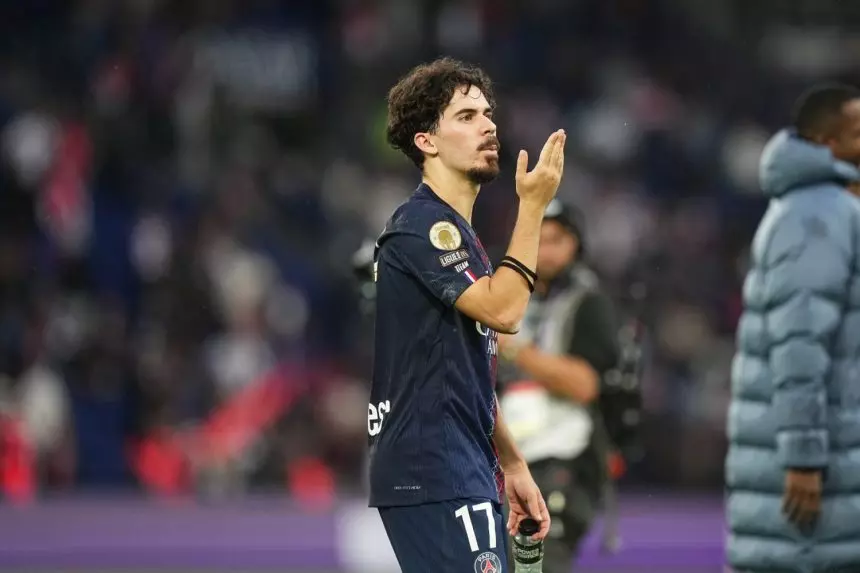
At 25, Vitinha, the Paris Saint-Germain midfielder, offers an unfiltered perspective on the evolution of modern football. In an interview with A Bola, the Portuguese international explains why easy matches have disappeared, both at PSG and with Portugal, and defends a demanding vision of a game that has become ultra-competitive.
Vitinha: “Football has undergone many changes…”
“Football has undergone many changes… Tactically, in terms of competitiveness, in the way the game is approached. Football is often criticized, with people saying it’s no longer as magical, as beautiful, as attractive as it used to be, and I understand that, but it’s inevitable. Every team wants to win. They are much better informed, much better organized than before.
Tactically, they are much stronger. Any team fighting to avoid relegation knows perfectly well how to defend, how to position itself, how to create a low block, and how to trouble the big teams. It’s difficult to play against just any team today.”
Vitinha: “Today, teams really make life difficult for us.”
There are no easy matches, no match against the bottom-ranked team in Ligue 1 where we think, “We’ll win easily, without even worrying.” It doesn’t exist. You always have to be at your best, even more so at a club like PSG and with a national team like Portugal.
Always give your all, always be focused, always want to win every three days. Because when you don’t, it’s a disaster. Today, teams really make life difficult for us.
Vitinha: “People still go to the stadium to see beautiful football.”
As I said, João and I, but also all the other players, love having the ball at our feet, creating, playing like we did when we were children. That will always be the reason we stand out. “
I can’t say that we get noticed because of me or João, but always because of a Yamal, a Dembélé, or a Pedri. It doesn’t matter. People always go to the stadium to see beautiful football thanks to these players, because what they do is magnificent to watch, and that’s what excites us…”
For Vitinha, humility is neither a slogan nor a communication strategy: it’s a condition for survival at the very highest level. The Portuguese midfielder puts it bluntly: believing yourself superior before you’ve even played is already a recipe for defeat. For him, respecting football means first and foremost accepting that every opponent works, improves, analyzes, and prepares their matches with almost surgical precision. There are no longer “weak” teams, only teams that are ready and others that aren’t ready enough.
In a club like Paris Saint-Germain, this reality is even more brutal. The opponent often plays their game of the year, sometimes of the season. The slightest mistake, the slightest lapse in concentration, becomes an invitation to punishment.
Vitinha then emphasizes that famous “extra effort”: the kind that doesn’t get the crowd on their feet, but wins matches. A seemingly pointless defensive run, sustained pressing in the 82nd minute, unwavering focus when the body demands comfort. That’s where the difference is made.
His words remind us of a simple yet demanding truth: talent alone is no longer enough. Modern football rewards those who respect the game down to its most thankless details. Humility, here, is not a weakness.
It’s a daily discipline, almost an ethic. And in a context where everything moves so fast, where victory can give the illusion of control, Vitinha lays down a clear framework: without respect, without hard work, without extra effort, football will always find a way to bring you back down to earth.