

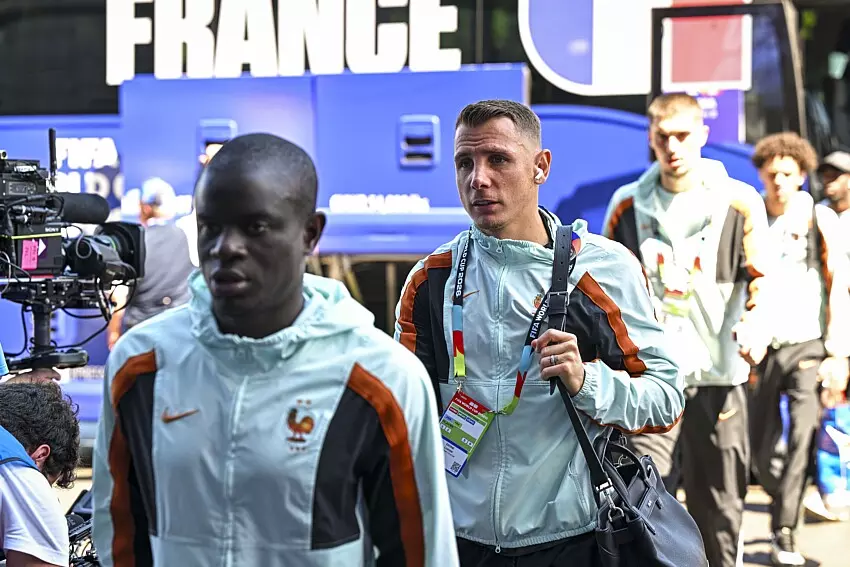
Ten years after leaving, Lucas Digne is poised to return to Paris Saint-Germain. At 32, the Aston Villa left-back would not be returning to build for the future or to upend the existing pecking order. Instead, Paris is targeting a player ready to step in immediately—someone capable of easing the workload on Nuno Mendes while offering Luis Enrique a different profile.
A return that is all but finalized, though not yet officially announced.
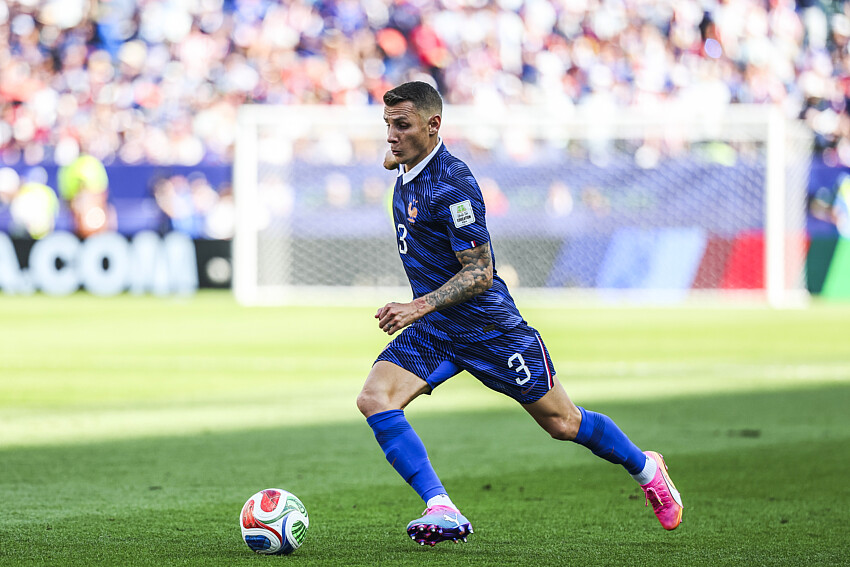
- Agreement reached for a three-season deal.
As of July 14, 2026, Lucas Digne remains officially an Aston Villa player. However, the matter has moved well beyond the stage of mere rumor. According to L’Équipe, the French defender has reached an agreement with PSG on a three-season contract. He is expected to sign after the World Cup, while Paris still needs to finalize the terms of the deal with the English club.
The player reportedly has a release clause of less than €10 million. This figure naturally makes the deal attractive for PSG, although the total cost will also have to factor in his salary and the contract duration. Caution is still required until the Parisian club makes an official announcement, but all available evidence now points to a deal that is well advanced.
- Unfinished business in Paris.
Lucas Digne’s return carries symbolic weight. Signed by Paris Saint-Germain in 2013, he never quite managed to displace Maxwell, whose tactical intelligence and consistency were a perfect fit for the Parisian squad. Still young at the time, the Frenchman left Paris in 2015 to join AS Roma on loan before transferring to FC Barcelona in 2016.
This time, the roles would be almost reversed. Digne would not be returning as a prospect tasked with challenging an experienced player, but rather as a veteran capable of covering the minutes left by Nuno Mendes. While the narrative is appealing, the logic behind this signing rests primarily on sporting grounds.
Another very solid 2025–2026 season.

- A full-back still capable of delivering.
At 32, Lucas Digne cannot be judged solely on his experience. Fortunately, his most recent season with Aston Villa provides much more concrete evidence. In the 2025-2026 Premier League campaign, he played 31 matches—starting 21 of them—for a total of 1,852 minutes.
Notably, the Frenchman provided six assists. According to Opta Analyst, this tally ranks him ninth among the league’s top assist-makers, level with several other players. It is a remarkable performance for a full-back who shared the position with Ian Maatsen and did not enjoy the status of an undisputed starter.
These figures confirm his key strength: Digne continues to pose a threat from the flank. His influence relies not on dribbling or spectacular bursts of speed, but on the precision of his left foot, the timing of his overlapping runs, and his ability to deliver crosses without necessarily having to reach the byline.
- Defensive contribution: putting it in context.
Defensively, Lucas Digne won 26 of his 36 tackles—a success rate of around 72%. He also recorded 13 interceptions and 67 clearances. While these statistics do not mark him out as a dominant defender, they reveal a player who remains active and reliable enough to compete at a high level.
The fact that he received only three yellow cards throughout the season also speaks to his composure. Digne does not automatically resort to fouling when under pressure; he compensates for some of his athletic limitations through his positioning and experience.
However, his 21 starts serve as a reminder that he was no longer an automatic choice at Aston Villa. Yet, this situation could actually work to Paris’s advantage: Digne is accustomed to competition, coming off the bench, and periods of reduced playing time. PSG would not be signing a starter who grows frustrated every time he is named as a substitute.
A profile that complements Nuno Mendes’s.

- Delivery rather than driving runs.
Directly comparing Lucas Digne to Nuno Mendes would make little sense. The Portuguese player possesses power, speed, and an ability to beat his man that very few full-backs can match. Digne would not be there to replicate those qualities, but rather to offer a different way of operating down the left flank.
The French international is, above all, a player who excels at delivery. He is capable of delivering first-time crosses, picking out dangerous areas from deep positions, and providing precision on set-pieces. Against a deep-sitting defense, his left foot could offer PSG a more direct option when short passing combinations fail to break the deadlock.
This attribute seems well-suited to a PSG side that frequently commits multiple players to the opposition penalty area. Digne could also give the left winger more freedom by holding the width, or conversely, stay deeper to support an asymmetrical tactical setup.
- Limitations that shouldn’t be overlooked.
However, Lucas Digne is not a complete full-back. His ability to beat opponents while dribbling is limited, and his age can leave him vulnerable against the most explosive attackers. When his team loses possession after a sustained attacking spell, he lacks the pace of Nuno Mendes to immediately recover ground in open space.
His attacking output also relies heavily on the volume of crosses he delivers. If the penalty area isn’t sufficiently occupied, or if Paris focuses exclusively on playing through the middle, his greatest asset loses some of its effectiveness. Luis Enrique would therefore need to deploy him in the right contexts, rather than asking him to replicate the style of the Portuguese starter.
A pragmatic solution to a genuine problem.

- The challenging search for a backup.
PSG’s problem is obviously not finding a left-back better than Nuno Mendes. The challenge lies in recruiting a player who is capable enough to perform in important matches, yet realistic enough about the pecking order to accept inconsistent playing time.
A young defender with high potential might see his development stunted while playing second fiddle to the Portuguese international. Conversely, a backup with limited ability would cause a sharp drop in the team’s overall level whenever rotation occurs. Lucas Digne sits right between these two risks. He brings experience from the Premier League, the Champions League, and the French national team, while also having learned how to handle competition for a starting spot.
- A new option for Luis Enrique.
His arrival would allow Luis Enrique to manage Nuno Mendes’s workload during busy spells, cover for suspensions or injuries, and adjust the team’s attacking setup mid-match. Digne could start certain Ligue 1 games, come on when Paris needs to flood the box with crosses, or utilize his precision on corners and wide free-kicks.
He would not merely be a backup option. His profile—more of a playmaker than a driving runner—would offer a genuine tactical alternative. Nuno Mendes brings power and the ability to beat his man; Lucas Digne offers control, crossing ability, and experience. That said, there is a certain logic to consider: Nuno Mendes is also very capable at set-pieces, possessing a strong shot and the ability to deliver quality crosses. PSG could field a competitive team without significantly altering the structure—something that isn’t the case with Lucas Hernandez or Lucas Beraldo.
A smart move, subject to certain conditions.

- The contract represents the main risk.
From a sporting perspective, the idea makes sense. Financially, the move needs to be evaluated in its entirety. A fee of under €10 million seems reasonable for a French international who is still performing well, but the reported contract running until 2029 would keep Digne at the club until he turns 35.
For a wide player, that duration is significant. PSG would be buying immediate stability while accepting a low resale value and the risk of physical decline during the final years of the deal. The wisdom of the move will therefore depend largely on the salary offered and the role he is actually promised within the rotation.
- A practical signing rather than a headline-grabbing one.
Lucas Digne should not be portrayed as a marquee signing brought in to go head-to-head with Nuno Mendes. That would be assigning him a role that does not seem to be his. However, he could serve as an excellent backup: experienced, still productive, and capable of immediately meeting PSG’s demands.
At a controlled cost, his return makes sense. Paris would gain experience, quality crossing, and a new option for set-pieces without making a massive investment in a position where the starter is firmly established. The gamble hinges less on Digne’s current level than on his ability to maintain it over three seasons.
Lucas Digne could be a smart signing for PSG precisely because he wouldn’t be coming in as a star attraction. Sometimes, a successful transfer window isn’t about stockpiling prospects; it’s simply about effectively plugging a gap in the squad.