

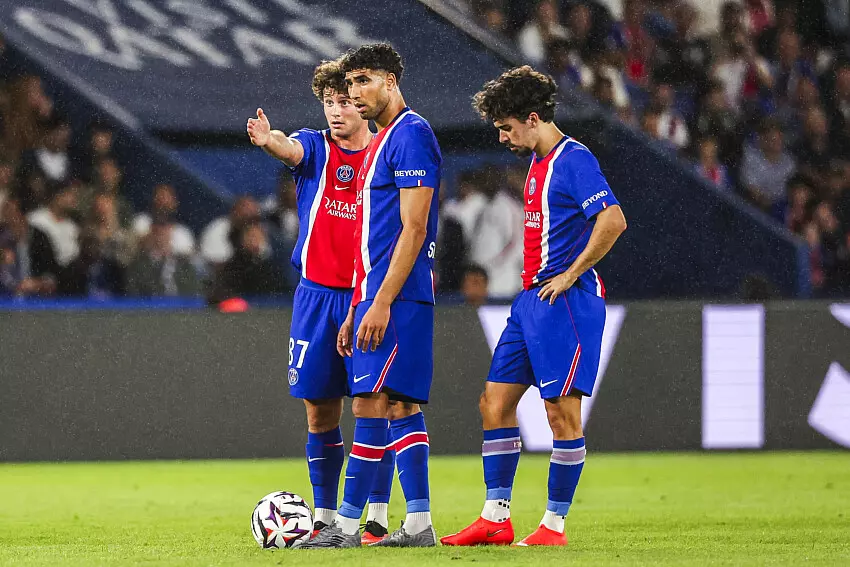
Four competitive matches, zero wins. A defeat against Lens in the Trophée des Champions, two draws against Rennes and Lille, then a loss at the Parc des Princes against Monaco. For a PSG side that is the reigning two-time European champion, this start inevitably looks bad. Yet, the numbers tell a story that is far less disastrous than the results suggest. Paris continues to dominate possession, pin opponents back around their own penalty area, and create a multitude of attacking opportunities. But something has stalled at the crucial moments when matches are decided. Movements feel less natural, decisions less obvious, and the attackers less clinical. What if, beneath PSG’s lack of precision, the primary issue is simply a lack of confidence?
PSG still dominates but no longer delivers the killer blow
- 92 touches in the box, yet zero wins
The result against Monaco could almost serve as a summary in itself. Paris took 23 shots compared to just four attempts from Monaco. Ten Parisian shots hit the target, versus two for ASM. Possession exceeded 68%, while Monaco didn’t even win a single corner.
Yet, at the final whistle, the scoreboard read 1–2. A statistic published by Paris Stats Germain highlights the paradox even further: PSG had 40 touches in the opposition box against Monaco, compared to just eight for their opponents. Across the matches covered by this statistic, Paris has now amassed a total of 92 touches in the box against 35 for their opponents. The result: zero wins.
This is likely the factor that is simultaneously the most reassuring and the most frustrating. PSG does not appear to have lost its ability to move forward, disrupt a defensive block, or reach the final third. The ball still reaches the zones where Luis Enrique wants it to go, but simply getting there isn’t enough.
An extra touch, a delayed pass, an imperfect touch, or a poor shot selection can turn a dangerous situation into nothing more than a line on a stat sheet. For Paris, the problem today lies more in capitalizing on this dominance than in the dominance itself.
When confidence vanishes, clarity goes with it
- The split second that changes an attack
Confidence remains hard to quantify. It appears in neither advanced statistics nor data charts, yet it profoundly transforms an attacker’s game. When a player is brimming with confidence, he anticipates. He knows—almost before receiving the ball—whether to shoot, beat his man, or set up a teammate. Everything seems instinctive. During a rough patch, that exact same situation can trigger hesitation: an extra touch, one more glance at the goal, or a pass played after the window of opportunity has already closed. At this level, a few tenths of a second are enough to turn a potential chance into a wasted attack.
This is likely what creates the current impression of a lack of fluidity in the final third. Paris might execute a brilliant sequence to cut through two opposition lines, only for the move to suddenly stall on the edge of the penalty area. It is not necessarily that the team’s collective principles have vanished; they are simply being executed with less natural ease. This can also give rise to a form of individualism that has nothing to do with a bad attitude.
When an attacker hasn’t scored for several matches, he might try to finish a move he would previously have kept alive. When a team is winning comfortably, everyone knows another chance will come. When they are chasing a win, every ball can start to feel like the one opportunity that simply cannot be missed. The quest for confidence can then end up having the opposite effect: haste, poor decision-making, and further frustration.
Marquinhos and Vitinha score: where are the attackers?
- A telling paradox
The five goals Paris has scored in the first three matchdays of Ligue 1 are particularly revealing. Ferran Torres netted both goals in the draw at Rennes. At Lille, Vitinha and then Marquinhos snatched an equalizer in the dying minutes. Against Monaco, the Brazilian captain was once again the only Parisian to score. Aside from Ferran, none of the forwards already established in the Paris setup have found the net in the league so far.
Ousmane Dembélé, Désiré Doué, and Khvicha Kvaratskhelia have yet to open their accounts. This obviously does not mean they are all playing poorly or are to blame for the team’s poor run of form; however, when Marquinhos has as many Ligue 1 goals as all the other Parisian forwards combined (excluding Ferran), the contrast is worth noting.
There is also a striking statistic from the Monaco match: of the 40 times Paris touched the ball in the opposition box, nine involved Achraf Hakimi. The full-back is naturally one of the most attack-minded players in Luis Enrique’s system, so his presence so high up the pitch is nothing unusual.
Yet, it reinforces the current impression that many of Paris’s dangerous situations are being created by players who are not, in theory, primarily responsible for finishing moves. Marquinhos is scoring, Vitinha is getting on the scoresheet, and Hakimi is frequently appearing in the box, all while the attacking unit is still searching for its rhythm—and, above all, the spontaneity that used to be its greatest strength.
An attack that also needs to learn to speak the same language again
- New signings inevitably alter on-field connections
However, dismissing this period as merely a slump in individual form would be too simplistic. The Parisian attack underwent changes over the summer. Ferran Torres, Maghnes Akliouche, and Mika Godts are among the new faces in the attacking unit. Ferran has already made his mark with a brace in his very first league match, while the others are still getting to grips with the specific demands of Luis Enrique’s style of play. This inevitably takes time—even for talented players—because the Parisian attack relies heavily on connections, positional rotations, and each player’s ability to read their teammates’ movements.
Positions are fluid; full-backs sometimes occupy attacking zones, and midfielders must instantly recognize the spaces opening up ahead of them. This brand of football becomes magnificent when everyone is thinking in sync. It looks far more labored the moment a run is made a second too early or a pass arrives a second too late.
The new signings must learn these instinctive patterns, but established players must also learn how to play alongside them. Perhaps that is why we should avoid immediately looking for someone to blame. The issue looks less like a major tactical flaw and more like a combination of minor disruptions: new teammates, the need to rebuild chemistry, attackers struggling for form, and results that steadily ramp up the pressure.
Doubt also alters opponents’ behavior
- Paris must regain its aura of intimidation
Finally, there is a less visible effect of this poor run of form: the impact it has on the opposing team. When Paris is stringing wins together and quickly converting chances, every spell of dominance weighs heavily on the opposition. Even at 0–0, the rival team may feel that a goal is inevitable.
Conversely, the longer the winless streak drags on, the more opponents realize they can survive the onslaught. Monaco provided the perfect example of this. Despite managing just four shots to Paris’s 23—and only two on target compared to ten—ASM stayed in the game and capitalized on their rare opportunities.
Paris needs to reclaim that sense of inevitability. Doubt creates a vicious cycle: a first missed chance gives the opponent a few extra minutes of hope, a second reinforces that belief, and Paris eventually begins to force its play.
The team then risks leaving itself exposed, becoming vulnerable to opposition counter-attacks and gradually losing the sense of control that its territorial dominance should normally provide. Confidence works both ways: as it dips slightly for Paris, it naturally rises among their opponents.
No need to panic, but no room for excuses either
Luis Enrique didn’t overreact to the Monaco result. The Spaniard felt his team clearly deserved more, while acknowledging the need for improvement:
“We need to improve, both individually and collectively. I do too, as the coach, because we are struggling in the standings.” — Luis Enrique, PSG.fr, September 4, 2026.
This assessment seems fair given the actual gameplay. It would be absurd to speak of a deep crisis just three matchdays into the Ligue 1 season, especially when Paris continues to produce enough to suffocate opponents for long stretches. Yet, it would be equally easy to assume that everything will simply snap back into place just because the squad is so talented.
Confidence cannot be commanded, nor does it return by decree. It is rebuilt when a striker finds the back of the net, when a player chooses the right pass instead of forcing a shot, or when the team wins without having to chase a deficit—or simply through a few passages of play where Dembélé, Doué, Kvaratskhelia, Ferran, Akliouche, or Godts start linking up instinctively again.
PSG hasn’t lost its footballing identity. The 92 touches in the opposition box—compared to the 35 conceded—actually suggest the opposite. However, there is currently a gap between reaching the danger zone and actually being dangerous—a gap Paris is struggling to bridge effectively. Precision, spontaneity, unselfishness, instinctive chemistry, and composure seem to be lacking at different times, but underlying all of these factors is likely one key element: confidence.


