

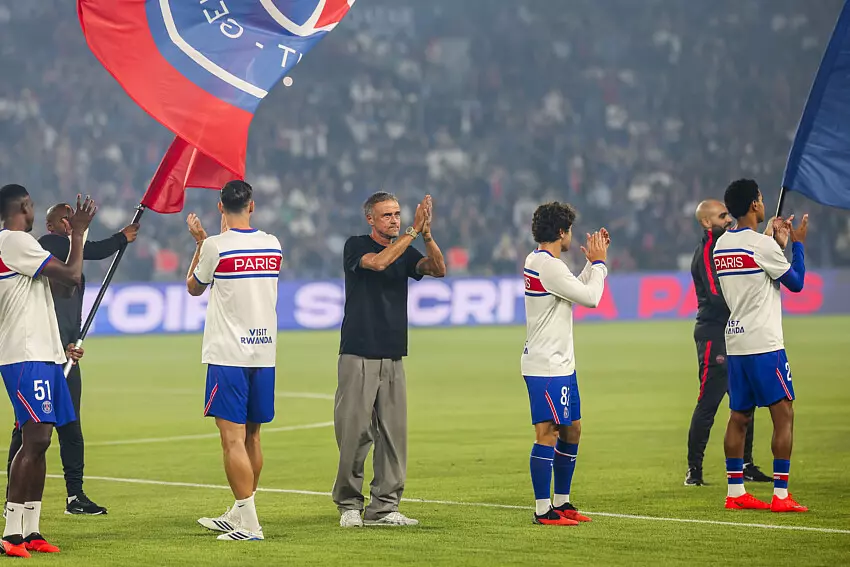
On Saturday, Paris Saint-Germain hosts Le Mans in Ligue 1 before traveling to face Manchester City in the Champions League on Wednesday, as confirmed by PSG’s official schedule. Between a grueling international break, the need to manage player fatigue, and an already packed fixture list, Paris has to make choices. There is a risk involved, however: being accused of focusing on a match that many are already eagerly anticipating.
Le Mans deserves respect, not a charade
There is something rather amusing about the way certain PSG matches are approached. On paper, every opponent deserves equal consideration; every game must be played with full intensity, and no one should look beyond the next kick-off. Fair enough. Yet in reality, one need only mention Manchester City to understand where much of the attention is actually focused. And this is no slight against Le Mans, who certainly shouldn’t have to suffer the consequences of Paris’s schedule.
The club from Le Mans is coming to the Parc des Princes to fight for a result. They deserve a serious, committed opponent that respects the competition. But do we really have to pretend that a league match in October and a trip to Manchester carry exactly the same stakes? It is possible to respect an opponent without pretending that every fixture is of equal magnitude. To suggest otherwise would be tantamount to believing that football is played in a vacuum—without context, objectives, or a future.
The strange obligation to think only of the next match
Yet, the prevailing narrative is well-entrenched: one supposedly shouldn’t let their mind wander to City before facing Le Mans. As if coaches only discovered their schedules on Sunday mornings, over coffee and toast. Planning ahead is part of the job. Preparing for multiple upcoming fixtures, managing workloads, and adapting choices to the circumstances is hardly a sign of arrogance. It is actually quite reassuring to know that a coaching staff doesn’t prepare for a football season the way one improvises a barbecue.
The schedule takes no account of the physical toll on players
This match comes right after an international break that kept many Paris players busy. Some played heavily, others traveled—sometimes vast distances—resulting in widely varying recovery times. On top of that, injuries and minor physical issues are already complicating squad management. And the schedule offers little respite: Le Mans, Manchester City, Strasbourg, then Barcelona. That is four matches in eleven days, not to mention training sessions, travel, and all the associated preparation.
Under these circumstances, Luis Enrique (56) inevitably has to consider the best way to utilize his players. This might involve squad rotation, limited playing time, or different lineups. While the wisdom of such decisions is certainly open to debate, dismissing them out of hand as a sign of disrespect would be overly simplistic. Especially since a stated goal of the Paris project is precisely to build a squad capable of functioning without relying constantly on the same individual stars.
The players need to be rested—without ever actually resting
It is a rather ironic contradiction. We demand responsible coaches who can protect their players and manage workloads intelligently. We worry about fixture congestion, decry overloaded schedules, and sound the alarm at the slightest new injury. Yet, if a coach decides to rest several key starters, he risks being accused of looking down on his opponent. So, the task is to rotate the squad without rotating too much, to rest players without benching them, and to prepare for Manchester without ever thinking about it. Simple, right?
Mind you, this does not mean Luis Enrique is always right. Excessive rotation can disrupt established chemistry, unbalance the team, or lead to a poor performance. And a PSG side that lacked commitment against Le Mans would fully deserve the criticism. However, one must distinguish between questionable squad management and an attitude of complacency. Just because a regular starter begins the match on the bench does not mean the club views its opponent as a pushover. Respect is shown primarily through the style of play, not the number of stars fielded at kickoff.
PSG facing sometimes conflicting demands
Let’s imagine, for a moment, that Paris struggles to win on Saturday. Speculation that the team already has its mind on Manchester would likely abound. Such claims might be justified—or they might not. Yet, among those decrying this alleged complacency, how many would also be the first to demand a fresh, competitive, and dominant PSG side just four days later? It is always easier to make demands than to make choices. From the comfort of one’s sofa, managing physical workloads suddenly seems like a remarkably simple science.
Criticize the choices? Fair enough. Ignore the context? No.
It would be equally unfair to attribute any strong performance by Le Mans solely to a weakness on PSG’s part. If Le Mans gives PSG a hard time, we must also look at what the team itself managed to achieve. Indeed, recognizing an opponent’s qualities—rather than automatically seeking an explanation rooted in the favorite’s performance—is another form of respect. While Paris remains responsible for its own level of play, the opposing team exists too; they are not merely there to gauge the champions’ level of motivation.
Ultimately, the stakes go far beyond this single match. A season is not won by fielding the same eleven players week in and week out in the name of lofty principles. It requires making trade-offs—sometimes imperfect ones—between the immediate need for results and the need for longevity. PSG must take Le Mans seriously, of course. But the club must also prepare for Manchester City intelligently. These are not mutually exclusive demands. True complacency would lie in believing that Paris can beat Le Mans without playing seriously. Without considering that there is also a match on Wednesday.


