

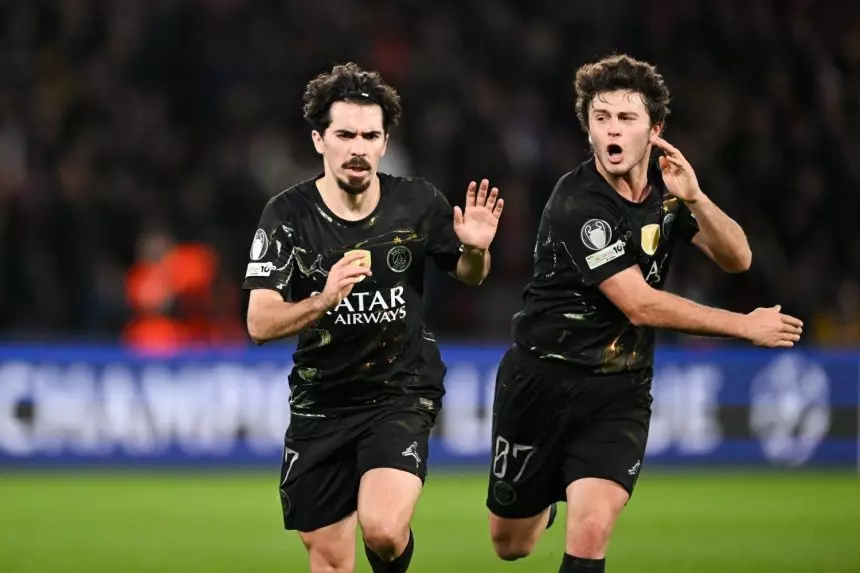
During the Champions League match between PSG and Barcelona (4–2) on Tuesday, October 20, Paris Saint-Germain once again asserted the strength of its midfield. Data from Opta and UEFA highlight the influence of Vitinha (26), João Neves (22), and Fabián Ruiz (30)—a trio whose mobility and ability to provide defensive cover make them a formidable, complementary unit.
Barça arrived with momentum, but ultimately gave way
A confident Barça side
Eleven matches, eleven wins, 50 goals scored: Barcelona arrived at the Parc des Princes with a strong case—but Paris presented a compelling counter-argument.
According to Opta, PSG landed 10 of their 12 shots on target in the first half alone. No opponent had tested the Catalan side’s goal as frequently before the break in a Champions League match since at least the 2003–04 season.
Greater threat with less possession
In total, Paris registered 22 shots to Barcelona’s 18 and created six “big chances” compared to the visitors’ five—all while holding just 47.2% of the possession, according to Squawka. These figures serve as a reminder that PSG’s dominance is also measured by the quality of their ball recoveries and the speed with which they transition into attacks.
Mobility rooted in intelligent positional coverage
Moving to free up a teammate
What is most impressive about these three players is their ability to move in unison without compromising the team’s structure. Back in January 2025, against Manchester City, UEFA noted their constant rotations, their astute reading of the opposition’s press, and their ability to shift the point of attack.
In the final against Inter, the analysis further underscored the difficulties opponents faced in determining who should track whom. These movements are purposeful: they are designed to provide an outlet, draw in an opponent, or create space for a teammate.
Providing cover without stifling forward surges
The principle of defensive cover is simple to explain, but far less simple to execute at such high speeds:
- A forward surge requires cover.
- Dropping deep opens up space for someone else to occupy.
- Pressing high necessitates protecting the space behind against a potential pass.
The quality of the trio lies in this shared tactical understanding. As one player moves, the other two adjust their positions accordingly. In doing so, they maintain passing options around the ball, while keeping the necessary spacing to react should possession be lost.
João Neves: the tenacious guardian of a midfield supposedly lacking in physical stature
Impact isn’t measured by the size of one’s biceps
One could always go looking for the “ideal” midfielder among the ranks of the physically imposing. Neves serves as a reminder that physicality is also defined by intensity, the ability to change direction, and the capacity for sustained, repeated effort.
His aggression in duels, his footwork, and his impeccable timing give this midfielder a strength that cannot be gauged simply by measuring the circumference of his biceps.
A ball-winner who also creates
Against Barcelona, Squawka credited him with three successful tackles, six chances created, and one assist.
His headed interception in the build-up to the opening goal instantly turned into a gift for Doué. This tenacious defensive midfielder also knows exactly what to do with the ball once he’s won it back. And that changes everything: the opposition loses possession and is immediately forced to defend against a dangerous situation.
Vitinha decides when Paris should catch its breath and when it should accelerate.
Knowing how to slow down in order to accelerate more effectively.
Scoring in the 81st minute—just two minutes after Yamal’s equalizer—Vitinha also knows how to calm the tempo, giving his team time to get back into position.
His patience draws out the opposition’s press: he lets them come, engages an opponent, and then finds a teammate who has broken free. When an opening appears, he shifts gears—either with a pass that breaks a defensive line or by carrying the ball forward, forcing the opposition’s defensive block to retreat.
Reading the game to regain possession.
His vision is also an asset in defense. By reading the body orientation of an opponent in possession and anticipating their next move, he can close off passing lanes and make interceptions without needing to engage in a direct duel. His positioning sets the stage for winning the ball back.
After the first five matchdays of the 2025–2026 European campaign, the UEFA statistics for the Portuguese midfielder included:
- 34 ball recoveries—the third-highest total in the competition.
- 563 touches and 476 successful passes—the highest figures in both categories during that period.
- 80 line-breaking passes.
In the 2025–2026 season, he covered 190.8 kilometers—the highest distance among all Paris players, according to the club—and scored six goals in 17 European appearances.
Fabián Ruiz deserves much more than a supporting role
Valuable technical quality
Ruiz deserves better than to be merely the third name mentioned after the two Portuguese players. He is an extraordinary footballer, distinguished by his technical quality, his forward runs, and his understanding of space.
His style of play provides invaluable continuity: receiving the ball under pressure, orienting it, linking up with teammates, and then immediately offering himself as an option again. He advances the play without needing to monopolize the ball.
Movement that shifts defensive challenges
His forward runs make him particularly difficult to mark. A well-timed movement can allow him to receive the ball behind the opposition’s midfield, draw a defender out of position, or open up a passing lane for a teammate. In this way, he creates opportunities through his movement alone—even before he touches the ball.
When he drops deeper to provide support, he helps maintain the tactical balance that enables others to move forward. His intelligence in covering for teammates is just as significant as his arrivals in the penalty area.
Against Barça, he recorded five shots—the highest tally in the match, with three on target—along with three interceptions.
His 86th-minute goal was a fitting reward for his presence in front of the net. This single match perfectly encapsulates a player capable of intercepting a pass, contributing to the build-up, and finishing the play. His lack of media attention is a poor indicator of his true importance.
Three seasons together, two titles, and a growing list of credentials
With Neves having arrived in August 2024, the trio is now in its third season together. Two full campaigns have already yielded two Champions League trophies.
2025: A one-sided final
In the 2025 final against Inter, the UEFA passing statistics tell a compelling story: the three Parisians completed 180 out of 194 passes—a 92.8% success rate—compared to 71 completed passes by Inter’s three starting midfielders. Neves finished with a perfect 55 for 55.
While the match scenario and playing time naturally influence these figures, they nonetheless shed light on the 5–0 scoreline.
2026: Winning in a different way
The 2026 final against Arsenal presented a much stiffer challenge: a 1–1 draw followed by a victory on penalties, with Vitinha named Player of the Match by UEFA. This team has shown it can win even when its technical control runs up against a defense capable of shutting down passing lanes. Dominance is no guarantee of an easy match—nor a guaranteed victory before the whistle blows.
2026–2027: The streak continues
This season, 4–2 victories against both Manchester City and Barcelona have brought the team’s tally to 14 goals in just three matchdays. According to Opta, Paris has equaled its own record of 13 consecutive Champions League matches without defeat—comprising nine wins and four draws. It is a collective effort: the pressing from the forwards and the support from the defenders bolster the strength of the midfield.
Where do they stand in history?
Whether facing City, Inter, Arsenal, or Barcelona—each with different styles and unique challenges—Paris consistently finds solutions through its midfield. Technique, intensity, and collective intelligence reinforce one another.
Neves provides protection and creativity, Vitinha dictates the tempo, and Ruiz links play while making surging runs forward. Each player possesses enough individual quality to transcend this brief summary, and that is precisely what makes their combination so difficult to contain.
Two European titles—along with an ability to cause problems for a wide variety of opponents—already provide plenty of food for thought, even if any definitive comparisons will require more perspective.
Where is the trio of Vitinha, João Neves, and Fabián Ruiz carving out a place for themselves in the history of PSG, and among the elite midfields in European football?


