

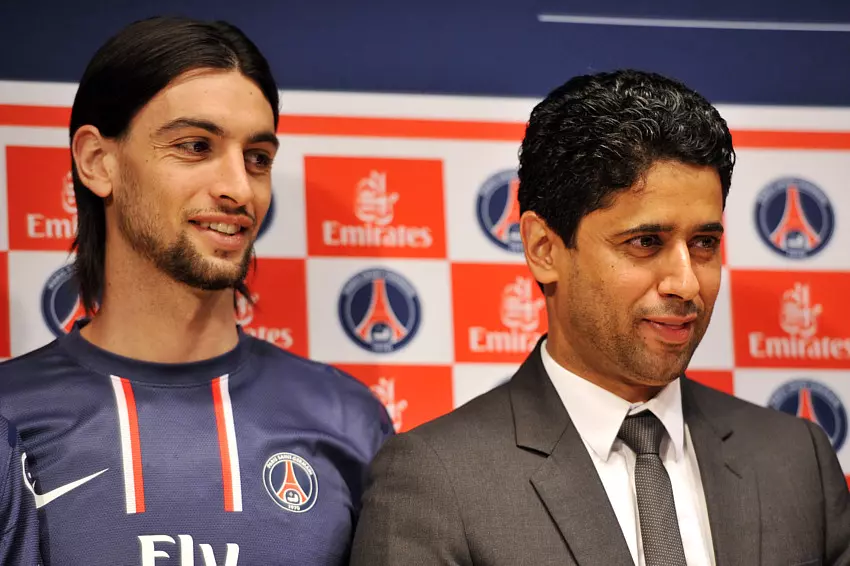
Javier Pastore, the former Argentine attacking midfielder who played for Paris Saint-Germain from 2011 to 2018, recalled in Le Parisien what it was like when Nasser Al-Khelaïfi first took over as club president. Now retired, Pastore speaks with admiration about how the executive would frequently attend training sessions, showing a genuine curiosity about the people who kept PSG running on a daily basis.
Javier Pastore: “We had never seen a president so present.”
“In the beginning, Nasser Al-Khelaïfi would come to every training session. It was incredible—we players had never seen a president who was so present.
He didn’t come from a football background, so to learn, he needed to be there. He wanted to observe and talk to everyone. What happens during training? What are the players doing? What is the coach doing? What does the kit man do? He wanted to understand everything. So, he was there.”
In Pastore’s recollection, the detail that speaks volumes is perhaps his mention of the kit man. The Argentine could have simply focused on the players’ surprise at seeing their president every single day; instead, he highlights Al-Khelaïfi’s interest in a role that is rarely discussed, yet is an integral part of life in the dressing room. This is where the account becomes personal. Pastore takes us back to a time when the new president was discovering PSG through the eyes of those who worked there—right down to the minutiae of an ordinary day.
Javier Pastore: “He developed himself personally.”
“He developed himself personally, he rebuilt the club, and today he is one of the most important figures in the world of football.”
In a single sentence, Pastore touches upon both the transformation of PSG and the evolution of its president. This is what gives weight to his tribute. Having arrived in 2011, the Argentine got to know Al-Khelaïfi back when the latter was still learning the inner workings of the club he had just taken charge of.
When he speaks about the role of an executive in today’s football, it becomes easier to understand why he insists on recounting those early sessions. It is there that he locates the beginning of the journey he admires—in the time spent with the people at the club.


