

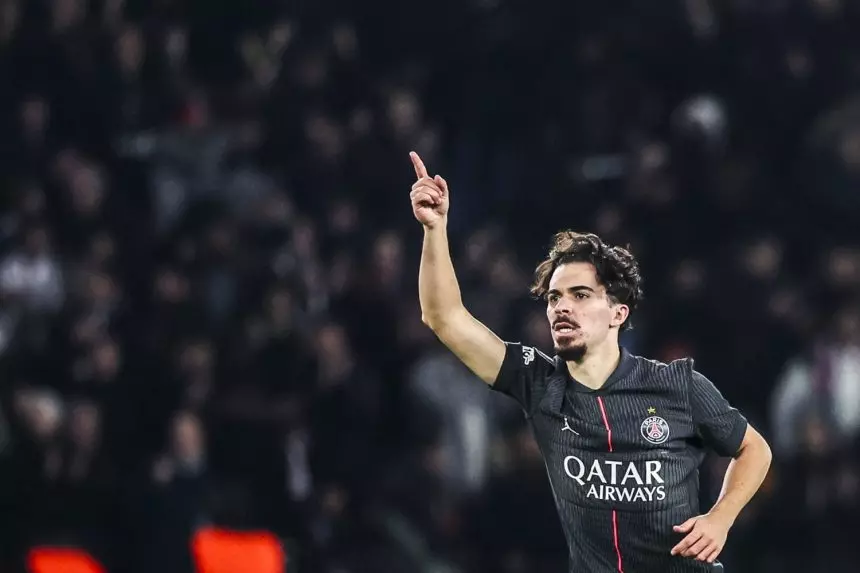
Paris Saint-Germain midfielder Vitinha (25) offered an insightful analysis of Luis Enrique’s work in an interview with A Bola. The Portuguese international notably explained the use of Ousmane Dembélé (28) as a false nine and the PSG’s gradual transformation driven by an increasing demand for mobility.
Vitinha: “Those who don’t know him might have questions”
“Dembélé as a ‘false nine’? Luis Enrique has a lot of ideas and makes decisions that, sometimes, for the average person and given our habits, can seem strange. Those who don’t know him might question it. Those who know him and trust him simply believe. That’s what we did.
Before this year, we knew Dembélé was capable of doing everything. We knew it. He was capable. We saw it in training, in matches—not always very consistently—but eventually it became clear. We believed in it.
Vitinha: “For opposing defenders, it was complicated because they had no one to mark”
He took on that role and helped us a lot in midfield by creating numerical superiority and allowing us to have a lot of possession, which we liked. For opposing defenders, it was complicated because they had no one to mark. They were disoriented, not knowing whether to step out or stay, which gave us a numerical advantage.
So he appears from behind, and they can’t track him. And in reality, all of this was very natural. In the first year, Luis Enrique tried to bring mobility to the team while keeping a certain order.
Vitinha: “He even presented us with a PSG 2.0, with increased mobility”
There were limits not to be crossed, and so on. In the second year, he even presented us with a PSG 2.0, with increased mobility. It’s not that we all went crazy, everyone doing their own thing without knowing where they’re going—that would be a bad thing—but he brought an extraordinary level of mobility.
You see a midfielder playing full-back, a winger playing striker, a midfielder playing striker, a forward playing as a pivot. And with this current organization—well structured and dynamic—it’s very difficult for the opposing team.”
Through Vitinha’s words, it becomes clear that nothing under Luis Enrique is improvised—especially not the choice of Dembélé as a false nine. This decision, puzzling from the outside, is built on a strong internal conviction: total trust in the players’ intelligence and versatility. By dropping deep, Dembélé doesn’t just disrupt defensive references; he creates numerical superiority in midfield, feeds possession, and constantly places opposing center-backs in a state of hesitation.
That’s where PSG hurt teams most: in doubt. Vitinha also highlights a clear evolution between the first season—still framed by structural limits—and a current “PSG 2.0” that is far more mobile, yet never disorganized. The constant rotations—between midfielders, wingers, and forwards—form a fluid collective, readable for its own players and unreadable for opponents. A demanding system, but a brutally effective one.


