

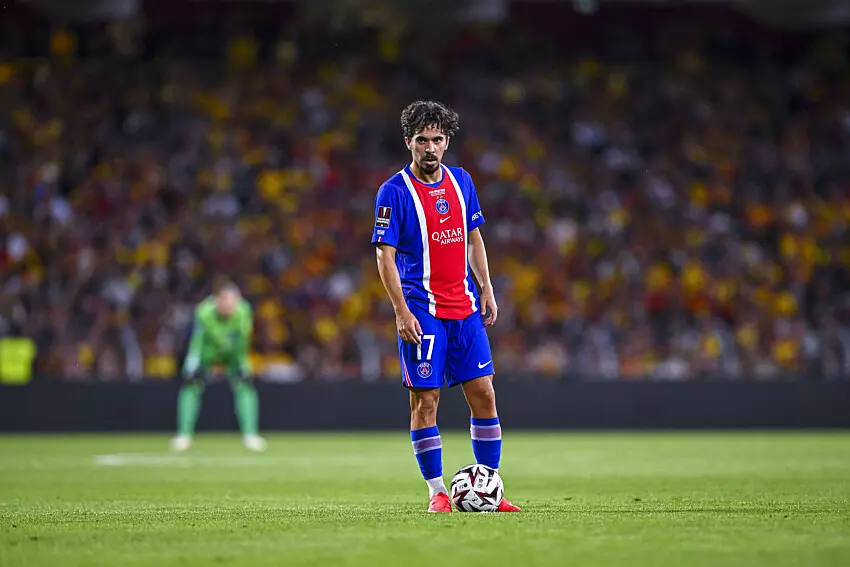
Beaten 1–0 by Lens in the Trophée des Champions, Paris Saint-Germain let their first trophy of the season slip away. It was an inevitably frustrating defeat for the fans, especially since Paris dominated for long spells without managing to convert that control into goals. But beyond the result, this setback raises a key question: are we truly judging this PSG side with due regard for their level of preparation, their summer management, and the actual substance of the match?
A defeat that matters, certainly.
- The high expectations surrounding Paris are perfectly normal.
Lens won the Trophée des Champions; Paris lost it. And when an opponent plays with ten men for more than a half, one can legitimately expect PSG to do more.
Fans have grown accustomed to seeing their team win, but their frustration stems from more than just that. It also comes down to how the game unfolded. Paris had possession, scoring opportunities, a numerical advantage, and plenty of time to fight back. They failed to do so.
We must avoid swinging too far the other way, however: no, this match shouldn’t simply be dismissed just because it is August. The lack of clinical finishing, certain sluggish passages of play, and the inability to truly unsettle the Lens defense are genuine issues.
But a defeat can be criticized without necessarily serving as a definitive verdict on the team.
The result inevitably colors our perspective.
- Had they won the same match, the assessment would likely have been more favorable.
After two consecutive Champions League campaigns, reactions to PSG are naturally less knee-jerk than they once were. Luis Enrique and his squad have built up a certain amount of credit. Yet, following the Lens game, some familiar conclusions resurfaced: Paris didn’t offer enough, failed to pick up the pace, and ultimately didn’t deserve much better.
These criticisms are understandable. But they raise a simple question: would we have analyzed the exact same performance in the same way if Paris had scored? Imagine PSG equalizing ten minutes from the end and then going on to win. Same preparation. Same lack of freshness. Same dominance. Same flaws. We would likely have focused more on a team that is still finding its feet but is already capable of pressing, winning the ball back high up the pitch, and pinning the opposition in their own half. That is the eternal challenge of football: the score inevitably shapes our perception. It simply shouldn’t replace it.
Analyzing a match also means analyzing the context surrounding it.
- Had they won the same match, the assessment would likely have been more favorable.
After two consecutive Champions League campaigns, reactions surrounding PSG are naturally less knee-jerk than they once were. Luis Enrique and his squad have built up a certain amount of credit. Yet, following the Lens match, familiar conclusions resurfaced: Paris didn’t offer enough, failed to shift gears, and ultimately didn’t deserve much better.
These criticisms are understandable. But they raise a simple question: would we have analyzed the exact same performance in the same way if Paris had scored?
Imagine PSG equalizing ten minutes from time and going on to win. Same preparation. Same lack of freshness. Same dominance. Same imperfections. We would likely have focused more on a team that is still finding its feet but is already capable of pressing, winning the ball high up the pitch, and pinning the opposition back. That is the eternal challenge of football: the score inevitably influences our perception. It simply shouldn’t replace it.
Analyzing a match also means analyzing the context surrounding it.
- The 90 minutes don’t begin at kickoff.
We often hear this phrase in reactions: “I’m not drawing conclusions about the season; I’m only analyzing the match.” In principle, that’s hard to dispute. But we still need to define what analyzing a match actually entails.
The players’ physical condition is part of it. So is their preparation. The rotations decided by the coach, the number of team training sessions, the available freshness, and the desire to distribute minutes evenly. Paris wasn’t playing a friendly against Lens. A trophy was at stake, and PSG wanted to win it.
At the same time, Paris remains a team still in the process of building. And that nuance is crucial. For the past two seasons, Luis Enrique has committed to a gradual build-up. PSG resumes training late—sometimes very late—because their seasons end late. He rotates the squad. He accepts that certain on-field understandings take time to develop. Above all, he aims to have his squad in peak condition when the big fixtures arrive. That does not excuse a poor performance. But completely ignoring this reality when evaluating performance would be just as excessive.
What happens on the pitch does not paint a picture of a PSG side adrift.
- Dominance does not equate to victory, yet it remains a telling factor.
The match statistics also help put certain impressions into perspective. Paris finished with around 69% possession, recording 22 shots to Lens’s 8, and 6 shots on target to their 2.
Naturally, these figures do not automatically vindicate PSG. Lens defended their lead admirably, showed great team spirit, and played the game perfectly to their advantage. Their success deserves respect. Yet the statistics also reveal something else: Paris was not outplayed.
They dominated without creating enough genuine danger. They took plenty of shots but failed to hit the target often enough. They pinned Lens deep in their own half but could not convert that territorial dominance into goals. And therein lies, perhaps, the most valid criticism of the match.
Efficiency remains the real warning sign.
- A known issue that could still prove costly.
PSG did not discover their lack of clinical finishing against Lens. For the past two seasons, certain matches have followed this same pattern: high possession, numerous chances, and sometimes clear dominance, yet a struggle to put the game to bed early. Twenty-two shots and no goals serve as a reminder that the problem persists. It is entirely possible to hold two ideas in mind at once: Paris was not physically ready to perform at its peak…
- …and yet, Paris should still have done better.
This is precisely where nuance proves useful. It is not about shielding PSG; on the contrary, it helps identify what truly needs fixing. Match fitness will return naturally over the coming weeks, as will freshness. However, converting periods of dominance into goals must remain a key priority.
A familiar story: we have seen this script before.
- August does not necessarily predict May.
This PSG side has already taught us one thing: the start of the season does not always mirror the end. Recent years have been filled with settling-in periods, imperfect performances, injuries, squad rotation, and spells where Paris seemed to be searching for its rhythm.
Then came the spring. This obviously does not mean that history will automatically repeat itself. Two Champions League campaigns offer no guarantee for a third. Paris might make mistakes, regress, or endure a less successful season. But those past experiences should at least prevent us from viewing every early-season struggle as a revelation.
We know this team is gradually finding its rhythm. We know it can go through matches that are disjointed or difficult. We also know that a lack of clinical finishing can sometimes come at a high price. Ultimately, the Lens match may not have revealed anything we didn’t already know.
Paris will lose again.
- High standards must survive defeat.
PSG has set the bar so high that losing a match now seems to trigger more frustration than it did a few years ago. That is the price of success. But Paris will lose again. They will drop more matches, and perhaps even miss out on other trophies. Some defeats will be worrying; others simply frustrating.
The challenge lies in distinguishing between the two. The Lens-PSG match should therefore be judged for what it was: a Paris side still finding its feet—dominant but lacking precision, unable to fully capitalize on its numerical advantage, and punished for its lack of clinical finishing. That is significant. But it is not a verdict on the entire season.
Analyzing a defeat means neither making excuses for it nor blowing it out of proportion. It simply means putting it into proper perspective.


