

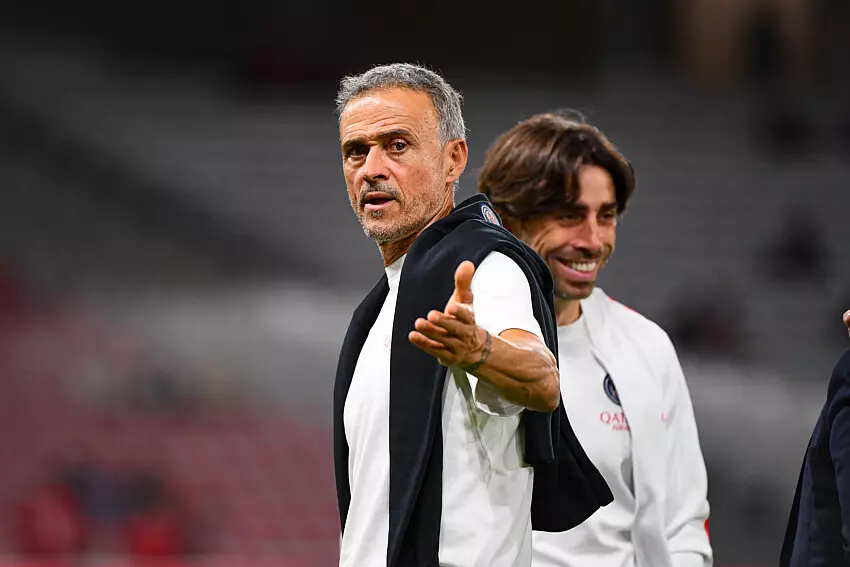
At Paris Saint-Germain, Luis Enrique’s management style goes far beyond the team sheet. It is evident when competition frustrates a key player, when a youngster has to wait his turn, or when the bench proves decisive on a European night. The Spanish term gestor—manager or administrator—captures his approach well: he does not seek to keep everyone happy at all times, but rather to keep everyone invested in the project.
High standards only hold weight if trust survives the decision.
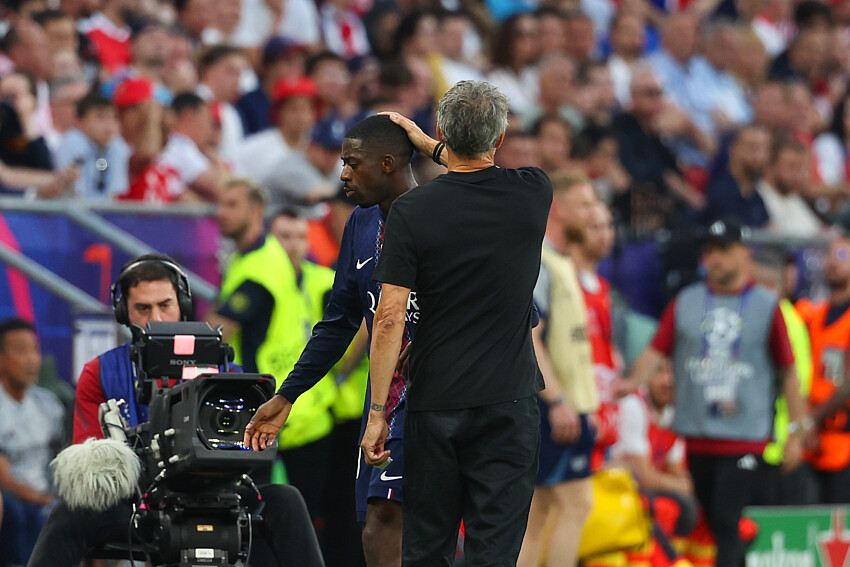
- Dembélé: setting boundaries without the drama.
On September 30, 2024, Luis Enrique dropped Ousmane Dembélé from the squad for the away match against Arsenal. He explained that the forward had failed to meet the team’s standards and took full responsibility for a difficult decision made—in his view—for the good of the collective. He also emphasized that the decision was reversible and refused to let the situation turn into a media circus. The episode encapsulates his management style: status grants no exemption from the rules, yet a sanction does not automatically lead to a permanent rift.
- Zaïre-Emery: acknowledging the disappointment.
The case of Warren Zaïre-Emery is even more telling. After a highly successful 2025–2026 season, the midfielder started the Champions League final against Arsenal on the bench. Luis Enrique later acknowledged that the decision had been “unfair” to him. A few days later, Zaïre-Emery admitted that remaining a substitute in the final was frustrating, while also explaining: “Luis Enrique never gave up on me.” There is no point pretending the decision didn’t hurt. What matters is that it didn’t erase the work accomplished or the relationship built during the more difficult months.
Developing players to foster acceptance of competition.
- Clarity of roles takes precedence over promises of playing time.
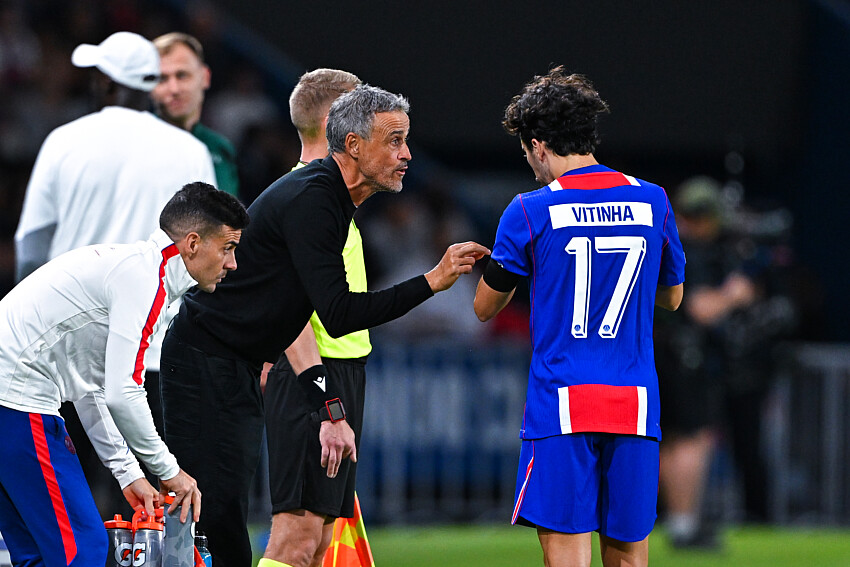
Vitinha describes a straightforward coach whose feedback genuinely reflects his thoughts and expectations. He places particular emphasis on clearly defined roles: everyone knows what they need to do, and the team keeps moving forward even when a player is missing. This approach doesn’t mean that hierarchies vanish entirely; rather, it explains why uncertainty regarding the lineup is manageable: a player may not always know exactly when he will play, but he knows the work required to earn that time.
- Doué: patience that remains demanding.
In March 2025, Luis Enrique notes that Désiré Doué needed several months to settle in. He highlights the player’s qualities and the work enabling him to showcase them more effectively. This is the value of such an approach: distinguishing the learning process from a final verdict, without letting patience turn into a free pass. The player still needs to improve and prove himself over the long term.
.The squad is truly motivated when the bench plays a meaningful role.
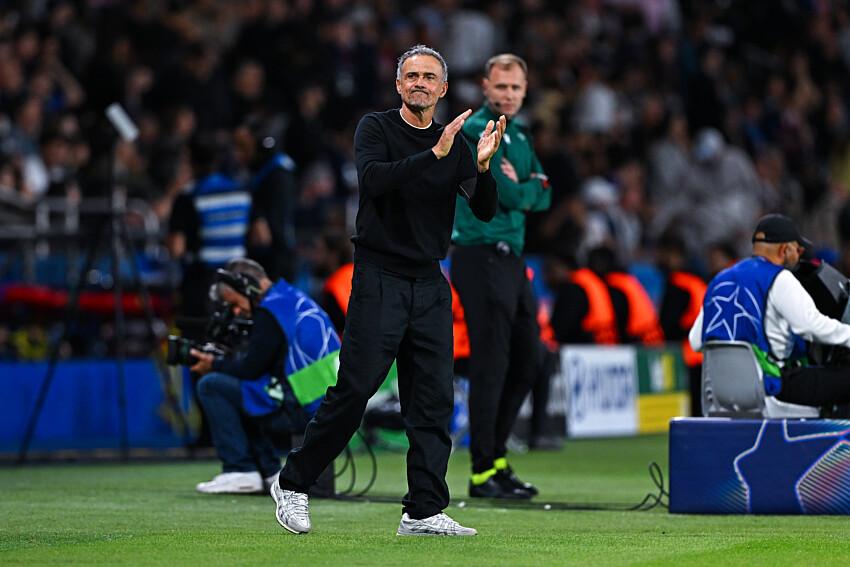
- The Super Cup as a concrete example.
On August 13, 2025, PSG trailed Tottenham 2–0 in the UEFA Super Cup. Substitute Kang-in Lee narrowed the gap in the 85th minute, and Gonçalo Ramos equalized in stoppage time (90+4). Paris ultimately won on penalties.
While this scenario doesn’t prove that every substitute feels fully valued, it gives substance to Luis Enrique’s promise: the match can also belong to those who start on the bench. To make an impact in such moments, players must be prepared, empowered, and kept up to speed.
- Rotating the squad without lowering standards.
In Rennes on March 8, 2025, Luis Enrique made eight changes following a defeat to Liverpool. Paris won 4–1 but struggled after the break. This example avoids the oversimplified narrative of a “miracle rotation”: resting key players preserves the squad, but it requires those who step in to deliver immediately and the coaching staff to adjust a delicate balance.
Preparing for the spring run-in without following a rigid schedule.
Rest is a sporting decision.
In May 2025, ahead of the Coupe de France and Champions League finals, Luis Enrique rested several key players, taking into account their physical workload, travel, and mental freshness. In March 2026, he summarized this case-by-case approach: “Match rhythm for some, rest for others.” His composure, therefore, does not stem from sticking to a fixed plan; rather, it comes from adjusting the balance whenever a player’s condition or the context of a match demands it.
- Reassuring the team after a defeat, revitalizing them after a title win.
Following the defeat against Liverpool at the Parc des Princes on March 5, 2025, Luis Enrique quickly stepped in to address his dejected players. He expressed his pride in them and maintained his belief that qualification was still within reach. Paris subsequently turned the tie around at Anfield.
A few weeks later, with the Ligue 1 title already secured, the coach once again focused on motivation, making nine changes to the lineup against Le Havre. The nature of the pressure shifted, but it did not vanish: the team had to prepare for what lay ahead while keeping those who played less involved.
A solid method, but not infallible.
- Luis Enrique’s composure also relies on a stable framework.
In November 2024, Nasser Al-Khelaïfi reaffirmed his confidence in Luis Enrique and Luis Campos, even in the event of elimination from European competition. While this support alone does not explain the results—which also depend on the players and staff—it gives the coach the opportunity to maintain a consistent approach over the long term. Institutional stability lends credibility to his message regarding progress and patience.
- Limitations emerge when the assigned role becomes too restrictive.
Randal Kolo Muani’s departure serves as a reminder that this method does not work for everyone. In February 2025, the forward explained that he needed playing time and was regaining his confidence at Juventus.
His case highlights the model’s limitations: asking a player to adapt is sometimes necessary, but the staff must also recognize when the proposed role no longer allows for development. Luis Enrique himself acknowledged, following a spate of injuries in the autumn of 2025, that he needed to better manage the return of players who were not yet fully match-fit.
The criticism is valid; the failure to remember the full picture is less so.
- September 2026, and the scrutiny begins all over again.
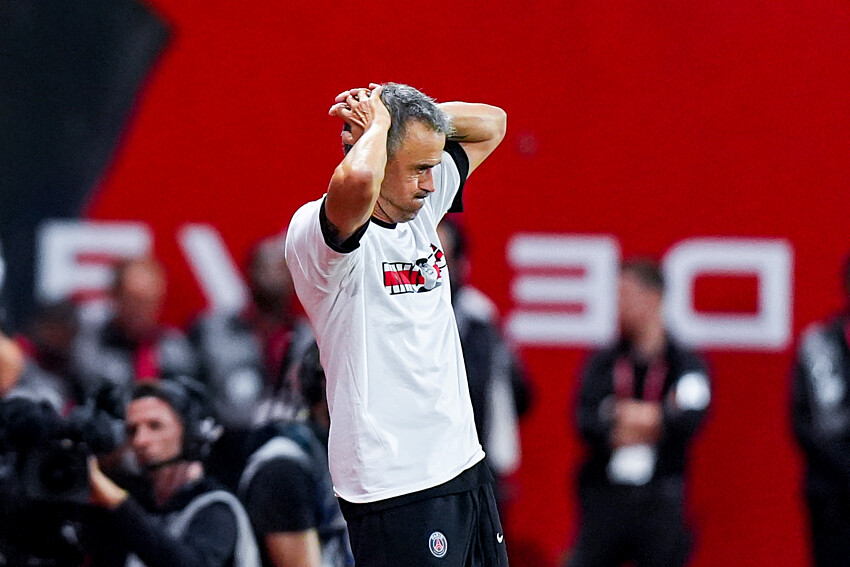
September 2026 once again demonstrated just how fragile a coach’s standing can be. After three winless matches and a defeat against Monaco, Luis Enrique’s confidence was perceived by Matthieu Dossevi as arrogance. A week later, despite a victory at Brest, Maxime Chanot questioned on RMC Sport whether the manager’s style was irritating certain players, citing the handling of Zaïre-Emery and decisions regarding Kvaratskhelia or Dembélé. However, the pundit acknowledged he might be mistaken. Questioning decisions is legitimate; proclaiming a rift based merely on impressions is less so.
- Immunity does not exist—but memory should.
Two consecutive Champions League titles and three league championships do not make Luis Enrique infallible. His rotation policy can unsettle the team, his communication can be irritating, and his decisions remain open to debate. Indeed, after the Brest match, he included himself among those who needed to do better. Yet, high standards turn into impatience when they erase everything that came before, and into forgetfulness when every controversial lineup choice resets the analysis to square one.
Should Luis Enrique be judged based on the latest disgruntled player, a four-game stretch, or a methodology that has transformed PSG since 2023? Perhaps the real question is not whether to grant him an immunity he does not seek, but rather how long our memory will hold up against the next disappointing result.


