

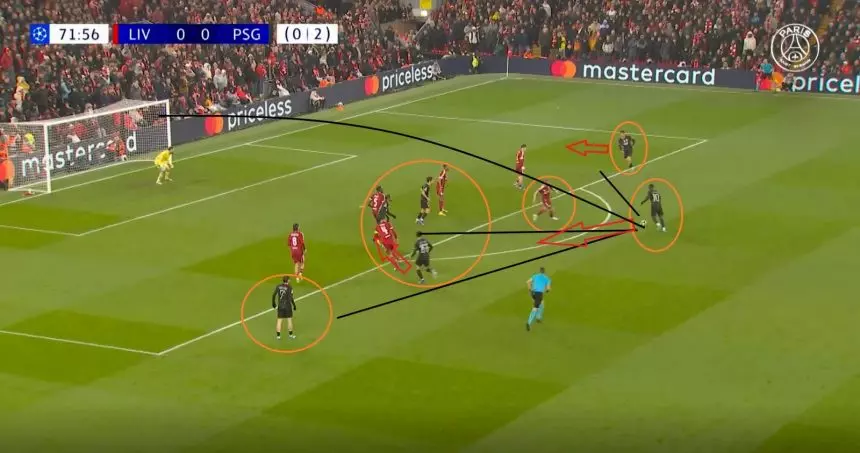
With the aim of providing our readers with richer content, we’ve launched a section analyzing key moments in a match, whether goals scored or conceded, skillful moves, missed opportunities, and more. The goal is to determine the degree of collective or individual success, or error, in each action. Here’s the latest installment. This particular sequence focuses on the 2-0 victory (4-0 on aggregate) against Liverpool this Tuesday at Anfield in the second leg of the 2025-2026 Champions League quarter-finals. It features the opening goal by Ousmane Dembélé (28-year-old forward).
The sequence shows PSG restarting play with a pass from Hakimi to Dembélé.
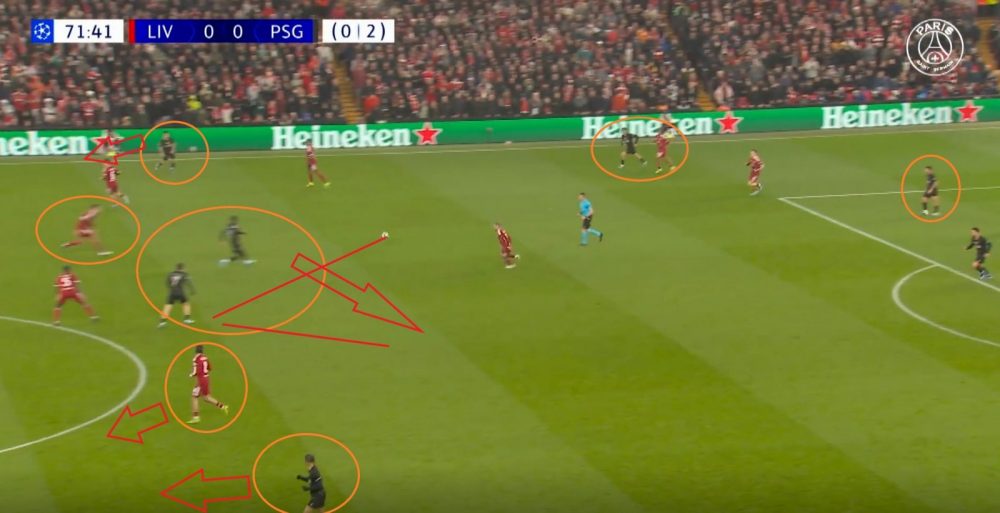
For the moment, PSG has only just regained possession and will score in about 17 seconds. Credit must be given to João Neves (21-year-old midfielder), who made the tackle on Rio Ngumoha (17-year-old forward). Achraf Hakimi can then launch the counter-attack, with a now-classic pass from the Parisian side: a full-back plays a diagonal pass to an attacking player, quite often Ousmane Dembélé.
The latter is, in fact, being chased by Virgil Van Dijk, and we can expect a certain aggressiveness during the initial control. Except that, precisely, the Parisian number 10 lets the ball run to Khvicha Kvaratskhelia (25-year-old forward). This initiative is surprising, avoids a duel, allows the Georgian to control the ball more calmly, and enables Dembélé to move forward, before perfectly passing to Bradley Barcola. It’s worth noting that the balance is maintained: Kvaratskhelia plays centrally, while Vitinha (the 26-year-old midfielder) is positioned along the right flank. The famous fluidity of Luis Enrique.
The situation when Barcola enters the Liverpool penalty area.
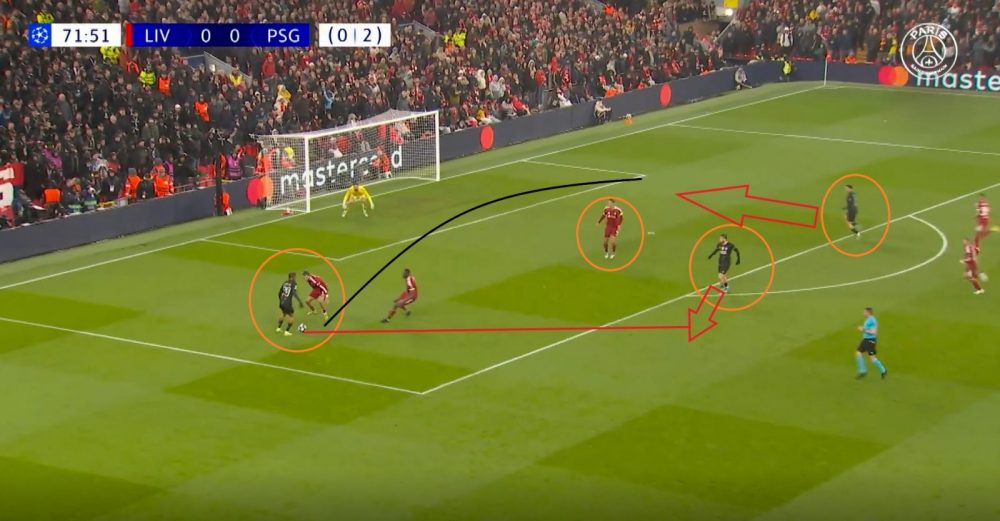
With his speed, Barcola was able to gain valuable ground and create danger in the Liverpool penalty area. But he was well marked, and Kvaratskhelia couldn’t get past Van Dijk in the center. They both had the intelligence to move on. The former stopped, the latter dropped back to create space. This leaves Van Dijk in a difficult position, as he can’t get out of position much while Hakimi (who was in his own box at the start of the play) has already arrived and is calling for the ball at the far post. A cross seems possible, but a back pass is simpler.
The situation when Kvaratskhelia passes to Dembélé.
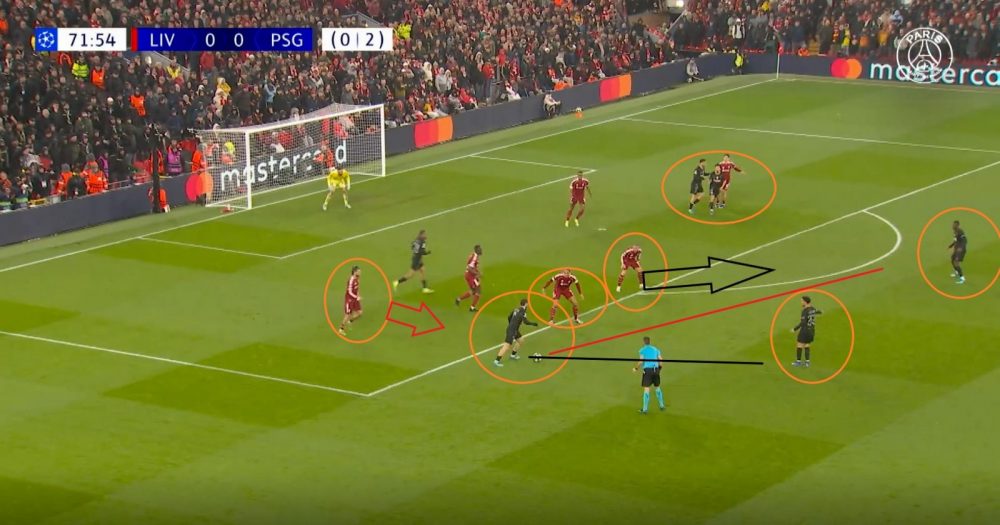
The counter-attack has settled down a bit, but the offensive is far from over. The Parisians are still coming forward, with Dembélé 25 meters from the opposing goal. It would seem logical to mark him as closely as possible. Except that Warren Zaïre-Emery is also next to Kvaratskhelia, as well as Barcola and Hakimi, who are in the box. Not forgetting that Vitinha also came close to the penalty spot (obviously).
We also see that Kvaratskhelia inspires fear: Van Dijk asks Szoboszlai to move closer, undoubtedly to prevent the Georgian from cutting inside onto his left foot to shoot or cross. There’s also the feeling that Mac Allister is there to help Van Dijk avoid a burst of speed and a powerful right-footed shot, something the Parisian number 7 is so adept at. This benefits Dembélé, who has plenty of space. That’s the strength of having multiple options and movement.
The situation when Dembélé controls the ball.
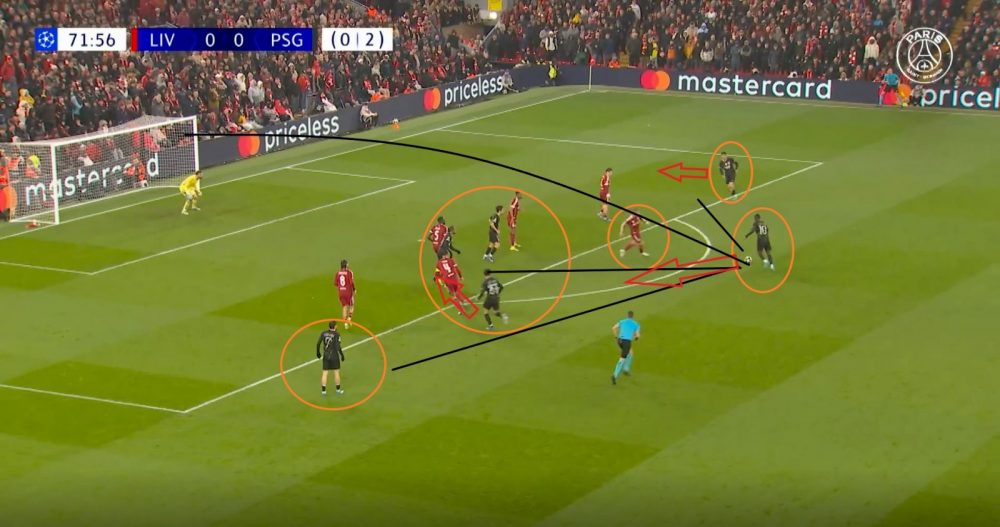
Dembélé was able to control the ball; the danger is clear. Mac Allister reacts fairly quickly, but a shot still seems possible, and there’s no stopping him given the danger posed by the Parisian number 10’s right foot. For the other Liverpool players, it’s difficult to offer support given the numerous other threats: Hakimi is already calling for the ball again on the right, Zaïre-Emery is making a run through the middle, while Barcola and Vitinha are also making themselves available, not to mention Kvaratskhelia is ready on the left. Dembélé uses all of this to his advantage, cutting inside and finishing with ease. Liverpool could possibly have done better, but…


